Acer tataricum L.
Amur maple, Tatarian maple
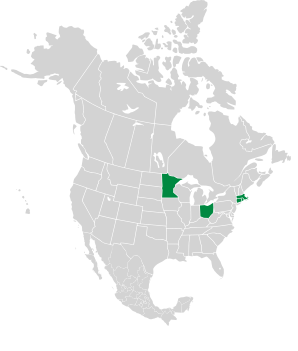
Tatarian maple is native to western Asia and southeastern Europe. “Tatars” loosely applies to Turkic-speaking ethnic groups scattered throughout this region, and is the source of the specific epithet. In North America, the species can be invasive in midwestern states, so it is not recommended for landscape planting there.
Plants: Deciduous trees reach 15–20′ (4.6–6.1 m), and are roughly as wide as they are tall.
Leaves: Most maple leaves are lobed, but these are unlobed, or with 3-5 shallow lobes. Leaves are opposite. Each leaf is simple, doubly serrate, and 1¾–4″ (5–10 cm) long.
Flowers: Panicles of small, green-tinged white flowers appear in April to May.
Fruits: Winged samaras are a showy red color in the fall.
Habitats: Forests and forest boundaries, and human-disturbed habitats.
Online References:

6/29/2023 · Harpers Ferry National Historical Park, Harpers Ferry, West Virginia 

6/29/2023 · Harpers Ferry National Historical Park, Harpers Ferry, West Virginia 
| Kingdom | Plantae | Plants, but not fungi, lichens, or algae (from Stearn's Botanical Latin) |
| Subkingdom | Tracheobionta | Vascular plants—plants with a “circulatory system” for delivering water and nutrients |
| Division | Magnoliophyta | Flowering plants, also known as angiosperms |
| Class | Magnoliopsida | Dicotyledons—plants with two initial seed leaves |
| Subclass | Rosidae | Roses, legumes, proteas, dogwoods, hydrangeas, mistletoes, euphorbias, grapes, many more |
| Order | Sapindales | Includes citrus; maples, horse-chestnuts, lychees and rambutans; mangos and cashews; frankincense and myrrh; mahogany and neem |
| Family | Sapindaceae | Soapberry family |
| Genus | Acer | Maples |
| Species | tataricum | Of Tataran origin—Russian and central Asia |
Acer tataricum description by Thomas H. Kent, not updated.

© FloraFinder.org. All rights reserved.