Amaranthus ‘Dreadlocks’
This cultivar of Amaranthus caudatus is not found in the wild. The parent plant is a South American native.
Plants: These plants reach 4′ (1.2 m) in height and up to 1½′ (45 cm) around, with fairly thick, pale green or red stems.
Leaves: 3–6″ (7.6–15 cm) long by 1–1½″ (2.5–3.8 cm) wide, tapering to sharp tips, green to yellow-green.
Flowers: Beautiful fuchsia-colored flowerheads up to 2–3′ (60–91 cm) long are composed of “dreadlocks”—many pom-pom shaped flowers.
Fruits: Fruits contain a single seed with a shiny coat.
Habitats: The natural plant has been cultivated for thousands of years by indigenous South American peoples.
Edibility: Leaves and seeds are edible, with high nutritional content.
Online References:
Wikipedia (Amaranthus caudatus)
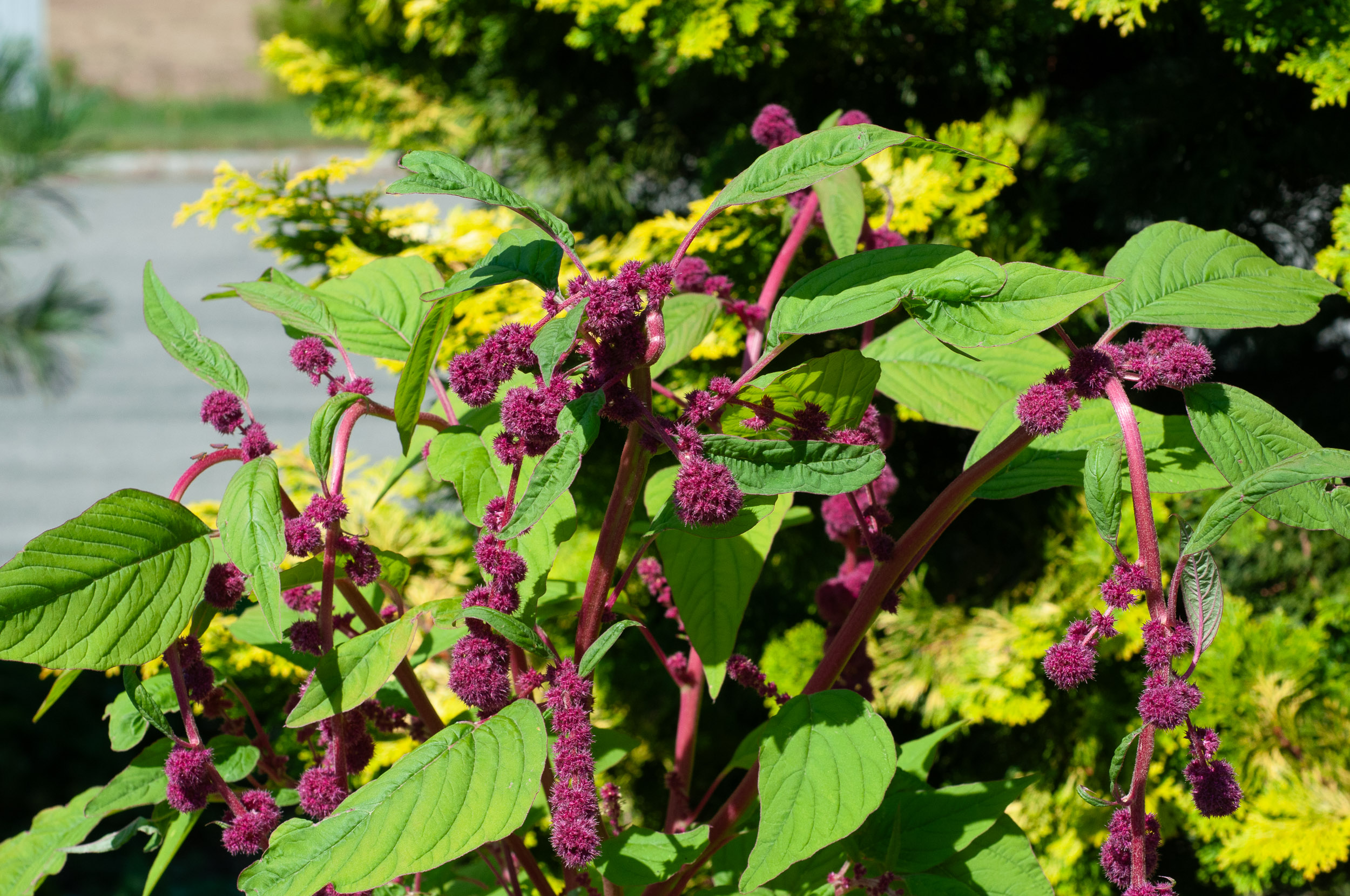
9/7/2010 · New England Botanic Garden at Tower Hill, Boylston, Massachusetts · ≈ 17 × 12″ (44 × 29 cm)  ID is uncertain

9/7/2010 · New England Botanic Garden at Tower Hill, Boylston, Massachusetts · ≈ 10 × 15″ (26 × 39 cm) ID is uncertain 
| Kingdom | Plantae | Plants, but not fungi, lichens, or algae (from Stearn's Botanical Latin) |
| Subkingdom | Tracheobionta | Vascular plants—plants with a “circulatory system” for delivering water and nutrients |
| Division | Magnoliophyta | Flowering plants, also known as angiosperms |
| Class | Magnoliopsida | Dicotyledons—plants with two initial seed leaves |
| Subclass | Caryophyllidae | Cacti, many other succulents, carnivorous plants, and leadworts |
| Order | Caryophyllales | Includes cacti, carnations, amaranths, ice plants, and many carnivorous plants |
| Family | Amaranthaceae | Amaranth family |
| Genus | Amaranthus | Contraction of Greek ἀμάραντος (amarantos), “unfading,” with ἄνθος (anthos), “flower” |

Amaranthus ‘Dreadlocks’ description by Thomas H. Kent, not updated.

© FloraFinder.org. All rights reserved.