Araucaria heterophylla (Salisb.) Franco
Norfolk pine, Norfolk Island pine
Norfolk Island pine isn’t a pine, but it is from Norfolk Island, and nowhere else. Norfolk Island is between Australia and New Zealand. They are popular as house plants in America.
Plants: In natural settings, trees reach 164–213′ (50–65 m), with a neat conical Christmas-tree shape. See also the similar-appearing monkey-puzzle tree and New Caledonia pine.
Leaves: Needle-shaped, sharp-tipped but soft to the touch, almost like moss. Each needle is ⅜–½″ (1–1.5 cm) in length and about 1/32″ (1 mm) around. On older trees, the needles reach up to ⅜″ (1 cm) and up to ⅛″ (4 mm) around. The thickest leaves are at the top, along with the cones.
Fruits: Cones are cylindrical, 1–3″ (2.5–7.6 cm) long. Female cones are spherical in shape, and 3–5″ (7.6–12 cm) around.
Habitats: Humid subtropical climates, in sandy soils and seacoasts.

Immature seed cones. By tree-species@flickr. 
Online References:

8/29/2010 · Joy and Jim’s, Mansfield, Massachusetts · ≈ 7 × 4½″ (17 × 11 cm)  ID is uncertain

1/5/2026 · Joy and Jim's, Mansfield, Massachusetts 
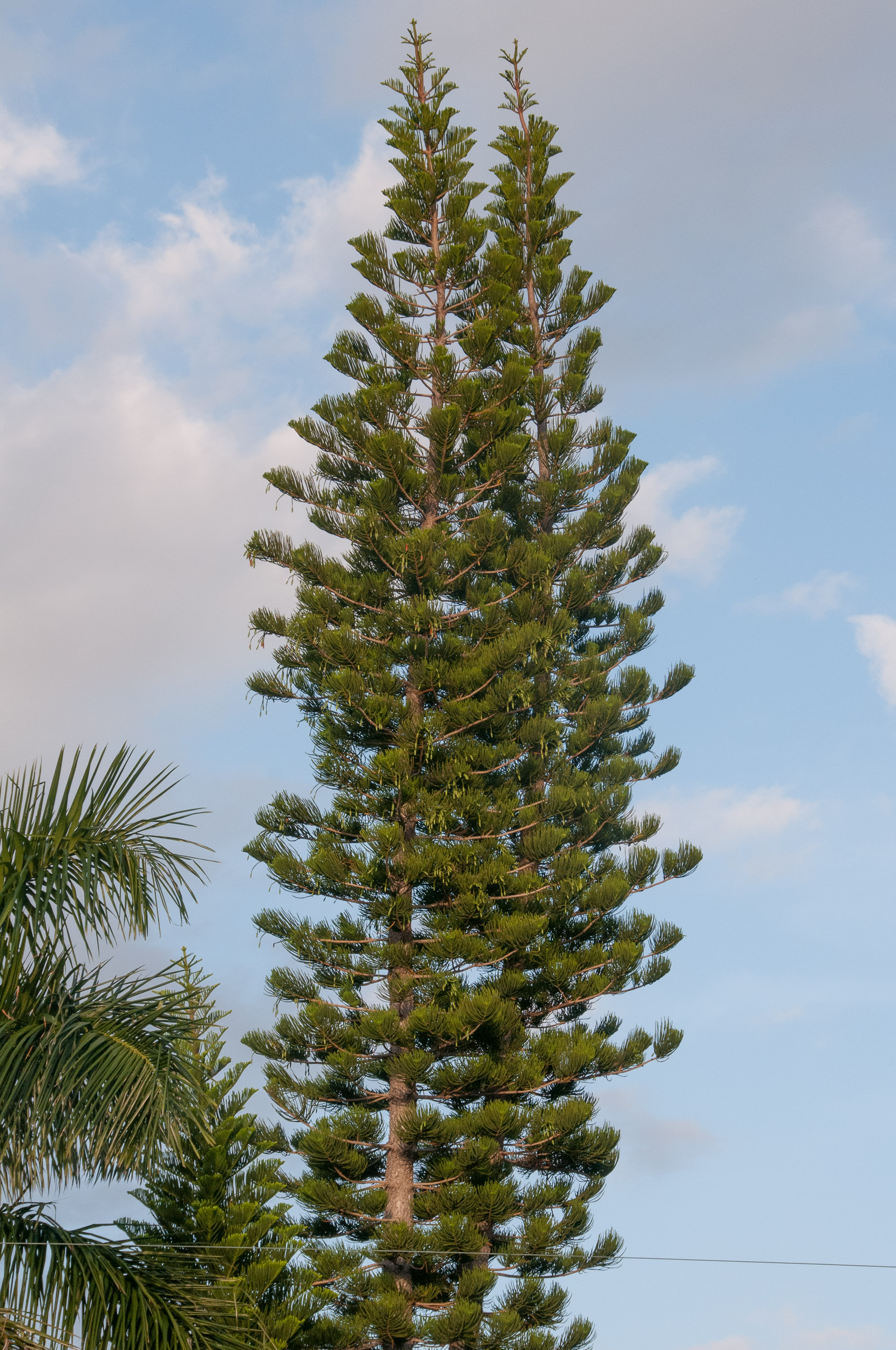
4/9/2015 · MacDonald‘s, Marco Island, Florida 
| Kingdom | Plantae | Plants, but not fungi, lichens, or algae (from Stearn's Botanical Latin) |
| Subkingdom | Tracheobionta | Vascular plants—plants with a “circulatory system” for delivering water and nutrients |
| Division | Coniferophyta | Conifers—cone-bearing trees (and a few shrubs) |
| Class | Pinopsida | Gymnosperms such as cedars, Douglas-firs, cypresses, firs, junipers, kauri, larches, pines, hemlocks, redwoods, spruces, and yews |
| Order | Pinales | Cone-bearing plants: cedar, cypress, fir, juniper, larch, pine, redwood, spruce, yew, and others |
| Family | Araucariaceae | Araucarian family |
| Genus | Araucaria | Named for the South Chilean province of Arauco |
| Species | heterophylla | Means that the leaves are different on the same plant |

Araucaria heterophylla description by Thomas H. Kent, not updated.

© FloraFinder.org. All rights reserved.