Asclepias californica Greene
California milkweed
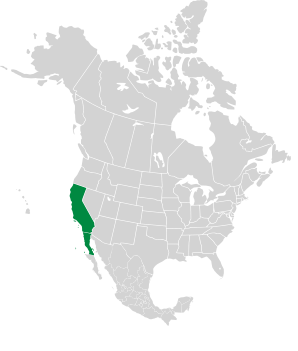
This milkweed variety is found mostly in central and southern California, where it is native.
Plants: 2–4′ (60–121 cm) in height, upright or reclining, with distinctively fuzzy stems and leaves, covered with thick, white, woolly hairs.
Leaves: Opposite, wrinkly edges and a grayish-white fuzzy or woolly appearance. Leaves have short or nonexistent petioles.
Flowers: The buds appear pink, opening into deep red/purple flowers about 1″ (2.5 cm) across. Well usually purple. Sometimes white, pink, lavender, green, red, or maroon. A yellow-green pentagon-shaped stamen (actually five fused stamens) is in the center of each flower. They appear from April to July.
Fruits: Follicles (seedpods) are sometimes paired, on upcurved pedicels, ovoid, 1¾–5 ⨉ ¾–1″ (5–12 ⨉ 2–3 cm). They have longitudinal ridges, and are densely hairy. The seeds are broadly oval to orbiculate, and ¼–⅜ ⨉ ¼–⅜″ (9–12 ⨉ 8–11 mm).
Habitats: Dry slopes at elevations of 600–7000′ (182–2133 m), in yellow pine forest, pinyon-juniper woodland, or chaparral.
Edibility: A Wikipedia article suggests that this milkweed is edible:
This plant was eaten as candy by the Kawaiisu tribes of indigenous California; the milky sap within the leaves is flavorful and chewy when cooked.
However, the sap mentioned above as a sort of candy contains cardiac glycosides in most other milkweed species, and monarch butterfly larvae eat the plants to make themselves poisonous to predators, so eating the sap in any form is potentially dangerous.
Online References:

5/3/2007 · Death Valley Area · By Rhonda Tatiana Schorer 
| Kingdom | Plantae | Plants, but not fungi, lichens, or algae (from Stearn's Botanical Latin) |
| Subkingdom | Tracheobionta | Vascular plants—plants with a “circulatory system” for delivering water and nutrients |
| Division | Magnoliophyta | Flowering plants, also known as angiosperms |
| Class | Magnoliopsida | Dicotyledons—plants with two initial seed leaves |
| Subclass | Asteridae | A large class that encompasses asters |
| Order | Gentianales | Gentians, coffee, gardenias, frangipani, many others |
| Family | Asclepiadaceae | Includes some herbs, twining shrubs, lianas, leafless stem succulents, rarely trees |
| Genus | Asclepias | For Asklepios, the Greek god of healing |
| Species | californica | “From California” |
Asclepias californica description by Thomas H. Kent, not updated.

© FloraFinder.org. All rights reserved.