Ecology Bibliography
These Trees Tell a Story: The Art of Reading Landscapes
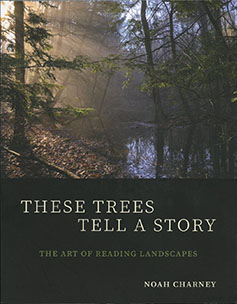
Author(s): Charney, Noah
Publisher: Yale University Press, 2023
ISBN: 978-0300230895
Comments: If you enjoy wandering in the forest, and sometimes wonder how forest habitats where shaped, you can learn a lot from this book about how to “read” landscapes. This easy-to-read book explains how weather, past land management, topology, and natural resources shape habitats. Charney, assistant professor of conservation biology at the University of Maine, helps us look at the forest from a much deeper perspective. 432 pages.
A Naturalist’s Guide to Wetland Plants
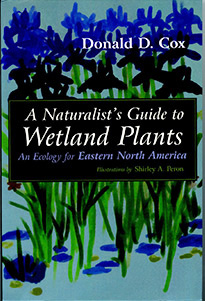
Author(s): Cox, Donald D.
Publisher: Syracuse University Press, 2002
ISBN: 978-0815607403
Comments: This book describes all manner of plants, including aquatic and shoreline plants, fungi, ferns, hallucinogenic plants, etc. The focus is on how these varies species adapt to wetland habitats, not on plant identification. Illustrated with line drawings. 194 pages.
Range: Eastern North America
The Book of Swamp and Bog: Trees, Shrubs, and Wildflowers of Eastern Freshwater Wetlands

Author(s): Eastman, John; illustrated by Hansen, Amelia
Publisher: Stackpole Books, 1995
ISBN: 978-0811725187
View at: Barnes & Noble, or Amazon
Comments: Describes "trees, shrubs, and wildflowers of eastern freshwater wetlands." This book, and others in the series, is not a guide in the traditional sense. It describes a relatively small number of common species in their full ecological context, providing deeper insight into the world that surrounds each plant. The author lists birds and other associated animals; insects that feed on (or in some cases are digested by) the plants; pollinators and gall-producing insects; and fungal threats. Descriptions are rich with detail, but not overly technical. 237 pages.
Range: Eastern North America
The Book of Field and Roadside: Open-Country Weeds, Trees, and Wildflowers of Eastern North America

Author(s): Eastman, John; illustrated by Hansen, Amelia
Publisher: Stackpole Books, 2003
ISBN: 978-0811726252
View at: Barnes & Noble, or Amazon
Comments: I love these books! (See also The Book of Swamp and Bog and The Book of Forest and Thicket.) Learning to identify a plant is one matter, a pleasant challenge to be sure, but one that leaves us with only the most superficial of introductions. What if you could be fully immersed in the world of the plant? Eastman’s books describe a relatively small number of common species in rich but not overly technical detail. I feel like a tiny bee might, as I see the insects that frequent the plant, the fungal blights it must tolerate, the birds who favor its fruits, its friends and associates. Amelia Hansen's detailed line drawings focus sometimes on the plant itself, but often on some aspect of the plant's environment. These books aren't really field guides, but they are much more. 336 pages.
Range: Eastern North America.
The Book of Forest and Thicket: Trees, Shrubs, and Wildflowers of Eastern North America

Author(s): Eastman, John; illustrated by Hansen, Amelia
Publisher: Stackpole Books, 1992
ISBN: 978-0811730464
Comments: I love these books! (See also The Book of Swamp and Bog and The Book of Field and Roadside.) Learning to identify a plant is one matter, a pleasant challenge to be sure, but one that leaves us with only the most superficial of introductions. What if you could be fully immersed in the world of the plant? Eastman's books describe a relatively small number of common species in rich but not overly technical detail. I feel like a tiny bee might, as I see the insects that frequent the plant, the fungal blights it must tolerate, the birds who favor its fruits, its friends and associates. Amelia Hansen's detailed line drawings focus sometimes on the plant itself, but often on some aspect of the plant's environment. These books aren't really field guides, but they are much more. 212 pages.
Range: Eastern North America
Sustaining Life: How Human Health Depends on Biodiversity

Author(s): Edited by Chivian, Eric and Bernstein, Aaron
Publisher: Oxford University Press, 2008
ISBN: 978-0195175097
View at: Barnes & Noble, or Amazon
Comments: This beautiful volume is not a field guide. It is the result of a large scale international effort, initiated in 1992, to coordinate "what was known about how other species contribute to human health." The project was directed by Nobel Peace Prize-winning scientist Eric Chivian, and consolidates information from over 100 contributors. It demonstrates in myriad ways that biodiversity is essential to human existence. 542 pages.
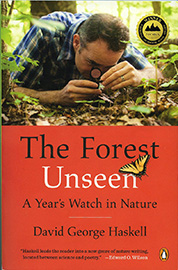
Author(s): Haskell, David George
Publisher: Penguin Books, 2013
ISBN: 978-0143122944
View at: Barnes & Noble, or Amazon
Comments: An amazing book! What would happen if you drew a circle about a meter in diameter at an arbitrary spot in the woods, then visited the same spot nearly every day for a year? Plenty, at least if you train yourself to play close attention to more of what is going on. David Haskell writes with a deep understanding of ecology; familiarity with a wide range of plant, animal, fungal, and microscopic life; and the soul of a poet. The book is organized as a series of short, rich essays prompted by different visits. I recommend this book for anyone who wants to understand the forest’s intriciate web of living relationships on a deeper level. The book is easy to read, not laden with dense terminology. Oh, and you'll find out what a mandala is.
Gathering Moss: A Natural and Cultural History of Mosses

Author(s): Kimmerer, Robin Wall
Publisher: Oregon State University Press, 2003
ISBN: 978-0870714993
View at: Barnes & Noble, or Amazon
Comments: This isn't a guide book, but it provides a very interesting introduction to mosses, and from a unique perspective. From the cover: "...Drawing on her diverse experience as a scientist, mother, teacher, and writer of Native American Heritage, Kimmerer explains the stories of mosses in scientific terms as well as in the framework of indigenous ways of knowing. In her book, the natural history and cultural relationships of mosses become a powerful metaphor for ways of living in the world."
Entangled Life: How Fungi Mmake our Worlds, Change our Minds & Shape our Futures
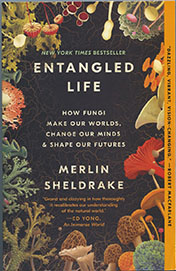
Author(s): Sheldrake, Merlin
Publisher: Random House, 2020
ISBN: 978-0525510321
Comments: Fungi are ancient, and deeply interwoven into everything living thing. Merlin Sheldrake presents fungi from fresh new perspectives, in this inventive and highly readable book. This is not a guide, but rather a deeper view of fungi and its role in life on Earth. 368 pages.
Bringing Nature Home: How You Can Sustain Wildlife with Native Plants

Author(s): Tallamy, Douglas W.
Publisher: Timber Press, 2020
ISBN: 978-0881929928
Comments: Douglas Tallamy describes the complex ways in which native species of plants interact with their surroundings and other animals and insects to create a healthy, vibrant habitat. By contrast, landscaping that uses non-native species impedes this balance severely. He makes a clear, non-technical case for gradually replacing non-native plantings with native counterparts. Extensive photographs show representative species and their interactions. 358 pages.
Half-Earth: Our Planet’s Fight for Life
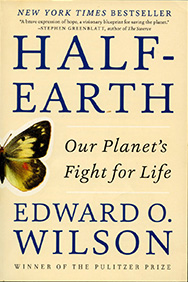
Author(s): Wilson, Edward O.
Publisher: Liveright, 2017
ISBN: 978-1631492525
Comments: Pulitzer-winning biologist Edward O. Wilson presents a cogent, well-reasoned case for preserving half of our entire ailing planet for natural development, in perpetuity. Why? Because human development is causing the planetary ecosystem to collapse. Unchecked, it will take us with it. 272 pages.
The Hidden Life of Trees: What They Feel, How They Communicate—Discoveries from a Secret World

Author(s): Wohlleben, Peter
Publisher: Greystone Books, 2016
ISBN: 978-1771642484
Comments: Peter Wohlleben presents trees and the ecosystems they create in a much deeper and more nuanced way. Using surprising means of communication, trees exist in cooperative groups reminiscent of animal social groups, interacting, protecting, and nurturing. You won’t think about trees the same way after you finish this readable, nontechnical book. 288 pages.
Note: book cover sizes in the list below are shown relative to each other. The list is organized by primary author. Some out-of-copyright books are available free at the supplied links.