Ferns Bibliography
This list encompasses true ferns, succulent ferns, and fern relatives, such as horsetails, clubmosses, firmosses, ground cedars, quillworts, and spikemosses.
A Field Guide to the Plants and Animals of the Middle Rio Grande Bosque
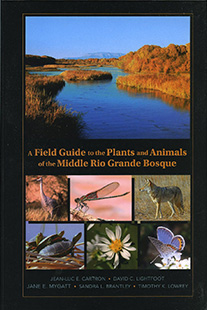
Author(s): Cartron, Jean-Luc E.; Lightfoot, David C.; Mygatt, Jane E.; Brantley, Sandra L.; Lowrey, Timothy K.
Publisher: University of New Mexico Press, 2008
ISBN: 978-0826342690
View at: Barnes & Noble, or Amazon
Comments: This volume has the ambitious goal of capturing a broad swath of life along the Rio Grande. It discusses the settings and their environmental histories, habitat types, and places to visit. It covers nonvascular plants such as lichens and fungi; vascular plants (flowering and spore-producing); invertabrate animals; and amphibians, reptiles, birds, and mammals. The section on plants makes up about a quarter of the book. It is organized by family. Blooming period is featured prominently, a good idea, since we tend to notice plants in bloom. Also included is identifying information, natural history, and whether a species is threatened. There are about three species per page, so photos tend to be smaller than with some layouts. 375 pages.
Range: From the back cover: “Extending from the spillway below Cochiti Dam, about fifty miles north of Albuquerque, to the headwaters of Elephant Butte Reservoir, near Truth or Consequences in the southern portion of New Mexico, the Middle Rio Grande Bosque is more than a cottonwood woodland or forest.”
Northeast Ferns: A Field Guide to the Ferns and Fern Relatives of the Northeastern United States

Author(s): Chadde, Steve W.
Publisher: CreateSpace Independent Publishing Platform, 2013
ISBN: 978-1492177289
View at: Barnes and Noble
Comments: This guide combines black-and-white photos with precisely executed line drawings, describing over 130 ferns and fern relatives of the northeastern United States. It includes the true ferns, as well as quillworts, clubmosses and spike-mosses. Species are organized by family. Descriptions are extremely comprehensive, but use a minimum of specialized botanical vernacular. Range maps are also detailed. The combination of photos and line art is quite unusual, and a very effective aid to identification. A very nicely done book. 434 pages.
Range: Northeastern North America
Peterson Field Guides: Ferns of Northeastern and Central North America

Author(s): Cobb, Boughton, Farnsworth, Elizabeth & Lowe, Cheryl
Publisher: Houghton Mifflin Company, 2005
ISBN: 978-0618394067
View at: Barnes & Noble, or Amazon
Comments: I love this book. Combining exquisitely detailed black & white line drawings and some photographs, it covers true ferns, succulent ferns, and fern relatives. These relatives include clubmosses and firmosses, tree clubmosses, ground cedars, horsetails, quillworts, and spikemosses. The 417-page guide covers northeastern and central North America. In addition to the illustrations, there are dichotomous keys that aid in identification.
Range:


Author(s): Cullina, William
Publisher: Echo Point Books & Media, 2020
ISBN: 978-1635618969
Comments: This books presents a wide selection of native ferns, mosses, and grasses, selected for garden plantings. William Cullina, a horticulturalist, highlights these oft-overlooked “background” plantings. This is the third of three volumes in his series. 256 pages.
Range: North America

Author(s): Fitter, Julian; Fitter, Daniel; Hosking, David
Publisher: Princeton University Press, 2015
ISBN: 978-0691170428
Comments: This compact guide does an amazing job at summarizing the natural history of the Galápagos archipelago. It covers geology, vulcanism, ocean currents, ecological zones, and points of interest. It also covers animals, birds, plants, and marine animals, most with photos. It lists islands and ecological zones and some of the species to be found there. How they managed to cram all this information into a pocket guide frankly boggles the imagination! 287 pages.
Range: Galápagos Islands
A Field Guide to Plants of Costa Rica
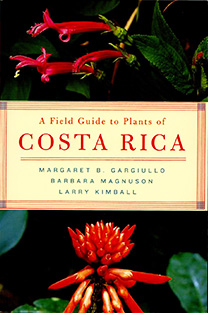
Author(s): Gargiullo, Margaret B.; photos by Magnuson, Barbara & Kimball, Larry
Publisher: Oxford University Press, 2008
ISBN: 978-0195188257
View at: Barnes & Noble, or Amazon
Comments: Nearly 1400 photos illustrate 856 Costa Rican plants organized into broad plant types ("habits"); then by color; then by family, genus and species. Detailed identifying descriptions include range information. The author's writing style avoids excessive jargon. 494 pages.
Range: Covers Costa Rica
Author(s): Gray, Asa; Robinson, Benjamin Lincoln; Fernald, Merritt Lyndon
Publisher: American Book Company, 1908
View at: Download free at University of California's California Digital Library
Range: Central and northeastern United States and adjacent Canada

Author(s): Hallowell, Anne C., Hallowell, Barbara G.
Publisher: Nature Study Guild Publishers
ISBN: 978-0912550244
View at: Barnes & Noble, or Amazon
Comments: This compact, inexpensive 61-page guide uses black & white line drawings and plain english descriptions to produce a flowchart for identifying common ferns. Part of a series of such books, it is remarkably effective at making quick identifications, and very easy to use.
Range: Covers central and northeastern United States and eastern Canada.
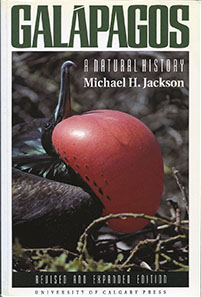
Author(s): Jackson, Michael H.
Publisher: University of Calgary Press, 1994
ISBN: 978-1895176407
Comments: This natural history guide is part hard science, and part storytelling. It isn’t just a field guide—the author complements his descriptions with interesting background, helping to capture what makes the Galápagos archipelago so special. He covers the geology of the islands, as well as plants, birds, fishes, reptiles, and mammals. He also presents the human history of the islands. 272 pages.
Range: Galápagos Islands
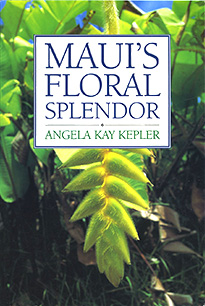
Author(s): Kepler, Angela Kay
Publisher: Mutual Publishing, 1998
ISBN: 978-1566470575
View at: Barnes & Noble, or Amazon
Comments: This book is organized by flower color, and identification is effectively by flower shape. Hawaiian flowers tend to be highly unique in shape, so this approach works quite well. Descriptions are informative and readable, targeted more at the natural history of the plants than at specific identifying features. 144 pages.
Range: Hawaii
The Plants of Baxter State Park
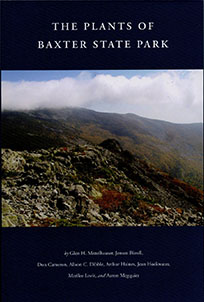
Author(s): Mittelhauser, Glen H.; Bissell, Jensen; Cameron, Don; Dibble, Alison C.; Haines, Arthur; Hockwater, Jean; Lovit, Marilee; Megquier, Aaron
Publisher: University of Maine Press, 2016
View at: Brickyard Books
Comments: This book does a beautiful job of presenting and keying 857 species of herbaceous plants, trees, and shrubs; ferns and fern allies; and grasses, sedges, and rushes found in the 200,000 acres of Baxter State Park. Photography is clear and detailed, with two species per page. About 2000 photos. 477 pages. See also the The Plants of Acadia National Park, Sedges of Maine, Grasses and Rushes of Maine, and Wildflowers of the Maine Islands: The Downeast and Acadia Coasts. All of these are by the same primary author.
The Plants of Acadia National Park
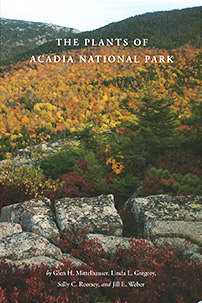
Author(s): Mittelhauser, Glen H.; Gregory, Linda L.; Rooney, Sally C.; and Weber, Jill E.
Publisher: University of Maine Press, 2010
ISBN: 978-0891011200
View at: University of Maine Press, or Amazon
Comments: Why would anybody buy a book for a single national park? Well, first off, it is an extremely well-designed guide, with 2-3 excellent photos per species and brief but useful descriptions. Descriptions cover the flowers, leaves, and fruit, as well as the locations and frequency of occurrence. The book describes two species per page, 862 in all, including wildflowers, ferns, grasses, sedges, rushes, trees and shrubs. The second reason for getting localized guides is that identification is greatly simplified, since you only see species known in the area. This book is a great resource for anywhere on the Maine and nearby Canadian coasts. 530 pages. See also the The Plants of Baxter State Park, Sedges of Maine, Grasses and Rushes of Maine, and Wildflowers of the Maine Islands: The Downeast and Acadia Coasts. All of these are by the same primary author.
Range: Acadia National Park, Maine coast
Plants of the Pacific Northwest Coast
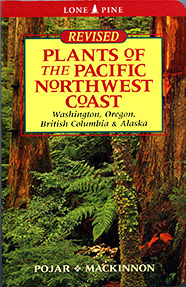
Author(s): Pojar, Jim; MacKinnon, Andy
Publisher: Lone Pine, 1994
ISBN: 978-1551055305
View at: Barnes & Noble, or Amazon
Comments: Describes 794 species, including trees, shrubs, wildflowers, aquatic plants, grasses, ferns, mosses and lichens. Includes 1100 color photos and 1000 line drawings and silhouettes. While many field guides cover wider regions and larger numbers of species, this provides deeper detail about each species in the more restricted region. If you search for wildflowers only in this region, this may be the only resource you need, and it is an excellent complement to other guides if you need to identify plants from a wider or different area. Includes keys that require moderate, but not advanced, understanding of botanical terminology. 528 pages.
Range: Washington, Oregon, British Columbia and Alaska, from the coast to the mountains.
Field Guide to the New England Alpine Summits
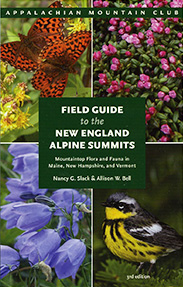
Author(s): Slack, Nancy G.; Bell, Allison W.
Publisher: Appalachian Mountain Club Books, 2013
ISBN: 978-1934028889
View at: Barnes & Noble, or Amazon
Comments: New England mountain tops can be challenging places for plants, and the species that colonize these exposed, cooler, more rugged climates are a hardy bunch. This books describes the trees, shrubs, herbacous plants, mosses, lichens, and ferns; as well as mammals, birds, insects, reptiles and amphibians that are common in this habitat, about 200 species in all. The book includes discussions of climate and geography.
Range: New England mountains
Mountain Plants of the Pacific Northwest
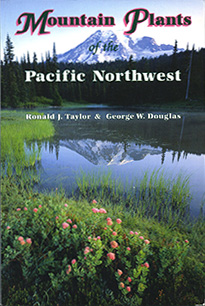
Author(s): Taylor, Ronald J.; Douglas, George W.
Publisher: Moutain Press Publishing Company, 1995
ISBN: 978-0878423149
View at: Barnes and Noble, or Amazon
Comments: Alpine plants are sometimes unique, sometimes familiar species morphed into new forms, for example, by becoming smaller for protection against the weather. This books organizes plants into ferns, trees, forbs (non-grass herbaceous plants) & shrubs, and grasses. (This is a little unusual: trees and shrubs are more often grouped, leaving herbaceous plants separate.) Each section is further subdivided by family, an organization that has pros (similar species often appear together) and cons (lookups by color or shape aren’t possible). Each pair of facing pages consists of a photos page and a descriptions page, usually covering two species. Typically there are two photos per species, with descriptions of leaves, flowers, fruits, and ecology. Habitats and edibility are discussed. The broad range of plant types covered, coupled with the narrow biome, make this a very useful resource if you are tramping around Pacific northwestern mountains. 437 pages.
Range: Pacific Northwest
Florida Wildflowers: A Comprehensive Guide
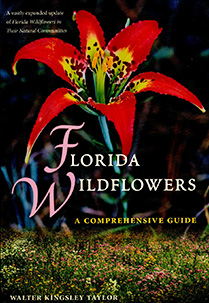
Author(s): Taylor, Walter Kingsley
Publisher: University Press of Florida, 2013
ISBN: 978-0813044255
Comments: Florida has many plants that aren't found in much of the rest of North America, so this guide covers ground that is not necessarily reflected in others. This guide covers 450 species. Includes descriptions, flowering times, habitat information, distribution within Florida, and notes on related species, etymology, edibility and landscape applications. The guide is organized by broad regions (hardwood forested uplands and wetlands), then by more specific biomes. Within each such grouping, I could not discern much order in the presentation of species, so it was necessary to flip through each section a page at a time. I found this to be an impediment to an otherwise wonderful and useful book. 567 pages.
Range: Florida
Mosses, Lichens and Ferns of Northwest North America

Author(s): Vitt, Dale H., Marsh, Janet E., & Bovey, Robin B.
Publisher: Lone Pine, 1988
ISBN: 978-1551055695
Comments: This 296-page guide covers about 370 species of mosses, lichens, liverworts, and ferns that are commonly found in the Pacific northwest. The guide includes range maps, photos, habitat indicators, and dichotomous keys as aids to identification. These plants can be difficult subjects, requiring microscopic examination and/or chemical tests, so there are relatively few guide books available.
Range:

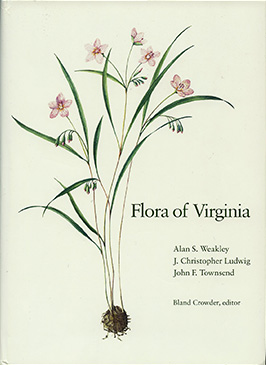
Author(s): Weakley, Alan S.; Ludwig, J. Christopher; Townsend, John F.; Crowder, Bland (Ed.)
Publisher: Botanical Research Institute of Texas Press, 2013
ISBN: 978-1889878386
View at: Flora of Virginia Project, or Amazon
Comments: I'm not sure where to start with the superlatives here. Flora are very specialized works intended for professional botanists. They combine complex identification keys, detailed species descriptions that are virtually incomprehensible to the unintiated, and precise line drawings that capture identifying features. All flora are towering accomplishments. This one is my favorite. The organization and layout seem to me to be flawless. Drawings are integrated into the descriptive material. Typography is necessarily cramped, but still readable. There is an aesthetic appeal to this document that stands out. It makes a dry, academic tome more approachable, easier to use. Species are organized taxonomically, as is typically the case with flora. Included are vascular spore-bearing plants, gymnosperms (cone-bearing plants), and flowering plants. Descriptions are very thorough. Keys are laid out readably. Drawings are exquisite, reproduced perfectly. As the creators of this work note, this flora appears “not a century too soon”—the last such flora for Virginia was issued 250 years ago! There is also a project to make this available as an app. 1554 pages.
Range: Virginia
Note: book cover sizes in the list below are shown relative to each other. The list is organized by primary author. Some out-of-copyright books are available free at the supplied links.