Mushrooms Bibliography
This bibliography covers fungi—mushrooms, “toadstools,” puffballs, gel fungi, stinkhorns, and slime molds.

Author(s): Arora, David
Publisher: Ten Speed Press, 1986
ISBN: 978-0898151695
View at: Barnes & Noble, or Amazon
Comments: This 959-page guide is the most comprehensive I have seen, describing over 2,000 species in detail. The book contains a section of color photos in the center, with many more black & white photos throughout. Spore prints and chemical tests are provided. If you get serious about fungi, this guide is a must. Other guides are better suited for beginners though.
Range: Covers the United States and Canada.
Mushrooms of the Northeastern United States and Eastern Canada
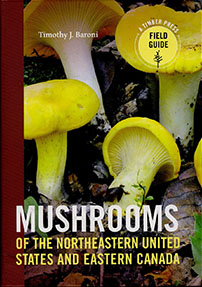
Author(s): Baroni, Timothy J.
Publisher: Timber Press, 2017
ISBN: 978-1604696349
Comments: A highly comprehensive guide to fungi in northeastern North America, with keys, diagrams, and photos. Each species gets a page with detailed descriptions. 599 pages.
Mushrooms of Northeast North America

Author(s): Barron, George
Publisher: Lone Pine Publishing, 1999
ISBN: 978-1551052014
View at: Barnes & Noble, or Amazon
Comments: Describes 609 species of mushrooms and slime molds, organized by groups. Includes a photo key at the beginning, dichotomous keys, and extensive color photographs. Contains 336 pages and 875 color photos.
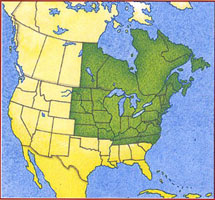
Range:

Mushrooms of Northeastern North America
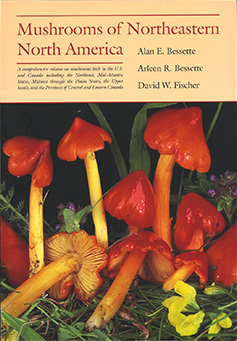
Author(s): Bessette, Alan E., Bessette, Arleen R., Fischer, David W.
Publisher: Syracuse University Press, 1997
ISBN: 978-0815603887
View at: Barnes & Noble, or Amazon
Comments: This book describes nearly 1500 species, with 650 color photos. It includes detailed keys that are written to be readable by ordinary mortals, not just botanists steeped in Botanical Latin. Photos are grouped into sections rather than included with the individual descriptions—a benefit when browsing images for possible matches, but not when browsing descriptions. 582 pages.
Range:
Mycophilia: Revelations from the Weird World of Mushrooms

Author(s): Bone, Eugenia
Publisher: Rodale Books, 2011
ISBN: 978-1609619879
Comments: I really enjoyed this book. The author relates her developing infatuation with mycology, the study of fungi. I think she coined the term “mycophilia.” Her writiing is lucid, funny, ireepressibly enthusiastic, and not overly technical. 368 pages.
A Field Guide to the Plants and Animals of the Middle Rio Grande Bosque
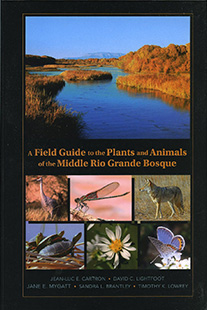
Author(s): Cartron, Jean-Luc E.; Lightfoot, David C.; Mygatt, Jane E.; Brantley, Sandra L.; Lowrey, Timothy K.
Publisher: University of New Mexico Press, 2008
ISBN: 978-0826342690
View at: Barnes & Noble, or Amazon
Comments: This volume has the ambitious goal of capturing a broad swath of life along the Rio Grande. It discusses the settings and their environmental histories, habitat types, and places to visit. It covers nonvascular plants such as lichens and fungi; vascular plants (flowering and spore-producing); invertabrate animals; and amphibians, reptiles, birds, and mammals. The section on plants makes up about a quarter of the book. It is organized by family. Blooming period is featured prominently, a good idea, since we tend to notice plants in bloom. Also included is identifying information, natural history, and whether a species is threatened. There are about three species per page, so photos tend to be smaller than with some layouts. 375 pages.
Range: From the back cover: “Extending from the spillway below Cochiti Dam, about fifty miles north of Albuquerque, to the headwaters of Elephant Butte Reservoir, near Truth or Consequences in the southern portion of New Mexico, the Middle Rio Grande Bosque is more than a cottonwood woodland or forest.”

Author(s): Miller, Jr., Orson K.
Publisher: E.P. Dutton, 1979
ISBN: 978-0525474821
Comments: Covers more than 680 species, with full descriptions of 422. Includes identifying dichotomous keys; large, clear photos; detailed descriptions. The 368-page book also includes edibility information. There was probably an outer cover on this book originally.
Range: Covers the continental United States and Canada.
Fascinating Fungi of New England

Author(s): Millman, Lawrence
Publisher: Kollath+Stensaas Publishing, 2011
ISBN: 978-1936571017
Comments: This wonderful nontechnical book illustrates many representative New England fungi with superbly executed color drawings. This book isn’t as comprehensive as some others, but it is a great way to become comfortable with classes of fungi, whether your goal is collecting, foraging, or simply admiring them. 134 pages.
Range: New England

Author(s): Petersen, Jens H.
Publisher: Princeton University Press, 2012
View at: Barnes & Noble
Comments: This is the most beautiful presentation of fungi that I have so far had the pleasure of encountering. Stunning is not a powerful enough word to describe both the technical usefulness and aesthetic delight of these photos. Interspersed among the photos are readable, non-technical descriptions of how fungi go about their business. This is not a field guide, but it is a compelling view into an alien-seeming universe that lies all around us.
Mushrooms and Other Fungi of North America
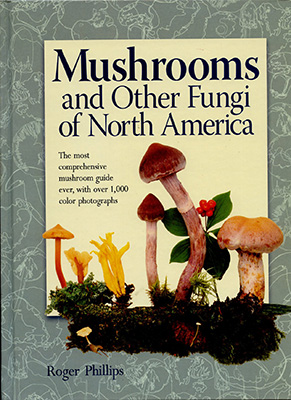
Author(s): Phillips, Roger
Publisher: Firefly Books, 2010
ISBN: 978-1554076512
View at: Barnes & Noble, or Amazon
Comments: This interesting 319-page book takes a different approach to photographing the mushrooms. Each species is represented by multiple photos of specimens at different stages of growth, uprooted to show underground features, with cross sections and undersides. Scientifically detailed text descriptions accompany the numerous photos.
Range: Covers the United States.
Mushrooms of West Virginia and the Central Appalachians
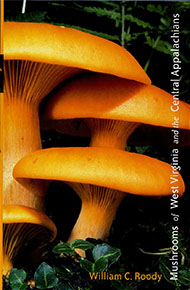
Author(s): Roody, William C.
Publisher: University Press of Kentucky, 2003
ISBN: 978-0813190396
Comments: This guide has extremely comprehensive descriptions of fungi, organized by picture key for major groups, followed by individual species in each group. Each species has a page with a photo(s) and a description. 520 pages.
Entangled Life: How Fungi Mmake our Worlds, Change our Minds & Shape our Futures
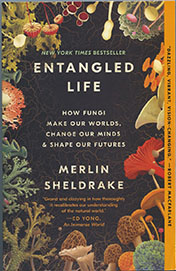
Author(s): Sheldrake, Merlin
Publisher: Random House, 2020
ISBN: 978-0525510321
Comments: Fungi are ancient, and deeply interwoven into everything living thing. Merlin Sheldrake presents fungi from fresh new perspectives, in this inventive and highly readable book. This is not a guide, but rather a deeper view of fungi and its role in life on Earth. 368 pages.
Growing Gourmet and Medicinal Mushrooms

Author(s): Stamets, Paul
Publisher: Ten Speed Press, 2000
ISBN: 978-1580081757
Comments: Author Paul Stamets probably knows more about mushroom cultivation than anybody else. In this book, he discusses cultivation of medicinal, edible, or otherwise useful mushrooms. This book is a standard reference on the subject. It is not a guidebook, covering species chosen by Stamets because they are prized as delicious, medically useful, or psychoactive. He presents growing techniques that are generally applicable to fungi. 592 pages.
The North American Guide to Common Poisonous Plants and Mushrooms
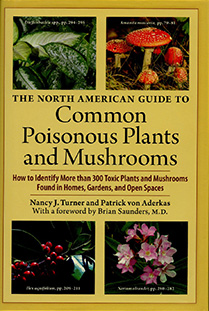
Author(s): Turner, Nancy J.; von Aderkas, Patrick
Publisher: Timber Press, 2010
ISBN: 978-0881929294
Comments: It isn't often when an academic treatise is approachable enough to read from cover to cover, but I found that to be the case here. The authors cover mushrooms in detail, as well as other plants. They include coverage for some molds, some toxic algae, lichens, ferns—about 300 species in all. Descriptions for identifying these species are thorough, often accompanied by photos. They also describe symptoms, toxic agents, and treatment protocols. The discussion encompasses not only human poisoning, but plants that are toxic to pets and livestock. This is a very useful addition to any forager's library, as well as a helpful tool to those who treat victims of poisoning. 375 pages.
Range: North America
Note: book cover sizes in the list below are shown relative to each other. The list is organized by primary author. Some out-of-copyright books are available free at the supplied links.