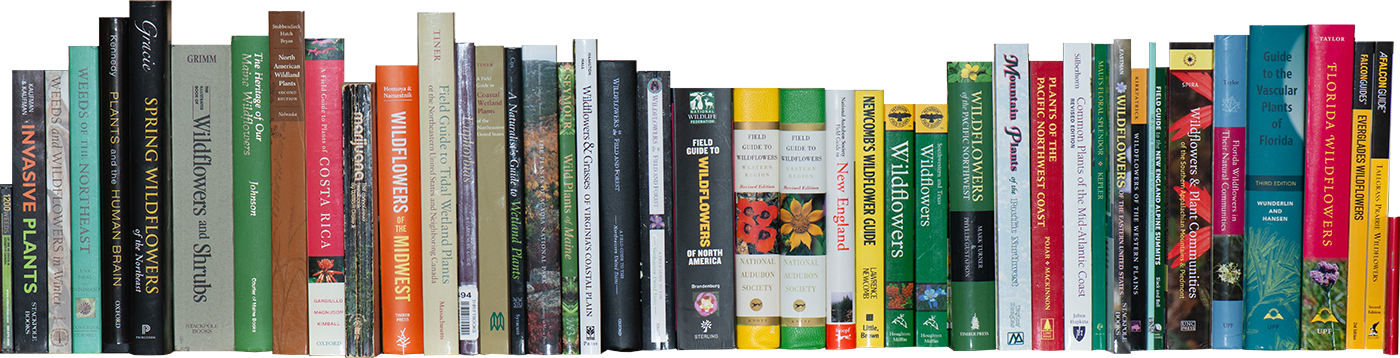
Wildflowers (Herbaceous Plants) Bibliography
Loosely speaking, plants that regrow from the ground each year, either from seed or from roots persisting from previous years, are herbaceous plants, and are listed here. See also the bibliography of trees and shrubs, or the bibliography of arid climate plants.
National Audubon Society Field Guide to New England
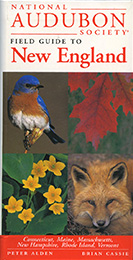
Author(s): Alden, Peter; Cassie, Brian
Publisher: Andrew Stewart Publishing, 1998
ISBN: 978-0679446767
View at: Barnes & Noble, or Amazon
Comments: Part of a series of regional field guides, this compact guide covers the most common members from all walks of life, as well as sites of interest and even some field astronomy. If you like the outdoors and are curious about nature in all forms, this is a great choice. Photos are great, though space is necessarily tight for such an ambitious range. 448 pages.
Range: Connecticut, Maine, Massachusetts, New Hampshire, Rhode Island, Vermont
100 Roadside Wildflowers of the Southwest Woodlands
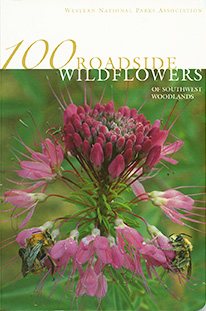
Author(s): Bowers, Janice Emily
Publisher: Western National Parks Association, Tucson, AZ, 2003
ISBN: 978-0911408737
View at: Barnes & Noble, or Amazon
Comments: This is the kind of book you buy on impulse when you stop at a visitor stand in a national park. It allows identification of some of the most common flowers in woodland habitats, but the American southwest is a large region and the 100 species covered provide only a tantalizing glimpse. Plants are presented two per page, with a nice photograph and clear, non-technical descriptions. There is no special organization to the presentation, but the book is short enough so it is possible to flip through it in search of an ID.
Range: Arizona, New Mexico, Utah, Nevada, Colorado
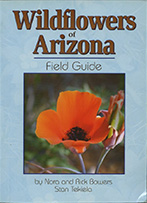
Author(s): Bowers, Nora & Rick, Tekiela, Stan
Publisher: Adventure Publications, Inc., 2008
ISBN: 978-1591930693
View at: Barnes & Noble, or Amazon
Comments: This compact 432-page guide describes about 200 wildflowers. Facing pages include a photo and a non-technical description.
Range: Arizona
National Wildlife Federation Field Guide to Wildflowers of North America
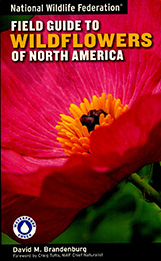
Author(s): Brandenburg, David M.
Publisher: Andrew Stuart Publishing, Inc., 2010
ISBN: 978-1402741548
View at: Barnes & Noble, or Amazon
Comments: This hefty (673-page) book covers more than 2,200 species, with extensive photos, detailed range maps, and brief non-technical descriptions. A key in the beginning is organized by flower color, while the body of the book is organized by plant family. Although the photos are well done, they are necessarily small, and there are few drawings; and the organization by plant family does not make it easy to identify by page-flipping. I use other wildflower guides first, going here for confirmation. This book is an excellent resource for browsing to become familiar with more species.
Range: Covers the United States and Canada.
Weeds and Wildflowers in Winter
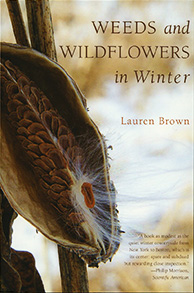
Author(s): Brown, Lauren
Publisher: The Countrymen Press, 2012
ISBN: 978-1581571776
Comments: If you are scratching your head, wondering why anyone would care about identifying some dead sticks poking above the surface of the snow in the middle of winter, you can probably squeak through life without a copy of this book. But if you're into winter hiking or cross-country skiing, and you've been noticing the stark beauty of some of these plant exoskeletons, this is a great way to figure out what you are seeing. I am often surprised by how different a species looks at various stages of its growth cycle, so guides like this help to form a more complete understanding of a plant's life cycle. The author complements the line drawings with interesting stories about the species. 135 species. 252 pages.
Range: New England, but relevant to other temperate regions
A Field Guide to the Plants and Animals of the Middle Rio Grande Bosque
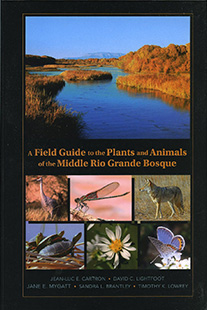
Author(s): Cartron, Jean-Luc E.; Lightfoot, David C.; Mygatt, Jane E.; Brantley, Sandra L.; Lowrey, Timothy K.
Publisher: University of New Mexico Press, 2008
ISBN: 978-0826342690
View at: Barnes & Noble, or Amazon
Comments: This volume has the ambitious goal of capturing a broad swath of life along the Rio Grande. It discusses the settings and their environmental histories, habitat types, and places to visit. It covers nonvascular plants such as lichens and fungi; vascular plants (flowering and spore-producing); invertabrate animals; and amphibians, reptiles, birds, and mammals. The section on plants makes up about a quarter of the book. It is organized by family. Blooming period is featured prominently, a good idea, since we tend to notice plants in bloom. Also included is identifying information, natural history, and whether a species is threatened. There are about three species per page, so photos tend to be smaller than with some layouts. 375 pages.
Range: From the back cover: “Extending from the spillway below Cochiti Dam, about fifty miles north of Albuquerque, to the headwaters of Elephant Butte Reservoir, near Truth or Consequences in the southern portion of New Mexico, the Middle Rio Grande Bosque is more than a cottonwood woodland or forest.”
Wildflowers in the Field and Forest
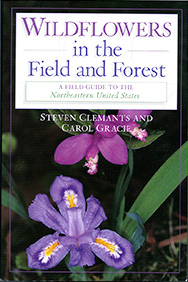
Author(s): Clemants, Steven; Gracie, Carol
Publisher: Oxford University Press, 2006
ISBN: 978-0195150056
View at: Barnes & Noble, or Amazon
Comments: This is my hands down favorite for identifying northeastern US wildflowers. It lists 1400 species of the northeastern United States, organized by flower color, then leaf characteristics. Descriptions are compact, fairly non-technical, yet incredibly precise, with unique identifying features in boldface. There is a photo (sometimes with additional inset photos) for each species. Photos are superb, with dark backgrounds that emphasize the subject. Range maps are detailed, not just restricted to state boundaries. Each pair of opposing pages lists species descriptions on the left page, and photos on the right, for several related species. The authors have done a superb job grouping related species. I'm a bit disappointed with the binding, though. If you will use this book frequently, consider the hardcover edition. 445 pages.
Range: Northeastern United States
A Naturalist’s Guide to Wetland Plants
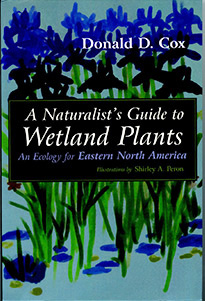
Author(s): Cox, Donald D.
Publisher: Syracuse University Press, 2002
ISBN: 978-0815607403
Comments: This book describes all manner of plants, including aquatic and shoreline plants, fungi, ferns, hallucinogenic plants, etc. The focus is on how these varies species adapt to wetland habitats, not on plant identification. Illustrated with line drawings. 194 pages.
Range: Eastern North America

Author(s): Fitter, Julian; Fitter, Daniel; Hosking, David
Publisher: Princeton University Press, 2015
ISBN: 978-0691170428
Comments: This compact guide does an amazing job at summarizing the natural history of the Galápagos archipelago. It covers geology, vulcanism, ocean currents, ecological zones, and points of interest. It also covers animals, birds, plants, and marine animals, most with photos. It lists islands and ecological zones and some of the species to be found there. How they managed to cram all this information into a pocket guide frankly boggles the imagination! 287 pages.
Range: Galápagos Islands
Peterson Field Guides: Eastern/Central Medicinal Plants and Herbs
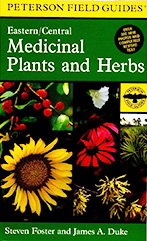
Author(s): Foster, Steven; Duke, James A.
Publisher: Houghton Mifflin, 2000
ISBN: 978-0395988145
View at: Barnes & Noble, or Amazon
Comments: This 411-page guide lists plants found in the eastern and central United States, listing their real or alleged medical properties. Descriptions cover historical beliefs about the plants as well as more recent research. Includes identifying photos.
Range: Covers states east of, but excluding, Colorado, Montana, and New Mexico. It does not fully cover the southern half of Florida or the southern and western halves of Texas. Adjacent regions of Canadian provinces are included.
A Field Guide to Plants of Costa Rica
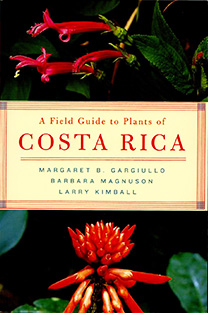
Author(s): Gargiullo, Margaret B.; photos by Magnuson, Barbara & Kimball, Larry
Publisher: Oxford University Press, 2008
ISBN: 978-0195188257
View at: Barnes & Noble, or Amazon
Comments: Nearly 1400 photos illustrate 856 Costa Rican plants organized into broad plant types ("habits"); then by color; then by family, genus and species. Detailed identifying descriptions include range information. The author's writing style avoids excessive jargon. 494 pages.
Range: Covers Costa Rica
Spring Wildflowers of the Northeast: A Natural History
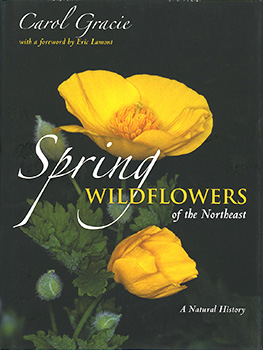
Author(s): Gracie, Carol
Publisher: Princeton University Press, 2012
ISBN: 978-0691144665
View at: Barnes & Noble, or Amazon
Comments: This is a collection of essays about some common wildflowers from the northeastern United States. Carol Gracie’s stories provide a much deeper understanding of the role each plant plays in its enviornment, and 500 detailed photos capture the beauty and uniqueness of these flowers. This is not a field guide, it is a book about natural history. Another of Gracie's books, which she co-authored with Steven Clemants, is Wildflowers in the Field and Forest, among my favorites. 272 pages.
Range: Northeastern United States.
Author(s): Gray, Asa; Robinson, Benjamin Lincoln; Fernald, Merritt Lyndon
Publisher: American Book Company, 1908
View at: Download free at University of California's California Digital Library
Range: Central and northeastern United States and adjacent Canada
The Illustrated Book of Wildflowers and Shrubs
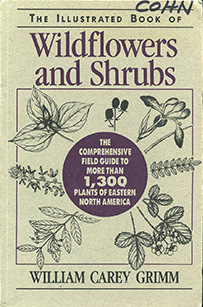
Author(s): Grimm, William Carey
Publisher: Stackpole Books, 1993
ISBN: 978-0811730853
View at: Barnes and Noble, or Amazon
Comments: This volume covers 1,300 wildflowers and shrubs of eastern North America. Each pair of facing pages typically consists of a set of precisely executed black-and-white line drawings of four or five species, and descriptions of four to eight species. Descriptions are readable and thorough. Even the keys have been translated into something approximating English, fairly unusual. Plants are organized by family, genus, and species. To use this book effectively requires a reasonably detailed understanding of plant families and their properties. There are a series of useful keys near the end for difficult-to-identify shrubs. 637 pages.
Range: Eastern North America.
Wildflowers & Grasses of Virginia’s Coastal Plain
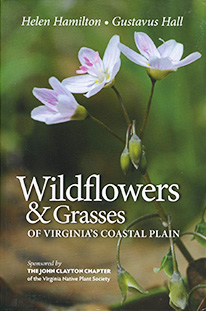
Author(s): Hamilton, Helen; Hall, Gustavus
Publisher: Botanical Research Institute of Texas Press, 2013
ISBN: 978-1889878416
View at: Barnes & Noble, or Amazon
Comments: Describes about 250 species found in Virgina's coastal plain—roughly the eastern third of Virginia. Herbaceous plants are arranged by flower color. Each entry includes a description, habitat and contents, along with a photo. Coverage includes small, weedy species that are often omitted from other guides. 276 pages.
Range: Eastern third of Virginia
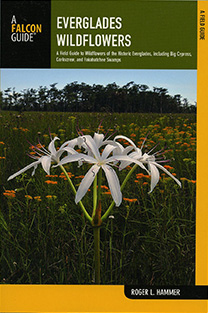
Author(s): Hammer, Roger L.
Publisher: Falcon Guides, Rowan and Littlefield, 2014
ISBN: 978-0762787531
View at: Barnes & Noble, or Amazon
Comments: Covering species from the Everglades National Park, as well as the Corkscrew, Big Cypress, and Fakahatchee Swamps, this guide presents 360 species of herbaceous plants. Plants are organized by flower color, typically two per page, with a color photo and a description, habitat/range, bloom season, and comments. It is easy to flip through this book in search of IDs. This is a great choice when you visit the Everglades, but Florida Wildflowers is a better choice if you are also interested in more northerly plants. 244 pages.
Range: Everglades National Park and the Corkscrew, Big Cypress and Fakahatchee Swamps, in Flordia.
The Front Yard Forager: Identifying, Collecting, and Cooking the 30 Most Common Urban Weeds

Author(s): Herrera, Melany Vorass
Publisher: Skipstone, 2013
ISBN: 978-1594857478
Comments: Those urban weeds we all ignore because they’re so common? Many are edible and delicious. This guide describes 30 common edible weeds, with information on finding, identifying, and preparing them. The book includes identifying photos, information on when to harvest, lookalikes to avoid, and recipes. 191 pages.
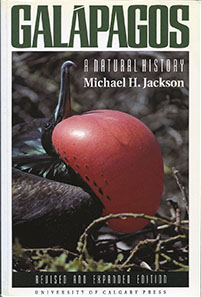
Author(s): Jackson, Michael H.
Publisher: University of Calgary Press, 1994
ISBN: 978-1895176407
Comments: This natural history guide is part hard science, and part storytelling. It isn’t just a field guide—the author complements his descriptions with interesting background, helping to capture what makes the Galápagos archipelago so special. He covers the geology of the islands, as well as plants, birds, fishes, reptiles, and mammals. He also presents the human history of the islands. 272 pages.
Range: Galápagos Islands
Author(s): Jan Kops (1765–1849); illustrated by Christiaan Sepp
Publisher: The Hague, 1800
View at: A collection of historic and modern biology books.
Comments: Flora Batava is a beautifully illustrated flora published in 28 volumes, spanning a time period of 134 years, from 1800 to 1934.
The Heritage of Our Maine Wildflowers
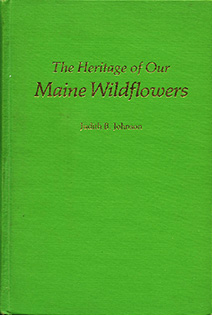
Author(s): Johnson, Judith B.
Publisher: Courier of Maine Books, Rockland, Maine, 1978
ISBN: 978-0913954324
Comments: I grew up in Maine, and when I noticed this book on a relative's end table I was immediately enchanted. This book is filled with watercolors of the species it describes, executed simply but evocatively. Each drawing manages to capture the essence of the plant. Plants are presented by flower color. Descriptions include identifying features and habitat information. There are also sections on history and folklore, medicinal herbs, and edible herbs, as well as several glossaries. The book is out of print—it took some searching to find a copy. 359 pages.
Range: Maine
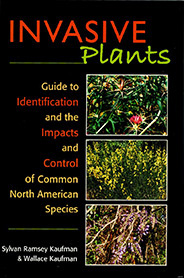
Author(s): Kaufman, Sylvan Ramsey; Kaufman, Wallace
Publisher: Stackpole Books, 2007
ISBN: 978-0811733656
View at: Barnes & Noble, or Amazon
Comments: Describes about 175 alien invading species, including wildflowers, trees, shrubs and grasses. Invasive plants spread quickly, displacing native species and reducing biodiversity. Entries include identifying information, habitat and range, management information, and cross references. There is also a section on how the plant affects the ecosystem, and how it was introduced to North America. 458 pages.
Range: North America
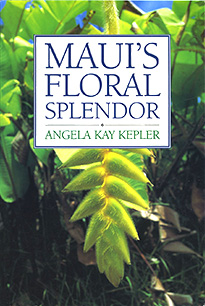
Author(s): Kepler, Angela Kay
Publisher: Mutual Publishing, 1998
ISBN: 978-1566470575
View at: Barnes & Noble, or Amazon
Comments: This book is organized by flower color, and identification is effectively by flower shape. Hawaiian flowers tend to be highly unique in shape, so this approach works quite well. Descriptions are informative and readable, targeted more at the natural history of the plants than at specific identifying features. 144 pages.
Range: Hawaii
Wildflowers of the Western Plains
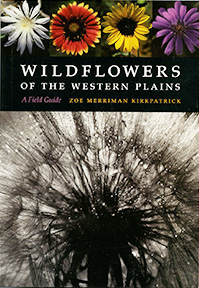
Author(s): Kirkpatrick, Zoe Merriman
Publisher: University of Nebraska Press, 1992
ISBN: 978-0803219052
View at: Barnes & Noble, or Amazon
Comments: 186 species are presented, organized by family. Within a family, a cluster of photos precedes detailed descriptions of the species. This organization makes it easier to compare family members. Descriptions include the plant, flower, fruit; its range, and other remarks that are most often related to making a successful identification. Photos are high in quality. 240 pages.
Range:
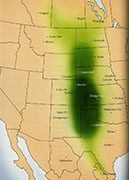
Range: The plains of Western Texas, eastern New Mexico, through Colorado, Kansas, Nebraska, Wyoming, Montana, Dakotas, and into Canada.
Tallgrass Prairie Wildflowers: A Field Guide to Common Wildflowers and Plants of the Prairie Midwest
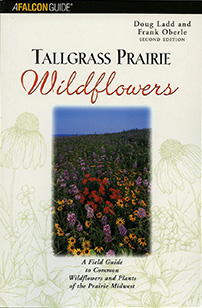
Author(s): Ladd, Doug; Oberle, Frank
Publisher: Falcon Guide, Morris Book Publishing, LLC, 2005
ISBN: 978-0762737444
Comments: Tallgrass prairies, so called because the grasses populating them are often at least three feet high and sometimes much higher yet, once made up a very large part of the United States. Now greatly fragmented, their value is being rediscovered. This guide presents about 300 species, one to two per page, with a color photo above and a description below. The description includes a bloom season, habitat/range information, and comments. Species are organized by flower color and family, with separate sections on grasses and weeds. 263 pages.
Range: Parts of Minnesota, the Dakotas, Wisconsin, Michigan, Nebraska, Iowa, Illinois, Indiana, Ohio, Kansas, Missouri, Kentuky, Oklahoma, Arkansas, and Tennessee.
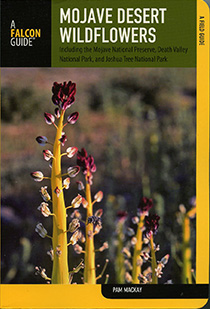
Author(s): MacKay, Pam
Publisher: Morris Book Publishing, LLC, 2013
ISBN: 978-0762780334
View at: Barnes & Noble, or Amazon
Comments: This book covers the Mojave Desert, including Death Valley National Park, Mojave National Preserve, and Joshua Tree National Park. It provides detailed descriptions and excellent photos for over 300 plants. Descriptions are clear and free of jargon. Note the difference between the 2003 edition (left) and the 2013 second edition. 337 pages.
Range: Mojave Desert: Parts of southern California and Utah, and small parts of Arizona and Utah. Includes the Mojave National Preserve, Death Valley National Park, and Joshua Tree National Park
Flowering Plants of the Galápagos
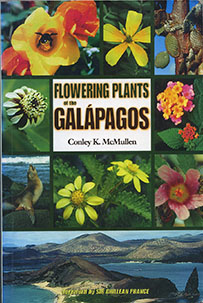
Author(s): McMullen, Conley K.
Publisher: Comstock Publishing Associates, 1999
ISBN: 978-0801486210
Comments: This book is comprehensive and not overly technical. It organizes plants into trees, shrubs, herbs, vines, and cacti, then into subsections based on some fairly obvious characteristic. It includes native species along with some of the introduced species, providing detailed descriptions and photos of most. The author also lists the islands on which each species is found, a major help in identification. 370 pages.
Range: Galápagos Islands
Medicinal Plants of North America: A Field Guide
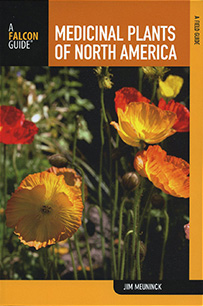
Author(s): Meuninck, Jim
Publisher: Globe Pequot Press, 2008
ISBN: 978-0762742981
View at: Barnes & Noble, or Amazon
Comments: This book describes many common North American plants, organized into groups by region and plant type (woody vs. herbaceous). The number of species covered is fairly small, about 120, with fairly large write-ups for each species. Medicinal and food uses are discussed, both traditional and contemporary. If your primary interest is identification, other guides are more comprehensive. 159 pages.
Range: North America
Berry Finder: A Guide to Native Plants with Fleshy Fruits
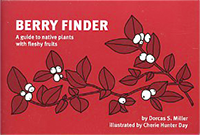
Author(s): Miller, Dorcas S., illustrated by Day, Cherie Hunter
Publisher: Nature Study Guild Publishers
ISBN: 978-0912550220
View at: Barnes & Noble, or Amazon
Comments: This diminutive 58-page guide uses black & white line drawings and plain english to provide a simple flowchart for identifying plants by their berries. Part of a series of such guides, it is a surprisingly effective aid.
Range: Covers Eastern United States and Canada.
Wildflowers of the Maine Islands: The Downeast and Acadia Coasts

Author(s): Mittelhauser, Glen H.
Publisher: University of Maine Press, 2021
View at: Brickyard Books
Comments: This beautiful guide is well organized and keyed, presenting excellent photos of wildflowers on Maine islands along part of the Maine coast. The guide spans from Muscongus Bay east to the Canadian border (Knox, Waldo, Hancock, and Washington counties). 379 pages. See also the The Plants of Acadia National Park, Sedges of Maine, Grasses and Rushes of Maine, and The Plants of Baxter State Park. All of these are by the same primary author.
The Plants of Baxter State Park
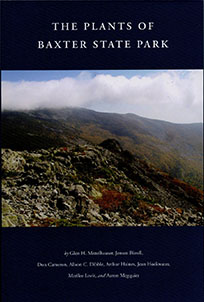
Author(s): Mittelhauser, Glen H.; Bissell, Jensen; Cameron, Don; Dibble, Alison C.; Haines, Arthur; Hockwater, Jean; Lovit, Marilee; Megquier, Aaron
Publisher: University of Maine Press, 2016
View at: Brickyard Books
Comments: This book does a beautiful job of presenting and keying 857 species of herbaceous plants, trees, and shrubs; ferns and fern allies; and grasses, sedges, and rushes found in the 200,000 acres of Baxter State Park. Photography is clear and detailed, with two species per page. About 2000 photos. 477 pages. See also the The Plants of Acadia National Park, Sedges of Maine, Grasses and Rushes of Maine, and Wildflowers of the Maine Islands: The Downeast and Acadia Coasts. All of these are by the same primary author.
The Plants of Acadia National Park
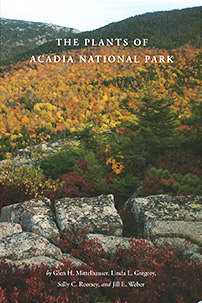
Author(s): Mittelhauser, Glen H.; Gregory, Linda L.; Rooney, Sally C.; and Weber, Jill E.
Publisher: University of Maine Press, 2010
ISBN: 978-0891011200
View at: University of Maine Press, or Amazon
Comments: Why would anybody buy a book for a single national park? Well, first off, it is an extremely well-designed guide, with 2-3 excellent photos per species and brief but useful descriptions. Descriptions cover the flowers, leaves, and fruit, as well as the locations and frequency of occurrence. The book describes two species per page, 862 in all, including wildflowers, ferns, grasses, sedges, rushes, trees and shrubs. The second reason for getting localized guides is that identification is greatly simplified, since you only see species known in the area. This book is a great resource for anywhere on the Maine and nearby Canadian coasts. 530 pages. See also the The Plants of Baxter State Park, Sedges of Maine, Grasses and Rushes of Maine, and Wildflowers of the Maine Islands: The Downeast and Acadia Coasts. All of these are by the same primary author.
Range: Acadia National Park, Maine coast
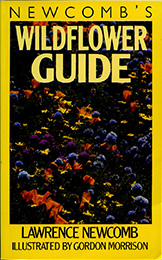
Author(s): Newcomb, Lawrence, Morrison, Gordon (Illus.)
Publisher: Little, Brown and Company, 1977
ISBN: 978-0316604420
View at: Barnes & Noble, or Amazon
Comments: This 490-page guide describes 1350 wildflowers. Many wildflower guides organize plants by flower color and shape, but Newcomb’s “... system of identification is based on natural structural features that are easily visible even to the untrained eye.” I found this arrangement to be counterintuitive at first, but I find myself using this book more and more often. The guide contains many high quality black & white line drawings.
Range:
Peterson Field Guides: Southwestern and Texas Wildflowers
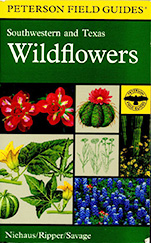
Author(s): Niehaus, Theodore F., Ripper, Charles L., Savage, Virginia
Publisher: Houghton Mifflin, 1984
ISBN: 978-0395936122
View at: Barnes & Noble, or Amazon
Comments: Describes over 1500 species of wildflowers found in portions of the southern and southwestern United States. Employs black & white line drawings, and some paintings, pointing out identifying features with arrows. Plants are presented by flower color, then organized by other identifying features such as flower shape, family, or seed appearence. Text descriptions are short, but focused on positive identification.
Range:
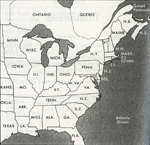
Peterson Field Guides: Edible Wild Plants of Eastern/Central North America
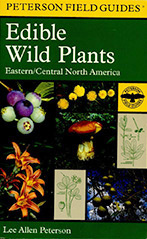
Author(s): Peterson, Lee Allen
Publisher: Houghton Mifflin Company, 1977
ISBN: 978-0395926222
Comments: Like other Peterson field guides, this one presents its subject with facing pages that contain high quality black & white line drawings on one side and text summaries on the other. There is also a section of color plates in the center of the book. Descriptions include brief preparation information, icons indicating the way in which the plants are consumed, and habitat information.
Range:
Peterson Field Guides: Wildflowers—Northeastern and North Central North America
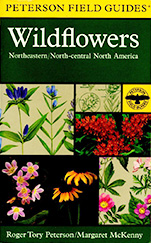
Author(s): Peterson, Roger Tory, McKenny, Margaret
Publisher: Houghton Mifflin, 1968
ISBN: 978-0395911723
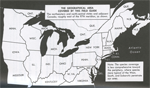
Comments: This 420-page guide organizes 1,293 wildflowers by color, then shape. Facing pages contain written descriptions on one side and detailed black & white line drawings, or sometimes color paintings, on the other. This is the layout that I like best. It permits quick comparisons among similar-appearing plants. Text descriptions are sometimes a bit too brief, but the 1,344 drawings make up for it.
Range:
Plants of the Pacific Northwest Coast
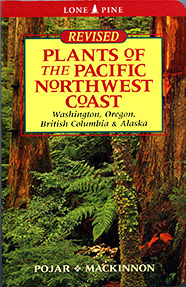
Author(s): Pojar, Jim; MacKinnon, Andy
Publisher: Lone Pine, 1994
ISBN: 978-1551055305
View at: Barnes & Noble, or Amazon
Comments: Describes 794 species, including trees, shrubs, wildflowers, aquatic plants, grasses, ferns, mosses and lichens. Includes 1100 color photos and 1000 line drawings and silhouettes. While many field guides cover wider regions and larger numbers of species, this provides deeper detail about each species in the more restricted region. If you search for wildflowers only in this region, this may be the only resource you need, and it is an excellent complement to other guides if you need to identify plants from a wider or different area. Includes keys that require moderate, but not advanced, understanding of botanical terminology. 528 pages.
Range: Washington, Oregon, British Columbia and Alaska, from the coast to the mountains.
Wild Plants of Maine: A Useful Guide
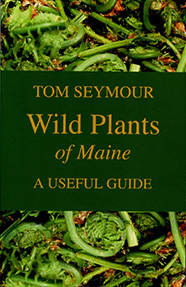
Author(s): Seymour, Tom
Publisher: Just Write Books, 2010
ISBN: 978-1-934949-25-2
Comments: Tom Seymour describes many common edible Maine wild plants. He covers their identification, when to harvest them, and how to prepare them as food. His presentation is practical and readable. 160 pages.
Range: Maine
Common Plants of the Mid-Atlantic Coast: A Field Guide
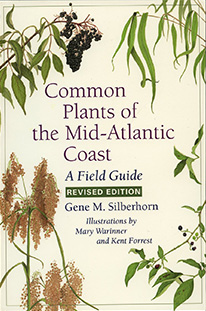
Author(s): Silberhorn, Gene M.; Warinner, Mary (Illus.); Forrest, Kent (Illus.)
Publisher: The Johns Hopkins University Press, 1999
ISBN: 978-0801860812
View at: Barnes & Noble, or Amazon
Comments: The first thing that jumps out of this book are the stunning black-and-white line drawings, which are exquisitely detailed and absolutely captivating. Focusing on the commonest species, the author lavishes two full pages on each, one for the drawing, another that includes a non-technical description for identification, and information about habitat, distribution, ecological value, and wetland status. Includes an identification key. 306 pages.
Range: Mid-Atlantic coast, from New York to North Carolina.
Field Guide to the New England Alpine Summits
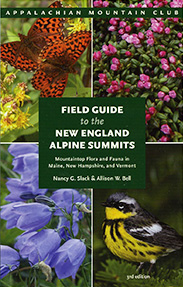
Author(s): Slack, Nancy G.; Bell, Allison W.
Publisher: Appalachian Mountain Club Books, 2013
ISBN: 978-1934028889
View at: Barnes & Noble, or Amazon
Comments: New England mountain tops can be challenging places for plants, and the species that colonize these exposed, cooler, more rugged climates are a hardy bunch. This books describes the trees, shrubs, herbacous plants, mosses, lichens, and ferns; as well as mammals, birds, insects, reptiles and amphibians that are common in this habitat, about 200 species in all. The book includes discussions of climate and geography.
Range: New England mountains
National Audubon Society Field Guide to Wildflowers, Western Region
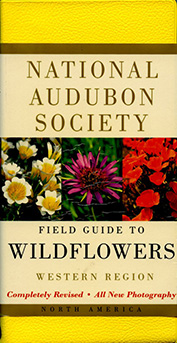
Author(s): Spellenberg, Richard
Publisher: Alfred A. Knopf, 2001
ISBN: 978-0394504315
View at: Barnes & Noble, or Amazon
Comments: This 862-page guide contains 940 photos of wildflowers found in the western half of the United States, organized first by color, then by flower shape. Photos are contained in front half of the book, partly to make it a little easier to scan for possible matches, and partly perhaps as a concession to printing costs. Discussions and identifying details are presented in the second half of the book. Personally, I think this organization is simplest for amateurs who are learning how to identify plants, though I wish that scientific names were included with the photos, as well as with the descriptions.
Range:
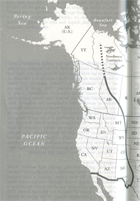
North American Wildland Plants, 2nd Ed.
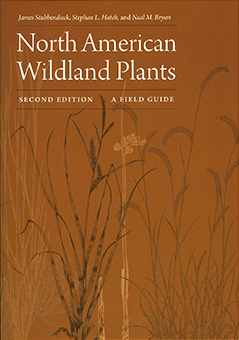
Author(s): Stubbendieck, James; Hatch, Stephan L.; and Bryan, Neal M.
Publisher: University of Nebraska Press, 2011
ISBN: 978-0803234857
View at: Barnes and Noble, or Amazon
Comments: There is a lot to like about this volume, which is divided roughly evenly between grasses and herbaceous plants, with a smattering of trees & shrubs; and with special interest in plants that are good or bad for forage. Plants are organized by family. In the hands of a gifted botanical artist, line drawings capture all the essential traits of a plant with none of the background clutter in photographs. These full-page line drawings are superb, showing the entire plant, the roots, and detail views. Range maps are detailed, not restricted to state boundaries. Descriptions cover plant shapes, flowering times, fruits, leaves and stems. Comments cover use for food or medical purposes. Plants poisonous to people or livestock are so noted. Habitats are also described. Each species is given two full pages, so per-species coverage is deep. As a consequence, the range of species is limited to about 200. 496 pages.
Range: North America
Mountain Plants of the Pacific Northwest
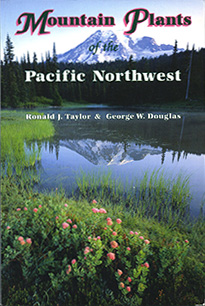
Author(s): Taylor, Ronald J.; Douglas, George W.
Publisher: Moutain Press Publishing Company, 1995
ISBN: 978-0878423149
View at: Barnes and Noble, or Amazon
Comments: Alpine plants are sometimes unique, sometimes familiar species morphed into new forms, for example, by becoming smaller for protection against the weather. This books organizes plants into ferns, trees, forbs (non-grass herbaceous plants) & shrubs, and grasses. (This is a little unusual: trees and shrubs are more often grouped, leaving herbaceous plants separate.) Each section is further subdivided by family, an organization that has pros (similar species often appear together) and cons (lookups by color or shape aren’t possible). Each pair of facing pages consists of a photos page and a descriptions page, usually covering two species. Typically there are two photos per species, with descriptions of leaves, flowers, fruits, and ecology. Habitats and edibility are discussed. The broad range of plant types covered, coupled with the narrow biome, make this a very useful resource if you are tramping around Pacific northwestern mountains. 437 pages.
Range: Pacific Northwest
Florida Wildflowers: A Comprehensive Guide
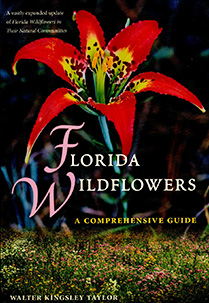
Author(s): Taylor, Walter Kingsley
Publisher: University Press of Florida, 2013
ISBN: 978-0813044255
Comments: Florida has many plants that aren't found in much of the rest of North America, so this guide covers ground that is not necessarily reflected in others. This guide covers 450 species. Includes descriptions, flowering times, habitat information, distribution within Florida, and notes on related species, etymology, edibility and landscape applications. The guide is organized by broad regions (hardwood forested uplands and wetlands), then by more specific biomes. Within each such grouping, I could not discern much order in the presentation of species, so it was necessary to flip through each section a page at a time. I found this to be an impediment to an otherwise wonderful and useful book. 567 pages.
Range: Florida
Florida Wildflowers in Their Natural Communities
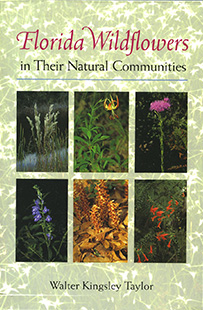
Author(s): Taylor, Walter Kingsley
Publisher: University Press of Florida, 1998
ISBN: 978-0813016160
View at: Barnes and Noble, or Amazon
Comments: Field guides are endlessly inventive in deciding how best to organize the species presented. Among the approaches are by color, by some shape property of the plant, by family, and by habitat. This guide is organized by terrestrial communities: pine flatwoods, sandhills and clayhills, scrubs, temperate hardwood forests, coastal uplands, rockland pinelands, rockland hardwood hammocks, and ruderal sites. Once you learn to distinguish the habitats, you can more quickly zero in on the species. About 450 species are covered, mostly herbaceous plants but some trees and shrubs, organized into families within each community. Each species has about half a page in coverage, including a photo, a description, flowering time, habitat, range, and perhaps comments. 370 pages.
Range: Florida
National Audubon Society Field Guide to North American Wildflowers, Eastern Region
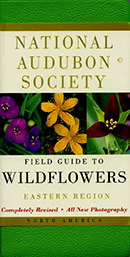
Author(s): Thierer, John W., Niering, William A, Olmstead, Nancy C.
Publisher: Alfred A. Knopf, 2001
ISBN: 978-0375402326
View at: Barnes & Noble, or Amazon
Comments: This 879-page guide contains 950 photos of wildflowers found in the eastern half of the United States, organized first by color, then by flower shape. Photos are contained in front half of the book, partly to make it a little easier to scan for possible matches, and partly perhaps as a concession to printing costs. Discussions and identifying details are presented in the second half of the book. Personally, I think this organization is simplest for amateurs who are learning how to identify plants, though I wish that scientific names were included with the photos, as well as with the descriptions.
Range:
Coastal Wetland Plants of the Northeastern United States
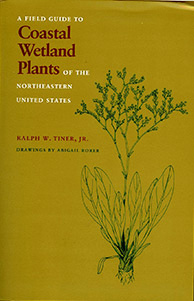
Author(s): Tiner Jr., Ralph W.
Publisher: University of Massachusetts Press, 1987
ISBN: 978-0870235382
Comments: New England’s craggy shores are host to numerous varieties of herbaceous plants, grasses, sedges, shubs, and aquatic plants that are well-adapted to the habitats. This guide book has crisp, well-executed line drawings and identifying information for many of these species. Most of the species appear along the entire Atlantic coast, and especially the northern parts of the Pacific coast. 285 pages.
Range: Northeastern United States
Field Guide to Tidal Wetland Plants of the Northeastern United States and Neighboring Canada
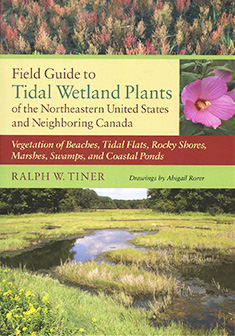
Author(s): Tiner, Ralph W.; Rorer, Abigail (illus.)
Publisher: University of Massachusetts Press, 2009
ISBN: 978-1558496675
View at: Barnes & Noble, or Amazon
Comments: I love the drawings in this book. They are large and detailed. Write-ups include detailed descriptions of plant features, the flowering period, the wetland indicator status, and similar species. Includes keys organized by detailed habitats and plant descriptions organized by habitat. Contains a good deal of supporting information too. This is the first comprehensive book I have seen that is specifically about wetland plants. It covers beaches, tidal flats, rocky shores, marshes, swamps, and coastal plants.
Range: Northeastern United States and neighboring Canada
Wildflowers of the Pacific Northwest
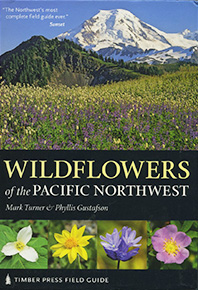
Author(s): Turner, Mark, Gustafson, Phyllis
Publisher: Timber Press, 2006
ISBN: 978-0881927450
View at: Barnes & Noble, or Amazon
Comments: This book organizes over 1,200 species, first by flower color, then by flower shape, in a format that averages three flowers per page. Each species includes a photo, a range map, and a non-technical description. I like its simple, straightforward format. This 511-page guide gets a lot of use, despite its relatively limited area of coverage.
Range: Covers the Pacific northwest: Washington, Oregon, part of northern California and some of southern British Colombia.
The North American Guide to Common Poisonous Plants and Mushrooms
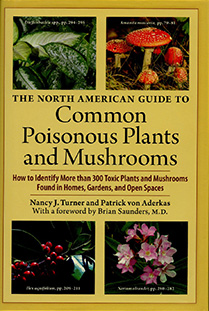
Author(s): Turner, Nancy J.; von Aderkas, Patrick
Publisher: Timber Press, 2010
ISBN: 978-0881929294
Comments: It isn't often when an academic treatise is approachable enough to read from cover to cover, but I found that to be the case here. The authors cover mushrooms in detail, as well as other plants. They include coverage for some molds, some toxic algae, lichens, ferns—about 300 species in all. Descriptions for identifying these species are thorough, often accompanied by photos. They also describe symptoms, toxic agents, and treatment protocols. The discussion encompasses not only human poisoning, but plants that are toxic to pets and livestock. This is a very useful addition to any forager's library, as well as a helpful tool to those who treat victims of poisoning. 375 pages.
Range: North America
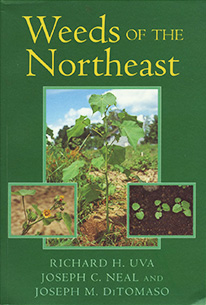
Author(s): Uva, Richard H.; Neal, Joseph C.; DiTomaso, Joseph M.
Publisher: Comstock Publishing Associates, 1997
ISBN: 978-0801483349
View at: Barnes & Noble, or Amazon
Comments: This 396-page guide describes 299 common or economically important weeds. Facing pages offer a detailed description of each weed, and multiple photographs of various aspects of the plant, including seeds. Includes several tables and keys.
Range: Covers northeastern North America south to Virginia, north to Maine and southeastern Canada, and west to Wisconsin.
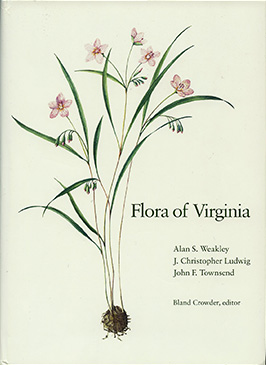
Author(s): Weakley, Alan S.; Ludwig, J. Christopher; Townsend, John F.; Crowder, Bland (Ed.)
Publisher: Botanical Research Institute of Texas Press, 2013
ISBN: 978-1889878386
View at: Flora of Virginia Project, or Amazon
Comments: I'm not sure where to start with the superlatives here. Flora are very specialized works intended for professional botanists. They combine complex identification keys, detailed species descriptions that are virtually incomprehensible to the unintiated, and precise line drawings that capture identifying features. All flora are towering accomplishments. This one is my favorite. The organization and layout seem to me to be flawless. Drawings are integrated into the descriptive material. Typography is necessarily cramped, but still readable. There is an aesthetic appeal to this document that stands out. It makes a dry, academic tome more approachable, easier to use. Species are organized taxonomically, as is typically the case with flora. Included are vascular spore-bearing plants, gymnosperms (cone-bearing plants), and flowering plants. Descriptions are very thorough. Keys are laid out readably. Drawings are exquisite, reproduced perfectly. As the creators of this work note, this flora appears “not a century too soon”—the last such flora for Virginia was issued 250 years ago! There is also a project to make this available as an app. 1554 pages.
Range: Virginia
Sierra Nevada Wildflowers, Including Yosemite, Sequoia, and Kings Canyon National Parks
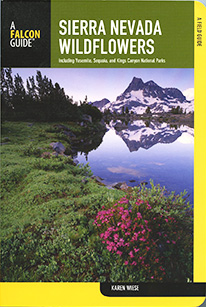
Author(s): Wiese, Karen
Publisher: FalconGuides, 2013
ISBN: 978-0762780341
View at: Barnes and Noble, or Amazon
Comments: This friendly, accessible guide is organized by flower color, with common names listed prominently and scientific names de-emphasized. Descriptions include plant, leaf and flower shapes, fruits, habitats, blooming periods, and comments. Two species per page, with one photo per species. Non-technical language. 215 pages.
Range: Sierra Nevada mountains, including Yosemite, Sequoia, and Kings Canyon National Parks
Plants and Animals of Galàpagos

Author(s): Wilson, Elsie
Publisher: Woodlands.explo, 2024
ISBN: 979-8884525382
Comments: This book covers mammals, reptiles and amphibianso, birds, plants, and insects of the Galàpagos Islands. For plants, the coverage is superficial and uneven, in the sense that uncommon or non-native species are described at the expense of native species. Scientific names are not included. I did not see any pattern of organization within broad groups. Descriptions are non-technical. 143 pages.
Range: Galàpagos Islands
Atlas of Florida Vascular Plants
Author(s): Wunderlin, R. P., and B. F. Hansen
Publisher: Institute for Systematic Botany, University of South Florida, Tampa, 2008
View at: The Institute for Systematic Botany Atlas of Florida Vascular Plants
Comments: From the web site: “The Atlas of Florida Vascular Plants is a joint effort by the Institute for Systematic Botany, the University of South Florida and the Florida Center for Community Design + Research to provide users with a comprehensive searchable database of vascular plants in the State of Florida. Florida, with over 4,200 species of native or naturalized ferns and seed plants, is the third most floristically diverse state in the United States. The Atlas of Florida Vascular Plants provides a source of information for the distribution of plants within the state.”
Range: Covers Florida.
Wild Urban Plants of the Northeast: a Field Guide
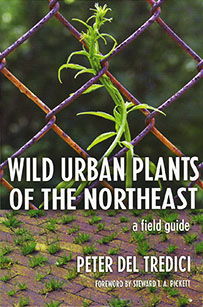
Author(s): del Tredici, Peter
Publisher: Comstock Publishing Associates, a division of Cornell Universty Press, 2010
ISBN: 978-0801474583
View at: Barnes & Noble, or Amazon
Comments: You could call this a weed book, since nearly every species in here would be so classed; or even a listing of invasive species, since many of these are a bit overly robust in some habitats. Or you could do as the author does, and recognize the vitality and sheer determination of these plants. Urban settings aren't especially friendly to wild plants, and those hardy few who manage quite nicely there deserve some respect. 158 common species are presented with two pages devoted to each. One page describes plant characteristics, germination, habitat preferences, ecological function, and cultural significance. The facing page contains many clear photos that allow an unambiguous identification. Even if you aren't a city dweller, you'll find most of these species in any temperate climate. 374 pages.
Range: Northeastern United States
Note: book cover sizes in the list below are shown relative to each other. The list is organized by primary author. Some out-of-copyright books are available free at the supplied links.