Mosses Bibliography
If you had no circulatory system to carry food and oxygen around your body, you'd be as small as a bug. That’s why mosses are tiny. In plants, the “circulatory system” is called the vascular system, and mosses never evolved such a system. Nevertheless, these miniature forests are well adapted to habitats all over the world.
A Field Guide to the Plants and Animals of the Middle Rio Grande Bosque
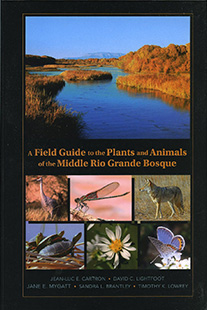
Author(s): Cartron, Jean-Luc E.; Lightfoot, David C.; Mygatt, Jane E.; Brantley, Sandra L.; Lowrey, Timothy K.
Publisher: University of New Mexico Press, 2008
ISBN: 978-0826342690
View at: Barnes & Noble, or Amazon
Comments: This volume has the ambitious goal of capturing a broad swath of life along the Rio Grande. It discusses the settings and their environmental histories, habitat types, and places to visit. It covers nonvascular plants such as lichens and fungi; vascular plants (flowering and spore-producing); invertabrate animals; and amphibians, reptiles, birds, and mammals. The section on plants makes up about a quarter of the book. It is organized by family. Blooming period is featured prominently, a good idea, since we tend to notice plants in bloom. Also included is identifying information, natural history, and whether a species is threatened. There are about three species per page, so photos tend to be smaller than with some layouts. 375 pages.
Range: From the back cover: “Extending from the spillway below Cochiti Dam, about fifty miles north of Albuquerque, to the headwaters of Elephant Butte Reservoir, near Truth or Consequences in the southern portion of New Mexico, the Middle Rio Grande Bosque is more than a cottonwood woodland or forest.”

Author(s): Cullina, William
Publisher: Echo Point Books & Media, 2020
ISBN: 978-1635618969
Comments: This books presents a wide selection of native ferns, mosses, and grasses, selected for garden plantings. William Cullina, a horticulturalist, highlights these oft-overlooked “background” plantings. This is the third of three volumes in his series. 256 pages.
Range: North America

Author(s): Fitter, Julian; Fitter, Daniel; Hosking, David
Publisher: Princeton University Press, 2015
ISBN: 978-0691170428
Comments: This compact guide does an amazing job at summarizing the natural history of the Galápagos archipelago. It covers geology, vulcanism, ocean currents, ecological zones, and points of interest. It also covers animals, birds, plants, and marine animals, most with photos. It lists islands and ecological zones and some of the species to be found there. How they managed to cram all this information into a pocket guide frankly boggles the imagination! 287 pages.
Range: Galápagos Islands
Mosses of the Northern Forest: A Photographic Guide

Author(s): Jenkins, Jerry
Publisher: Comstock Publishing Associates, 2020
ISBN: 978-1501748615
Comments: This book is a superb compendium of mosses, photographed clearly against dark backgrounds. It covers the northeastern United States and eastern Canada. I estimate that is covers over 400 moss species. 176 pages. See also Sedges of the Northern Forest: A Photographic Guide, by the same author.
Range: Northern US, Canada
Gathering Moss: A Natural and Cultural History of Mosses

Author(s): Kimmerer, Robin Wall
Publisher: Oregon State University Press, 2003
ISBN: 978-0870714993
View at: Barnes & Noble, or Amazon
Comments: This isn't a guide book, but it provides a very interesting introduction to mosses, and from a unique perspective. From the cover: "...Drawing on her diverse experience as a scientist, mother, teacher, and writer of Native American Heritage, Kimmerer explains the stories of mosses in scientific terms as well as in the framework of indigenous ways of knowing. In her book, the natural history and cultural relationships of mosses become a powerful metaphor for ways of living in the world."
Common Mosses of the Northeast and Appalachians

Author(s): McKnight, Karl B.; Rohrer, Joseph R.; Ward, Kirsten McKnight; Perdrizet, Warren J.
Publisher: Princeton University Press, 2013
ISBN: 978-0691156965
View at: Barnes & Noble, or Amazon
Comments: This is a beautifully designed field guide. It has a key system that is approachable to us amateurs. Excellent photos, drawings and microphotographs on one page for each species. On the facing page, a detailed description. Does not cover liverworts, which are sometimes grouped with mosses. 391 pages; about 200 species.
Range: Northeastern United States and the Appalachians.
Outstanding Mosses and Liverworts of Pennsylvania & Nearby States

Author(s): Munch, Susan
Publisher: Sunbury Press, 2006
ISBN: 978-0976092575
View at: Barnes & Noble, or Amazon
Comments: This is a rather odd book. At first I was underwhelmed. It isn't very long, and it cannot possibly cover such a large class of these diminutive plants. But then I started going through it. Several times I thought, "So that’s what that is!" From the liverworts growing on the trees in the back yard to the moss on the chimney or the apparently dead brown mosses that bide their time until the weather improves, these plants escape notice but are richly varied. The photos are clear and informative, the writing descriptive and enthusiastic. This guide provides a grounding in the broad characteristics of many genera, enough to get started in serious identification. I also very much like the spiral binding, because the pages lie flat. 89 pages.
Range: PA and nearby states
Plants of the Pacific Northwest Coast
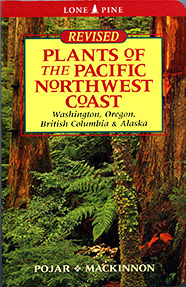
Author(s): Pojar, Jim; MacKinnon, Andy
Publisher: Lone Pine, 1994
ISBN: 978-1551055305
View at: Barnes & Noble, or Amazon
Comments: Describes 794 species, including trees, shrubs, wildflowers, aquatic plants, grasses, ferns, mosses and lichens. Includes 1100 color photos and 1000 line drawings and silhouettes. While many field guides cover wider regions and larger numbers of species, this provides deeper detail about each species in the more restricted region. If you search for wildflowers only in this region, this may be the only resource you need, and it is an excellent complement to other guides if you need to identify plants from a wider or different area. Includes keys that require moderate, but not advanced, understanding of botanical terminology. 528 pages.
Range: Washington, Oregon, British Columbia and Alaska, from the coast to the mountains.
Mosses, Liverworts, and Hornworts: A Field Guide to Common Bryophytes of the Northeast

Author(s): Pope, Ralph
Publisher: Cornell University, 2016
ISBN: 978-1501700781
View at: Barnes and Noble, or Amazon
Comments: “Hornworts,” for the record, is not a sister school to the Hogwarts School of Witchcraft and Wizardry. Instead they are members of the bryopyhte family, small mosslike plants which have elongated hornlike structures that are their namesake. Good bryophyte field gudes are few and far between, since these dimunitive plants are practically innumerable and notoriously difficult to identify. This volume is divided into peat mosses, acrocarpous mosses, pleurocarpous mosses, and liverworts & hornworts. It includes keys, photographs, references to similar species, and detailed range maps. Many line drawings and some microphotographs are present as well. There are perhaps 4 or 5 photos or drawings per species, enormously helpful in confirming IDs. The book is printed on non-glossy paper, making the photos seem a bit muted; I think glossy printing would produce better-appearing photos. A well-organized, interesting, functional guide. 368 pages; approximately 350 species.
Range: Northeastern United States
Field Guide to the New England Alpine Summits
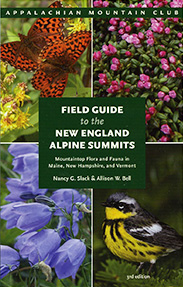
Author(s): Slack, Nancy G.; Bell, Allison W.
Publisher: Appalachian Mountain Club Books, 2013
ISBN: 978-1934028889
View at: Barnes & Noble, or Amazon
Comments: New England mountain tops can be challenging places for plants, and the species that colonize these exposed, cooler, more rugged climates are a hardy bunch. This books describes the trees, shrubs, herbacous plants, mosses, lichens, and ferns; as well as mammals, birds, insects, reptiles and amphibians that are common in this habitat, about 200 species in all. The book includes discussions of climate and geography.
Range: New England mountains
Mosses, Lichens and Ferns of Northwest North America

Author(s): Vitt, Dale H., Marsh, Janet E., & Bovey, Robin B.
Publisher: Lone Pine, 1988
ISBN: 978-1551055695
Comments: This 296-page guide covers about 370 species of mosses, lichens, liverworts, and ferns that are commonly found in the Pacific northwest. The guide includes range maps, photos, habitat indicators, and dichotomous keys as aids to identification. These plants can be difficult subjects, requiring microscopic examination and/or chemical tests, so there are relatively few guide books available.
Range:

Note: book cover sizes in the list below are shown relative to each other. The list is organized by primary author. Some out-of-copyright books are available free at the supplied links.