Tropical and Subtropical Plants Bibliography
These books cover plants from tropical or subtropical environments.
South Florida Trees: A Field Guide

Author(s): Buckley, Bill
Publisher: Summer Wind Productions, 2015
ISBN: 978-0990676904
View at: Barnes & Noble, or Amazon
Comments: Trees present a real photographic challenge. Do you try to show the entire tree’s habit, at the expense of any detail? Or concentrate on leaves, highly variable for some species? What about trunks, which change dramatically in texture and color over time? Or flowers or fruit or seeds? The only real answer is “all of the above,” and Bill Buckley approaches this ideal by presenting three photos per species, dedicating a page to each species. He presents 150 subtropical species that occur in south Florida, providing clear, non-technical descriptions for each. The book is organized into conifers (cone-bearing trees);, palms, and hardwoods; hardwoods are organized by some basic identifying features. I found the photos to be somewhat flat and muddy, an artifact of the printing process. 170 pages.
Range: South Florida: areas south of Lake Okeechobee—including Lee, Hendry, Palm Beach, Collier, Broward, Monroe, and Miami-Dade counties and coastal areas.
Succulent Flora of Southern Africa

Author(s): Court, Doreen
Publisher: Struik Nature, Cape Town, South Africa, 2010
ISBN: 978-1770075870
View at: Barnes & Noble, or Amazon
Comments: Southern Africa has the most diverse array of succulents anywhere in the world. Succulents, which adapt to dry conditions with thick, water-storing leaves and stems, exist in all arid climates. Nobody knows why they are especially prevalent in southern Africa, or why so many unique species are present there. This work, now in its third edition, apologizes for its lack of comprehensiveness, but there is little else that even comes close. The photography is excellent and the descriptions are thorough. Species are arranged by family, an arrangement that seems especially well-suited for arid climate plants. If you are lucky enough to spend time in the region, this is an excellent resource. It is also a great resource if you love these plants. 336 pages.
Range: Southern Africa, including Namibia, South Africa, Botswana, southern Zimbabwe, southern Mozambique, Swaziland, and Lesotho.
Encyclopedia of Tropical Plants: Identification and Cultivation of Over 3000 Tropical Plants

Author(s): Fayaz, Ahmed
Publisher: Firefly Books, 2011
ISBN: 978-1554074891
View at: Barnes & Noble, or Amazon
Comments: This is an immensely detailed encyclopedia of tropical and subtropical plants. Plants are organized into four major groups: lycophytes, monilophytes, and gymnosperms (cone-bearing plants and some others); angiosperms (flowering plants); angiosperm monocots; and angiosperm eudicots. Within these major branches plants are organized by family. 3000 species are described in great botantical detail, and include a photo, common names, morphology, flower characteristics, geographical distribution, habitats, cultivation information, and hardiness zones. At 6.4 pounds, this not a field guide: is a true encyclopedia for advanced plant fanatics for pro botanists. 720 pages.
Range: Tropics and subtropics worldwide.

Author(s): Fitter, Julian; Fitter, Daniel; Hosking, David
Publisher: Princeton University Press, 2015
ISBN: 978-0691170428
Comments: This compact guide does an amazing job at summarizing the natural history of the Galápagos archipelago. It covers geology, vulcanism, ocean currents, ecological zones, and points of interest. It also covers animals, birds, plants, and marine animals, most with photos. It lists islands and ecological zones and some of the species to be found there. How they managed to cram all this information into a pocket guide frankly boggles the imagination! 287 pages.
Range: Galápagos Islands
A Field Guide to Plants of Costa Rica
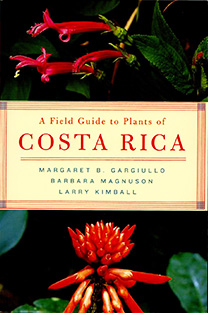
Author(s): Gargiullo, Margaret B.; photos by Magnuson, Barbara & Kimball, Larry
Publisher: Oxford University Press, 2008
ISBN: 978-0195188257
View at: Barnes & Noble, or Amazon
Comments: Nearly 1400 photos illustrate 856 Costa Rican plants organized into broad plant types ("habits"); then by color; then by family, genus and species. Detailed identifying descriptions include range information. The author's writing style avoids excessive jargon. 494 pages.
Range: Covers Costa Rica
Exotic Plant Manual: Fascinating Plants to Live With—Their Requirements, Propagation, and Use
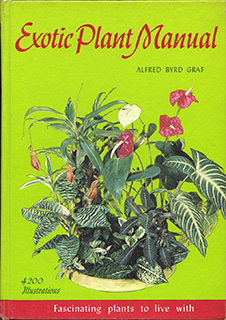
Author(s): Graf, Alfred Byrd
Publisher: Roehrs Company, 1974
ISBN: 978-0911266139
Comments: This book describes tropical and subtropical plants suitable for use as indoor plants or in gardens. With about 1200 illustrations and over 3000 photos, it covers a great deal of ground. Most photos are black and white. Written descriptions are very comprehensive. The book is literally jammed with information, with 840 pages of small print. This is an encyclopedia and horticulture guide, not a field guide, but with an extensive section with 18 photos per pair of facing pages, it provides a simple way to browse in search of likely matches. Long out of print, I picked up this book at an antique book store.
Range: Tropics and subtropics worldwide.
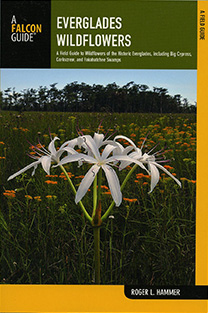
Author(s): Hammer, Roger L.
Publisher: Falcon Guides, Rowan and Littlefield, 2014
ISBN: 978-0762787531
View at: Barnes & Noble, or Amazon
Comments: Covering species from the Everglades National Park, as well as the Corkscrew, Big Cypress, and Fakahatchee Swamps, this guide presents 360 species of herbaceous plants. Plants are organized by flower color, typically two per page, with a color photo and a description, habitat/range, bloom season, and comments. It is easy to flip through this book in search of IDs. This is a great choice when you visit the Everglades, but Florida Wildflowers is a better choice if you are also interested in more northerly plants. 244 pages.
Range: Everglades National Park and the Corkscrew, Big Cypress and Fakahatchee Swamps, in Flordia.
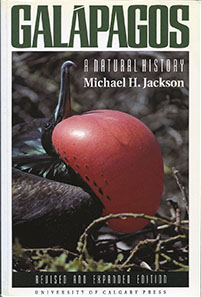
Author(s): Jackson, Michael H.
Publisher: University of Calgary Press, 1994
ISBN: 978-1895176407
Comments: This natural history guide is part hard science, and part storytelling. It isn’t just a field guide—the author complements his descriptions with interesting background, helping to capture what makes the Galápagos archipelago so special. He covers the geology of the islands, as well as plants, birds, fishes, reptiles, and mammals. He also presents the human history of the islands. 272 pages.
Range: Galápagos Islands
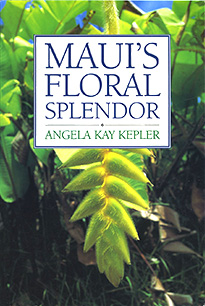
Author(s): Kepler, Angela Kay
Publisher: Mutual Publishing, 1998
ISBN: 978-1566470575
View at: Barnes & Noble, or Amazon
Comments: This book is organized by flower color, and identification is effectively by flower shape. Hawaiian flowers tend to be highly unique in shape, so this approach works quite well. Descriptions are informative and readable, targeted more at the natural history of the plants than at specific identifying features. 144 pages.
Range: Hawaii
Flowering Plants of the Galápagos
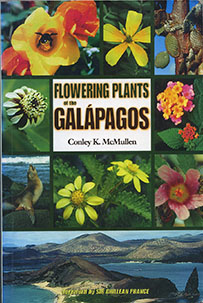
Author(s): McMullen, Conley K.
Publisher: Comstock Publishing Associates, 1999
ISBN: 978-0801486210
Comments: This book is comprehensive and not overly technical. It organizes plants into trees, shrubs, herbs, vines, and cacti, then into subsections based on some fairly obvious characteristic. It includes native species along with some of the introduced species, providing detailed descriptions and photos of most. The author also lists the islands on which each species is found, a major help in identification. 370 pages.
Range: Galápagos Islands
Succulents: The Illustrated Dictionary

Author(s): Sajeva, Maurizo & Costanzo, Mariangela
Publisher: Timber Press, 1994
ISBN: 978-0881923988
View at: Barnes & Noble, or Amazon
Comments: Contains 1200 excellent photographs covering roughly the same number of species from more than 195 genera of succulent plants. This is not a guide book—entries are organized by genus and species. Organized with six items per page, descriptions are a bit anemic. 238 pages.
Range: Worldwide.

Author(s): Stevenson, George B.
Publisher: University Press of Florida, 1996
ISBN: 978-0813014418
View at: Barnes & Noble, or Amazon
Comments: There are a lot of books describing palms cultivated for landscape uses, but I have found almost none that focus on native species. South Florida is a habitat with many unique characteristics, and this book concentrates on the many native palm species. This book presents one or two species per pair of pages, with descriptions on one facing page and detailed black & white line drawings on the other. The line drawings show the overall habit of the tree or shrub, along with as many as a dozen drawings of particular identifying details, such as intersections of leaf groupings, precise leaf shape, trunk details, flowers and fruits, even leaf cross-sections. These details provide for precise IDs, more so than with typical photographs. The written descriptions are equally comprehensive, containing both botanical information and information useful to landscapers. 251 pages.
Range: Southern Florida
Florida Wildflowers: A Comprehensive Guide
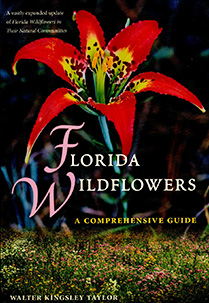
Author(s): Taylor, Walter Kingsley
Publisher: University Press of Florida, 2013
ISBN: 978-0813044255
Comments: Florida has many plants that aren't found in much of the rest of North America, so this guide covers ground that is not necessarily reflected in others. This guide covers 450 species. Includes descriptions, flowering times, habitat information, distribution within Florida, and notes on related species, etymology, edibility and landscape applications. The guide is organized by broad regions (hardwood forested uplands and wetlands), then by more specific biomes. Within each such grouping, I could not discern much order in the presentation of species, so it was necessary to flip through each section a page at a time. I found this to be an impediment to an otherwise wonderful and useful book. 567 pages.
Range: Florida
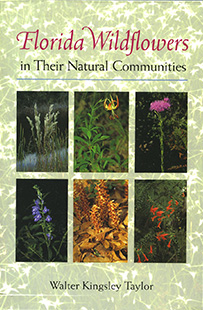
Florida Wildflowers in Their Natural Communities
Author(s): Taylor, Walter Kingsley
Publisher: University Press of Florida, 1998
ISBN: 978-0813016160
View at: Barnes and Noble, or Amazon
Comments: Field guides are endlessly inventive in deciding how best to organize the species presented. Among the approaches are by color, by some shape property of the plant, by family, and by habitat. This guide is organized by terrestrial communities: pine flatwoods, sandhills and clayhills, scrubs, temperate hardwood forests, coastal uplands, rockland pinelands, rockland hardwood hammocks, and ruderal sites. Once you learn to distinguish the habitats, you can more quickly zero in on the species. About 450 species are covered, mostly herbaceous plants but some trees and shrubs, organized into families within each community. Each species has about half a page in coverage, including a photo, a description, flowering time, habitat, range, and perhaps comments. 370 pages.
Range: Florida
Plants and Animals of Galàpagos

Author(s): Wilson, Elsie
Publisher: Woodlands.explo, 2024
ISBN: 979-8884525382
Comments: This book covers mammals, reptiles and amphibianso, birds, plants, and insects of the Galàpagos Islands. For plants, the coverage is superficial and uneven, in the sense that uncommon or non-native species are described at the expense of native species. Scientific names are not included. I did not see any pattern of organization within broad groups. Descriptions are non-technical. 143 pages.
Range: Galàpagos Islands
Atlas of Florida Vascular Plants
Author(s): Wunderlin, R. P., and B. F. Hansen
Publisher: Institute for Systematic Botany, University of South Florida, Tampa, 2008
View at: The Institute for Systematic Botany Atlas of Florida Vascular Plants
Comments: From the web site: “The Atlas of Florida Vascular Plants is a joint effort by the Institute for Systematic Botany, the University of South Florida and the Florida Center for Community Design + Research to provide users with a comprehensive searchable database of vascular plants in the State of Florida. Florida, with over 4,200 species of native or naturalized ferns and seed plants, is the third most floristically diverse state in the United States. The Atlas of Florida Vascular Plants provides a source of information for the distribution of plants within the state.”
Range: Covers Florida.

Author(s): Zachos, Ellen
Publisher: Timber Press, 2005
ISBN: 978-0881927320
View at: Author's web site:, or Amazon
Comments: This book describes about 175 tropical plants that are suitable as indoor plants. The author concentrates on plants that are relatively unusual in indoor gardens, and she has a sure eye for eye-catching species. Her descriptions for planting and caring for these species are engaging and free of jargon. Plants are organized by genus and species. 328 pages.
Range: Indoors
Note: book cover sizes in the list below are shown relative to each other. The list is organized by primary author. Some out-of-copyright books are available free at the supplied links.