Croton scouleri var. darwinii G.L. Webster
Croton scouleri var. grandifolius Müll. Arg.
Croton scouleri var. scouleri Hook. f.
Croton scouleri Hook. f.
Galápagos croton, chala
Galápagos croton is native to the Galápagos Islands of Isabela, San Cristóbal, and Santa Cruz.
Plants: A shrub or tree 6½–20′ (2–6 m) tall, with gray bark. Sap from this plant stains clothes dark brown.
Leaves: Alternate, gray-green, linear to ovate, ¾–10″ (2–25 cm) long. Both leaf surfaces are hairy, with smooth edges or minute teeth.
Flowers: Small, cream-colored, on spikes up to 4″ (10 cm).
Fruits: Round, three-segmented capsules contain tiny seeds.
Habitats: Arid lowlands and moist uplands.
Online References:
References:
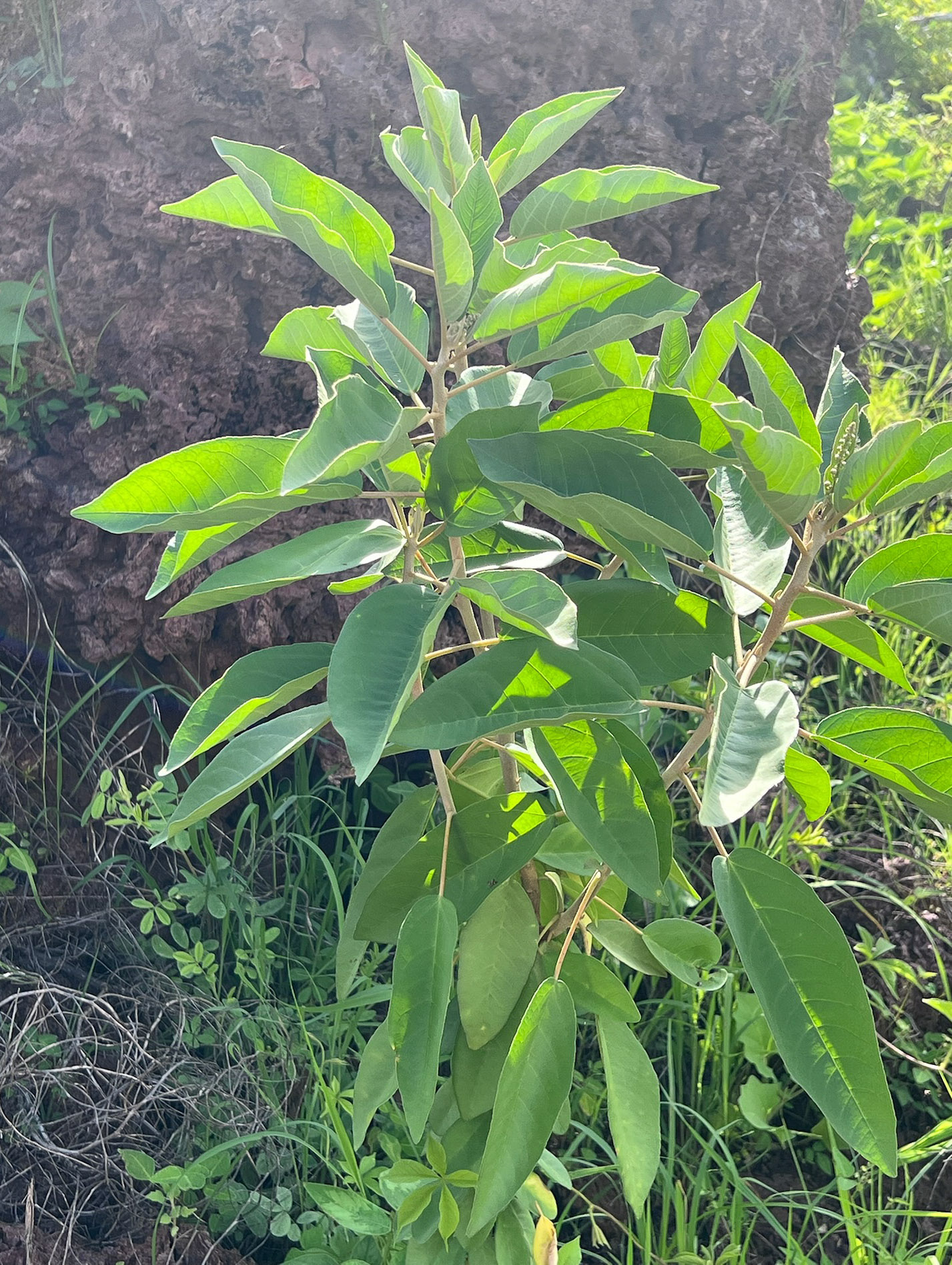
3/31/2025 · Rábida, Galápagos Islands, Ecuador · By Heather Kent 
| Kingdom | Plantae | Plants, but not fungi, lichens, or algae (from Stearn's Botanical Latin) |
| Subkingdom | Tracheobionta | Vascular plants—plants with a “circulatory system” for delivering water and nutrients |
| Division | Magnoliophyta | Flowering plants, also known as angiosperms |
| Class | Magnoliopsida | Dicotyledons—plants with two initial seed leaves |
| Subclass | Rosidae | Roses, legumes, proteas, dogwoods, hydrangeas, mistletoes, euphorbias, grapes, many more |
| Order | Malpighiales | A broad group encompassing 16,000 species |
| Family | Euphorbiaceae | Euphorbia or spurge family |
| Genus | Croton | From the Greek kroton, “a tick,” because of the way the seeds look in some members of the family |
| Species | scouleri | For botanist, minerologist, zoologist, and geologist John Scouler (1804-1871), who made extensive collections of plants in Canada, western North America, and the Galápagos |
Croton scouleri description by Thomas H. Kent, not updated.

© FloraFinder.org. All rights reserved.