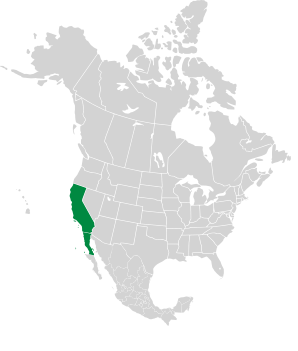
3–13′ (1–4 m) high, shrublike or treelike. Segments green or purple, 4–20″ (10–50 cm) long and ¾–1″ (2–3 cm) around. Spines are in groups of 6-20 or more, white to gray, tipped with yellow, ⅝–1¼″ (1.6–3.2 cm) long.
These multiply branched cacti are up to 6½′ (2 m) high, sometimes looking like trees, other times like shrubs. Each stem segment is 1½–7″ (4–18 cm) long and ⅜–¾″ (1–2 cm) in diameter, and greenish-purple to purple in color. The areoles from which the spines appear are tan to brown; spines are in groups of 6-8, ⅜–⅝″ (1–1.8 cm) long. The spines are yellow to golden in color, and so dense that they intermingle with each other, producing a golden (or silvery) fuzzy appearance that looks soft from a distance.
These cacti look more treelike, at up to 13′ (4 m), branching into irregular crowns. Stem segments are gray-green, eventually turning black, and spiny. The segments are 2–9″ (6–23 cm) long and ¾–1¼″ (2–3.5 cm) around. The areoles under each group of spines are triangular, with 0-18 spines per group. Spines are up to 1¼″ (3.5 cm) long. They are yellow, but get darker with age.
Flowers
Flowers may be yellow, pink, bronze, or brick red, and are ¾–1½″ (2–4 cm) long.
Usually yellowish green, but may be yellow, gold, bronze, red, rose, or magenta.
White and pink to magenta, streaked with lavender. They appear from April to September, opening in the afternoon.
Fruit
Fruits are green, then tan, spiny, and inconspicuous.
Wrinkled, leathery spineless fruits are yellowish green or reddish in color and less than ¾″ (2 cm) long.
Fruits form long chains like teardrops attached to each other; each fruit is fleshy, green, nearly spineless, ¾–2″ (2–5.5 cm) long.
Range/ Zones
USDA Zones: 9-11
USDA Zones: 8b-10b
Habitats
Grassland, scrubland, pinyon-juniper foothills up to 5000′ (1.5 km) elevation.
Deserts, between 100–300′ (30–91 m)
Scrubland, grassy hillsides, desert flats; up to 3,500 feet elevation.
Gander’s cholla is shrub-like, with many erect, upright branches. Plants can reach 5′ (1.5 m) in height. Stem segments are green, 1¾–10 ⨉ ⅝–1¾″ (5–26 ⨉ 1.7–4.5 cm), with prominent bumps. Each spine group contains 11-28 spines, each ¾–1¼″ (2–3.5 cm) long. Spines are white to yellow to tan to reddish, later darkening to brown to black, closely spaced enough to overlap each other.
Diamond cholla is multiply branched, resembling either a shrub or a small tree, and 1½–6½′ (50–200 cm) tall. Stem segments are ¾–4″ long ⨉ ⅛–⅜″ in diameter (2–10 cm ⨉ 4–10 mm). Unusually long spines ⅞–2″ (2.5–6 cm) long occur in groups of one to five. The spine groups are widely spaced, and the spines are tan to reddish brown or deep purple, finally becoming gray.
Low, compact, tangled shrubs, 1–6½′ (40–200 cm) high. Stem segments are rippled with oval tubercules, resembling heavy rope. Each segment is 1¾–9 ⨉ ½–1¼″ (5–23 ⨉ 1.3–3.5 cm) around, and green to purple in color. Glochids— clusters of easily detached spines—are yellow to tan to gray a 1/32–1/16″ (1–2 mm) long.
Flowers
Greenish-yellow, often with red tips, 1½–2″ (3.8–5 cm) around.
Pale yellow, orange, pink, or brown, tinged with red.
A range of colors: magenta, red, purplish, bronze-purple, yellow, or nearly white; they are up to 3″ (7.6 cm) around.
Fruit
Fruits resemble burrs, and are yellowish in color. They are dry and spiny.
Oval-shaped, tan, very spiny, and ½–1 ⨉ ⅜–½″ (1.5–3 ⨉ 1–1.5 cm).
Cylindrical, also covered with tubercules, yellow with purple, ¾–1¾″ (2–5 cm) long.
Range/ Zones
USDA Zones: 8a-11
USDA Zones: 8-11
Habitats
Many Sonoran desert habitats, and Anza-Borrego Desert State Park, at eleveations of 328–3281′ (100–1000 m).
Arid, sandy or stony areas, scrubland, often on volcanic soils; at up to 3500′ (1 km) elevation.
Forming low shrubs that may be upright or semi-prostrate, plants are less than 2½′ (80 cm) high. Stem segments are round, 1–4½″ long ⨉ ⅛–⅜″ (3–12 cm ⨉ 5–12 mm) in diameter, pale green or brownish green. The tubercules—raised bumps on the stem segments—are small and inconspicuous. The glochids, or groups of small, easily detached spines, are yellow to reddish brown, and 1/16–⅛″ (2–4 mm) long. Spines are sometimes present.
Tree- or shrublike, to 6½′ (2 m) tall. Stem segments greenish purple to purple, 1½–7″ (4–18 cm) × ⅜–¾″ (1–2 cm) around. Tubercules (ropy bumps on stems) are 3 to 5 times longer than they are wide. 7-10 spines per group, ¼–⅝″ (6.3–15 mm) long, reddish.
These heavily branched, shrublike plants reach 1½–5′ (50–150 cm) in height. Stems are segmented, yellowish green, with segments 2–16″ (6–40 cm) long and ⅞–1½″ (2.5–4 cm) around. Spines are yellowish to brown, darkening with age, in groups of 12-30, up to 1″ (3 cm) long.
Flowers
Yellow or yellowish-green. They appear from March to May.
Up to 3″ (7.6 cm) around. Yellowish green, yellow, bronze, red, rose, or magenta.
Yellowish green with tinges of bronze, to purplish brown. (Thanks to Joanne Schwartz for correcting an error in my reporting of flower color.)
Fruit
Cylindrical, ½–⅞″ (1.5–2.5 cm) long and ¼–½″ (8–15 mm) around, tan, and dry. They do not have spines.
Yellow-green to red-purple, forming chains. Fruits are fleshy, with few or no spines, ¾–1½ ⨉ ⅜–¾″ (2–4 ⨉ 1–2 cm).
Grayish fruits are bumpy, and densely covered with spines, about 1″ (3 cm) long and 1″ (3 cm) in diameter.
Range/ Zones
Habitats
Gravelly flats, sandy areas, alluvial fans in dry scrubland, at elevations below 2600′ (792 m).
Desert scrub, flats, washes, rocky hillsides, and canyons, at elevations of 1969–4265′ (600–1300 m).
Shrubs are up to 5′ (1.5 m) tall, and densely branched, resembling other teddy bear chollas but with a distinct reddish or pinkish tinge. Branch segments are 6–12″ (15–30 cm) long. Branch tips are 4–8″ (10–20 cm) long and dark blue-green in color. Tubercules are up to ¾ ⨉ ⅜″ (2 ⨉ 1 cm). Spines are in groups of 3-5, red-brown, with pale tips, up to 1¼″ (3.7 cm) long. There are also finer, shorter radial spines, angled so they lie close to the stem, and covered in gray sheaths. Branch tips break off easily, rooting on the ground or attaching themselves stubbornly to your shoe.
Flowers
Flowers mostly appear on spine-bearing bumps (areoles) near tips of upper branches. Their tepals are pale green to whitish, sometimes tipped with red, ¾–⅞″ (2–2.5 cm) in size. Flower centers contain orange anthers, a light green style, and a light- to dark-green stigma.
Fruit
Leathery, green to yellow-green to yellow when mature, ⅛ ⨉ 1/16″ (5 ⨉ 2.5 mm), roughly lens-shaped, usually with a few fine spines. They have many tubercules.
Habitats
California, Arizona, and Nevada, in the Mojave and Sonoran deserts; at elevations of 984–2953′ (300–900 m).
Cylindropuntia description by Thomas H. Kent, not updated.