Eucalyptus deglupta Blume
Rainbow eucalyptus, Mindano gum, rainbow gum, Indonesian gum
The genus Eucalyptus was described and named in 1788 by the French botanist l’Héritier. Rainbow eucalpytus is a native of Indonesia, Papua New Guinea, and the Phillippines. In North America, it is naturalized only in Hawaii. It is the only eucalyptus (of 700) found naturally in the northern hemisphere.
Plants: This species of eucalyptus can reach as much as 250′ (76 m) in height. This is the most stunning and unique tree trunk that I have ever seen. The common name “rainbow eucalyptus” comes from its smooth, orange-tinted bark, which peels naturally, revealing pale yellow, orange, brown, blue, red, or purple, as well as bright green. No other tree shows such unique coloration in the trunk. (When grown outside of their native tropical habitats, the colors are less dramatic.) Rainbow eucalyptus is planted as an ornamental tree, for its impressive bark, and also forested for timber and ornamental wood. Twigs are squarish in cross-section, often narrowly winged in the corners.
Leaves: Opposite, lanceolate, aromatic, 3–6 ⨉ 1¾–3″ (7.5–15 ⨉ 5–7.5 cm).
Flowers: Inflorescences are comprised of panicles of seven-flowered umbels. Individual flowers are white, and tiny.
Fruits: A woody, brown, hemispherical capsule 1/16–3/16″ (3–5 mm) in size, with 3 or 4 valves, containing 3-12 brown seeds.
Habitats: Requires bright light; often found along rivers, especially on disturbed soil such as volcanic soil; prefers high rainfall areas; at elevations under 1.0 mi (1.6 km).
Online References:

2/26/2010 · San Diego Zoo, San Diego, California 

4/10/2015 · Naples Botanical Garden, Naples, Florida 

3/4/2001 · Haleakula, Maui, Hawaii 

11/16/2018 · Puerto Rico · By Heather A. Kent 
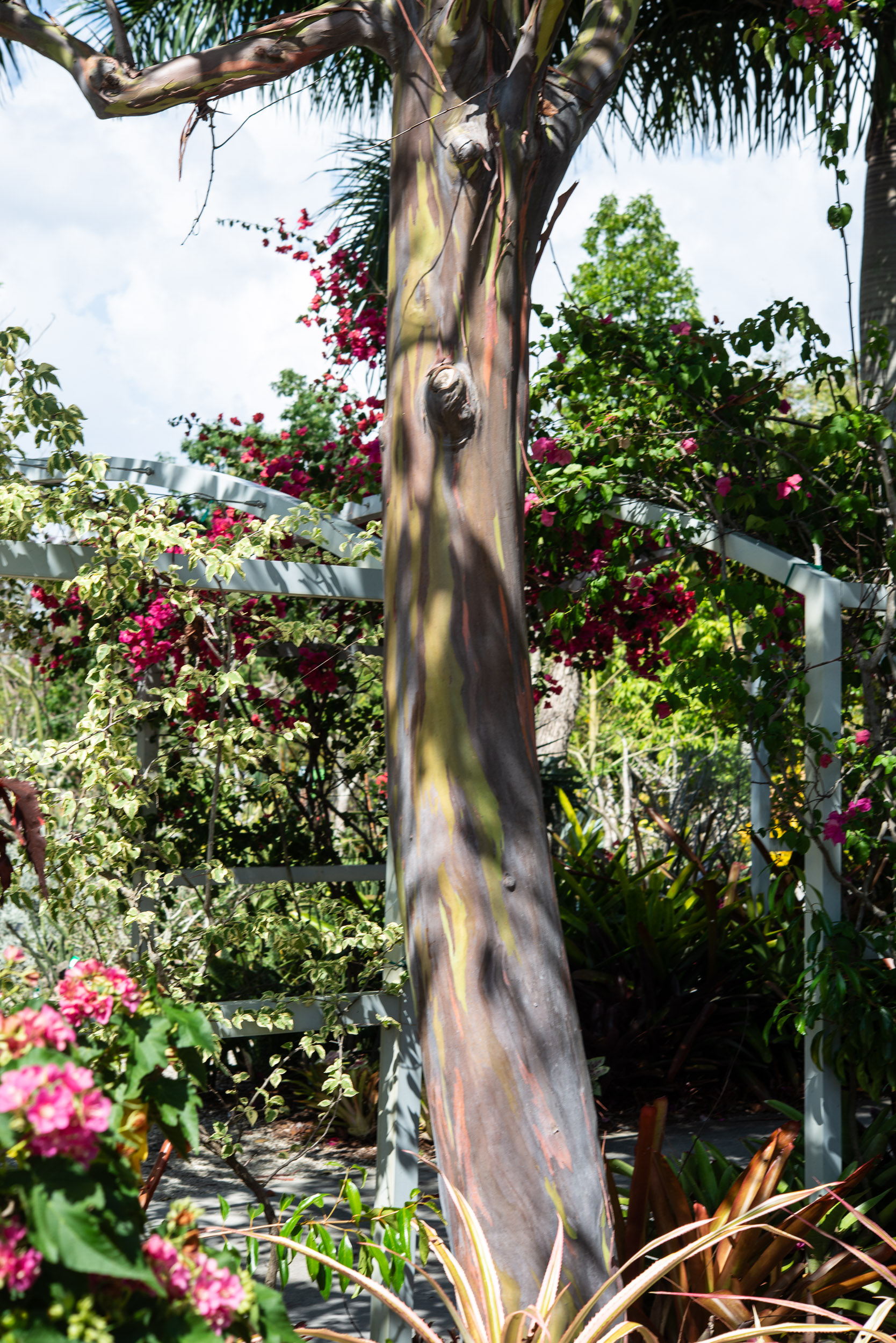
4/10/2015 · Naples Botanical Garden, Naples, Florida 

4/10/2015 · Naples Botanical Garden, Naples, Florida 

11/16/2018 · Puerto Rico · By Heather A. Kent 

11/16/2018 · Puerto Rico · By Heather A. Kent 

4/10/2015 · Naples Botanical Garden, Naples, Florida 

2/26/2010 · San Diego Zoo, San Diego, California · ≈ 4½ × 7′ (1.5 × 2.2 m) 
| Kingdom | Plantae | Plants, but not fungi, lichens, or algae (from Stearn's Botanical Latin) |
| Subkingdom | Tracheobionta | Vascular plants—plants with a “circulatory system” for delivering water and nutrients |
| Division | Magnoliophyta | Flowering plants, also known as angiosperms |
| Class | Magnoliopsida | Dicotyledons—plants with two initial seed leaves |
| Subclass | Rosidae | Roses, legumes, proteas, dogwoods, hydrangeas, mistletoes, euphorbias, grapes, many more |
| Order | Myrtales | Includes myrtles, leadwoods, loosestrifes, pomegranates, evening primroses, many others |
| Family | Myrtaceae | Myrtle family, include myrtle, clove, guava, feijoa, allspice, and eucalyptus |
| Genus | Eucalyptus | From the Greek ευ, “well,” and καλυπτος (kalyptos), “covered,” for the covering that encloses the flower |
| Species | deglupta | From Latin deglupta, “peeled off, husked or shelled.” |

Eucalyptus deglupta description by Thomas H. Kent, not updated.

© FloraFinder.org. All rights reserved.