Euphorbia coerulescens
Sweet noor, blue euphorbia, blue noors
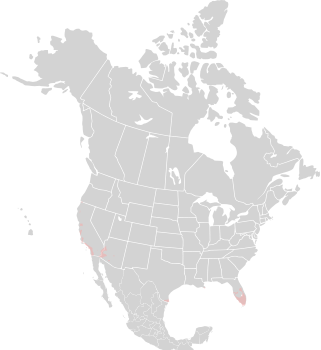
Sweet noor is native to the Cape Province in South Africa. It is not found in North America, though it is cultivated as a house plant. “Noor” is for the Noorsveld desert in Cape Province, where it is most abundant.
Plants: Succulent, multiply-branched shrubs are up to 5′ (1.5 m) in size. Branches are cactus-like, four- to six-angled, with constrictions every 1½–3″ (4–8 cm). They are up to 1¾″ (5 cm) in diameter. Raised edges on branches are lined with spines in pairs. The spine pairs are characteristic of spiny euphorbias. Each spine is up to ⅜″ (1.2 cm) long. Branches are typically blue-gray in color—hence the species epithet meaning cerulean—but they may also been green or yellowish green.
Leaves: Essentially leafless, but some plants develop small temporary leaflets at the apical tips.
Flowers: Yellow cyathia have both male and female flowers. They appear on stem tips. There are no petals or sepals, just a cuplike involucre.
Fruits: Pink, three-lobed capsules.
Habitats: Stony mostly northern slopes and flats among arid scrub and larger bushes from Calitzdorp to Klipplaat and Jansenville, South Africa.
Edibility: Poisonous  Ingestion is toxic, and the
sap can cause a contact dermatitis.
 |
Similar euphorbias |
Online References:
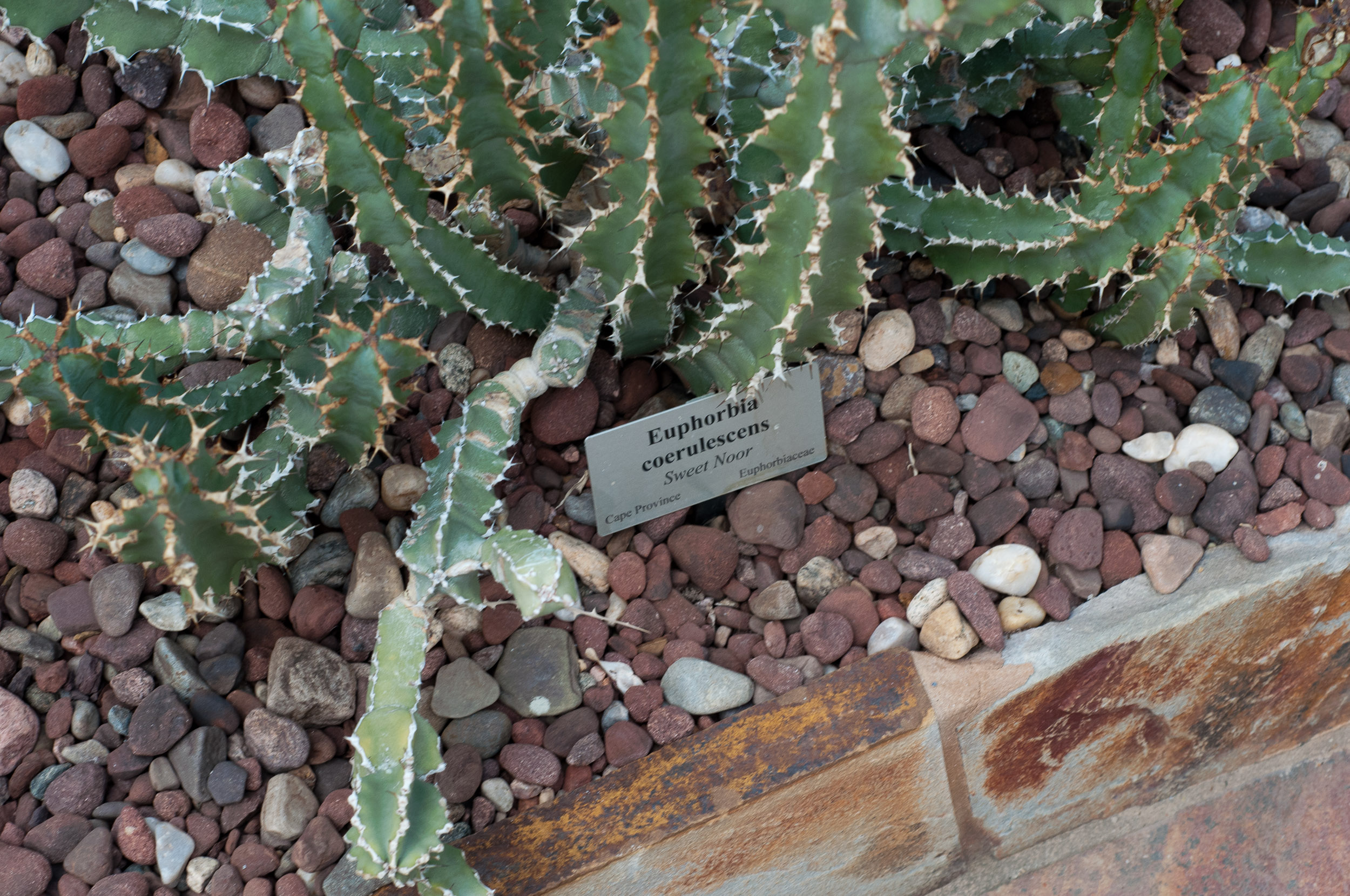
4/6/2011 · Howard Peters Rawlings Conservatory & Botanic Gardens, Druid Hill Park, Baltimore, Maryland · ≈ 2 × 1′ (62 × 41 cm) 

4/6/2011 · Howard Peters Rawlings Conservatory & Botanic Gardens, Druid Hill Park, Baltimore, Maryland · ≈ 1 × 1½′ (34 × 52 cm) 

4/6/2011 · Howard Peters Rawlings Conservatory & Botanic Gardens, Druid Hill Park, Baltimore, Maryland · ≈ 1 × 2′ (41 × 62 cm) 
| Kingdom | Plantae | Plants, but not fungi, lichens, or algae (from Stearn's Botanical Latin) |
| Subkingdom | Tracheobionta | Vascular plants—plants with a “circulatory system” for delivering water and nutrients |
| Division | Magnoliophyta | Flowering plants, also known as angiosperms |
| Class | Magnoliopsida | Dicotyledons—plants with two initial seed leaves |
| Subclass | Rosidae | Roses, legumes, proteas, dogwoods, hydrangeas, mistletoes, euphorbias, grapes, many more |
| Order | Malpighiales | A broad group encompassing 16,000 species |
| Family | Euphorbiaceae | Euphorbia or spurge family |
| Genus | Euphorbia | An extremely diverse-looking genus of mostly tropical and subtropical succulent plants. For Euphorbus, corpulent Greek physician of Juba II, King of Mauretania. Literally, “euphorbia” means “well-fed” |
| Species | coerulescens | Bluish, becoming blue |
Euphorbia coerulescens description by Thomas H. Kent, not updated.

© FloraFinder.org. All rights reserved.