Fomitopsis betulina (Bull.) B.K.Cui
Birch polypore, razor strop
The birch polypore is native to temperate regions worldwide. Its habitat is birch trees, especially white birch. They are tougher than they look: barbers once sharpened their razors on leathery strips cut from these mushrooms.
Fruits: These bracket fungi extend from the sides of dead or dying birches. (This is kind of amazing, since the bark of white birches is so durable that an entire downed tree rots before the bark degrades.) The fruits are whitish or gray-brown on top and cream-colored below, and kidney-shaped. As they mature, they become flatter and browner on top, and tan beneath. Undersides are dense clusters of pores 1/32–⅛″ (1.5–5 mm) deep. The fruits have a strong pleasant mushroomy odor.
Habitats: Weakened or dead birch trees, where it bursts through the bark.
Spores: Spores are cylindrical to ellipsoidal, smooth, and 3-6 µm × 1.3-2 µm. Spore prints are white.
Edibility: Tough and bitter, these are technically edible but not desirable.
Medical: The antibiotic piptamine is obtained from this fungus. Piptamine shows antimicrobial activity against some Gram positive bacteria, yeasts (Candida albicans) and fungi. They are a natural astringent, used to help stop bleeding.
Online References:

On gray birch. · 4/14/2013 · Bemis Rd, Pepperell, Massachusetts · ≈ 5 × 3½″ (13 × 9.2 cm) 

On gray birch. · 4/14/2013 · Bemis Rd, Pepperell, Massachusetts · ≈ 4½ × 3½″ (11 × 9.2 cm) 

On gray birch. · 4/14/2013 · Bemis Rd, Pepperell, Massachusetts · ≈ 4½ × 3″ (11 × 7.9 cm) 

1/5/2026 · Gordon and Kathy’s, Prospect, Maine 

9/27/2013 · Gordon and Kathy’s, Prospect, Maine · ≈ 7 × 6″ (17 × 14 cm) 

12/9/2011 · Nashua River Rail Trail, Groton Center, Groton, Massachusetts · ≈ 7 × 6″ (17 × 14 cm) 

9/17/2014 · Beaver Brook Conservation Area, Hollis, New Hampshire · ≈ 15 × 10″ (37 × 25 cm) 

3/21/2012 · Nashua River Rail Trail, Groton Center, Groton, Massachusetts · ≈ 10 × 7″ (25 × 18 cm) 

9/27/2013 · Gordon and Kathy’s, Prospect, Maine · ≈ 9 × 6″ (22 × 15 cm) 
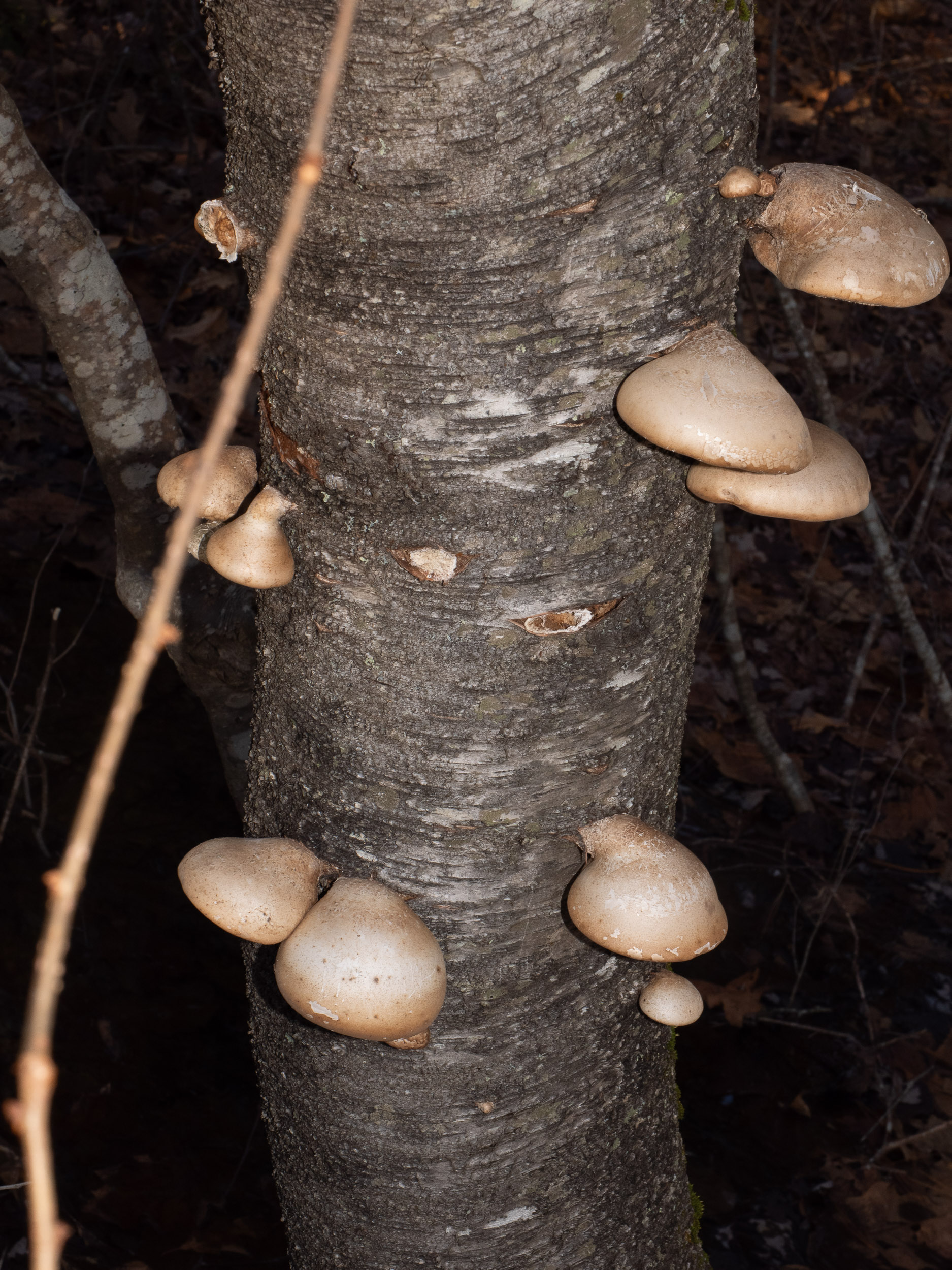
1/2/2024 · Bald Head Preserve, Arrowsic, Maine 

11/24/2024 · Elmwood Trail, Pownal, Maine 

9/29/2012 · Franconia Falls Trail, Franconia Notch, New Hampshire · ≈ 4½ × 6″ (11 × 14 cm) 
| Roughly 75 people in North America are poisoned each year by mushrooms, often from eating a poisonous species that resembles an edible species. Though deaths are rare, there is no cure short of a liver transplant for severe poisoning. Don’t eat any mushroom unless you are absolutely certain of its identity! Please don’t trust the identifications on this site. We aren’t mushroom experts and we haven’t focused on safely identifying edible species. |
Fomitopsis betulina description by Thomas H. Kent, not updated.

© FloraFinder.org. All rights reserved.