Gossypium hirsutum L.
Cotton, upland cotton
This variety of cotton is native to Mexico, the West Indies, northern South America, Central America, and maybe southern Florida. It may have originated in the Tehuacan Valley in Mexico. It is by far the most popular species of cotton used for commerical cotton production in the United States—many cultivars have been created from it.
Plants: Annual subshrubs, up to 5′ (1.5 m) tall. Some branches fruit, while others do not.
Leaves: Alternate, on petioles (leaf stems), cordate (heart-shaped), up to 3–6″ (7.5–15 cm) in width, somewhat wider than long, divided into 3-5 lobes, with smooth edges.
Flowers: Flowers are white to yellowish, 5-petaled, and up to 3½″ (8.9 cm) across, occurring singly or in groups of 6-8. Some have a prominent maroon spot at the base of each petal. Some are pink (cultivars?). All have a large number of stamens, around 100, in the center. The flower shape is reminiscent of wild roses.
Fruits: Cotton balls are fibrous trichomes surrounding seed capsules. Trichomes, from the Greek τρίχωμα (trikhōma) meaning “hair”, are fine outgrowths or appendages. The tufts are 1–1¾″ (3–5 cm) around. The seed capsule within has 3-5 cells. It is globose to broadly ovoid, beaked, ⅞–1¼″ (2.5–3.5 cm) long, white to reddish brown, and smooth. Each cell contains 5-11 seeds.
Habitats: Cotton has been cultivated for so long that its natural habitats are not documented.
Edibility: Poisonous  Gossypol, found in seeds and seedlings,
must be removed before cottonseed can be fed to animals.
Gossypol, found in seeds and seedlings,
must be removed before cottonseed can be fed to animals.
Online References:

9/1/2013 · Colonial Williamsburg, Williamsburg, Virginia · ≈ 4 × 7″ (11 × 16 cm) 

9/1/2013 · Colonial Williamsburg, Williamsburg, Virginia · ≈ 4 × 3″ (11 × 8.5 cm) 

9/1/2013 · Colonial Williamsburg, Williamsburg, Virginia · ≈ 9 × 6″ (22 × 15 cm) 

7/13/2008 · By Jacquelyn Boyt 

9/1/2013 · Colonial Williamsburg, Williamsburg, Virginia · ≈ 10 × 8″ (26 × 21 cm) 
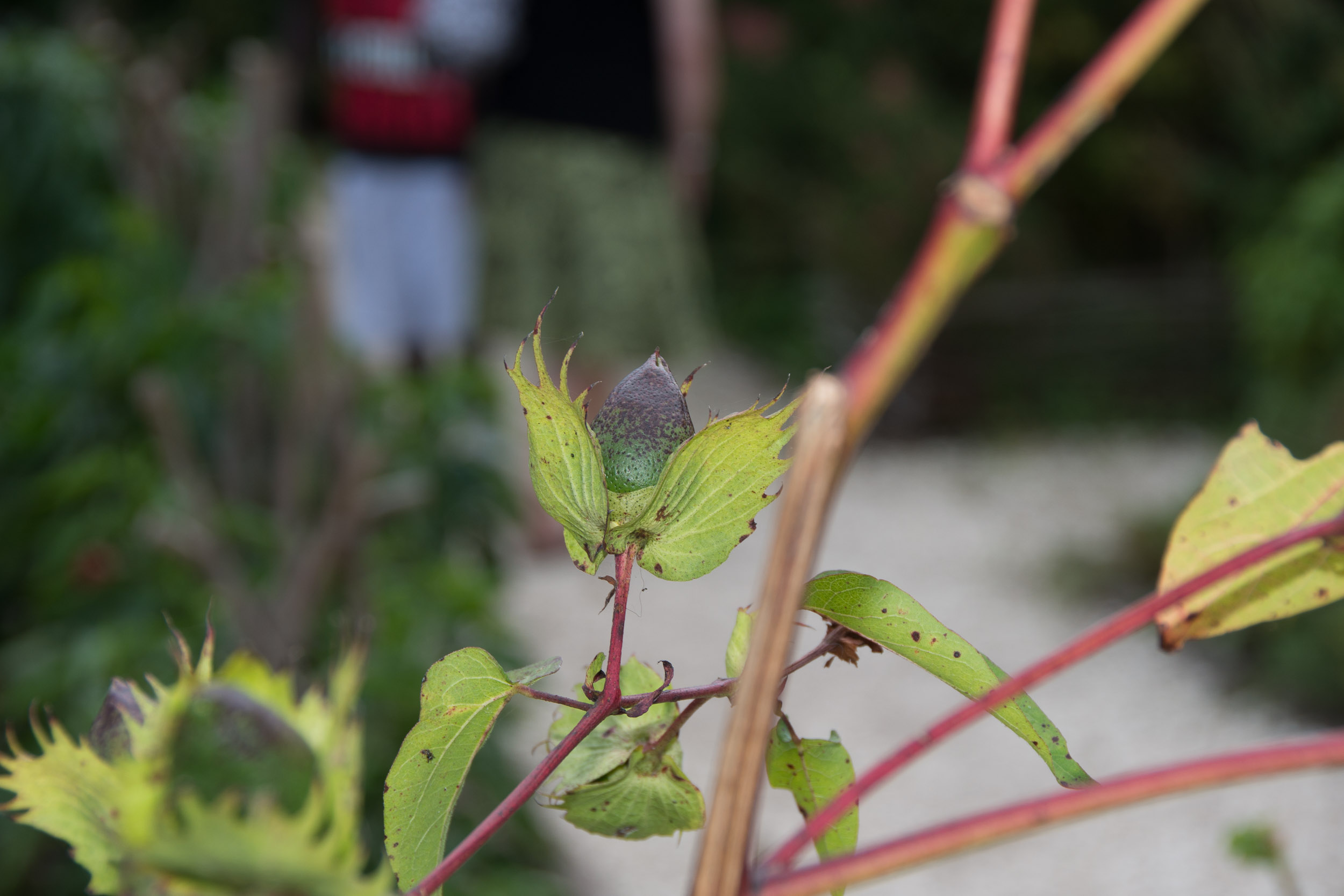
9/1/2013 · Colonial Williamsburg, Williamsburg, Virginia · ≈ 16 × 10″ (39 × 26 cm) 

9/1/2013 · Colonial Williamsburg, Williamsburg, Virginia · ≈ 10 × 8″ (25 × 19 cm) 

7/13/2008 · By Jacquelyn Boyt 
| Kingdom | Plantae | Plants, but not fungi, lichens, or algae (from Stearn's Botanical Latin) |
| Subkingdom | Tracheobionta | Vascular plants—plants with a “circulatory system” for delivering water and nutrients |
| Division | Magnoliophyta | Flowering plants, also known as angiosperms |
| Class | Magnoliopsida | Dicotyledons—plants with two initial seed leaves |
| Subclass | Rosidae | Roses, legumes, proteas, dogwoods, hydrangeas, mistletoes, euphorbias, grapes, many more |
| Order | Malvales | Includes cacao, balsa, lime, linden, basswood, daphnes, hibiscus, hollyhocks, okra, baobab, cotton, kapok, and many others |
| Family | Malvaceae | Includes okra, jute, cacao, hibiscus, many others |
| Genus | Gossypium | From Latin names used by Pliny for the cotton tree |
| Species | hirsutum | Hairy |

Gossypium hirsutum description by Thomas H. Kent, not updated.

© FloraFinder.org. All rights reserved.