Grona adscendens
Ascending grape
Ascending grape is native to dry tropical regions, including Amazonia, the Caribbean and Pacific islands, the Galápagos, tropical Africa, and Central America.
Plants: Lianas (climbing shrubs) are up to 3′ (1 m) in size, with terete (smooth and cylindrical) stems that creep or form tussocks.
Leaves: In groups of three. Leaf bases have stipules that are ovate-lanceolate in shape, with pointed apexes, ⅛–⅜″ long ⨉ 1/32–⅛″ wide (5–10 ⨉ 1.5–3 mm). Leaf petioles are ⅜–1″ (1–3 cm) long. Leaflets are elliptic-obovate, cuneate to rounded at base, hairless or pilose (covered with fine soft hairs) on the upper surface, and densely pilose on the lower. The terminal leaflet is ⅝–1½″ long ⨉ ¼–1¼″ wide (1.7–4.3 cm ⨉ 7–32 mm). Lateral leaflets are ½–1″ long ⨉ ¼–¾″ wide (1.3–3 cm ⨉ 7–20 mm).
Flowers: Racemes are axillary (from leaf axils) and terminal. Each flower has a whitish, greenish-blue, pink or mauve obovate main petal (the “standard“), bright pinkish-mauve wings, and a greenish-white keel.
Fruits: ¾–⅞″ (2–2.5 cm) long, with 2-5 segments. They are semi-elliptic, and joined by narrow necks and covered with short hooked hairs. Seeds are 1/16–⅛″ long ⨉ 1/32″ wide (2.5–5 ⨉ 1.5 mm).
Habitats: Forests and woodlands, savannas, shrublands, native grasslands, and inland wetlands, at elevations up to 1.6 mi (2.6 km).
Medical: Ascending grape has a rich history of medicinal use in tropical America. It is still commonly used to treat a wide range of conditions, especially in the treatment of asthma and allergies, and for the relief of muscle spasms and back pain.
Online References:
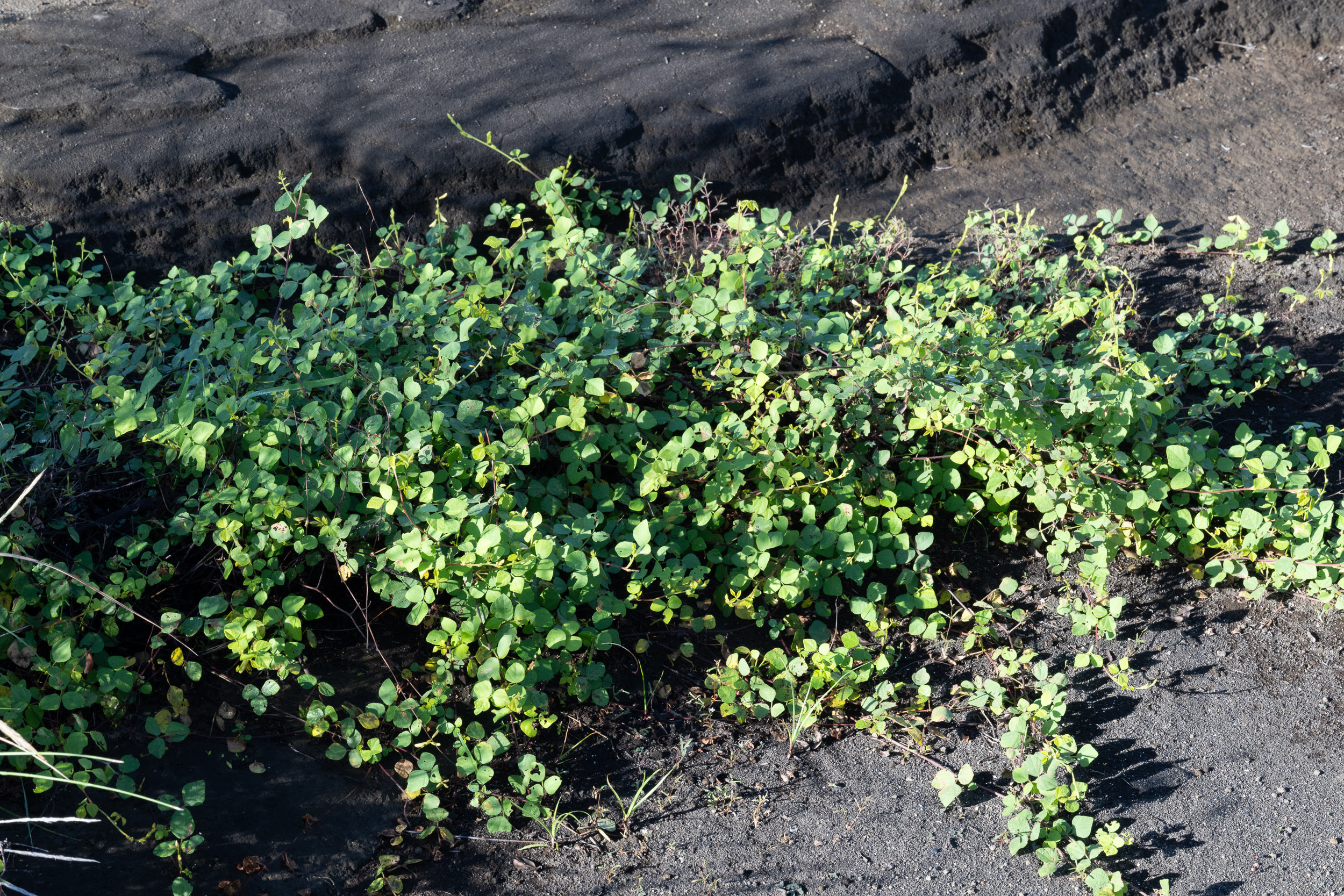
3/31/2025 · Puerto Egas, Santiago, Galápagos Islands, Ecuador 
| Parents | Unknown | Genus is not in the current taxonomy |
| Genus | Grona | From Greek grónos, “hollow” or “eaten out” |
| Species | adscendens | From Latin adscendere, “ascending, climbing,” or “rising” |
Grona adscendens description by Thomas H. Kent, not updated.

© FloraFinder.org. All rights reserved.