Heliotropium curassavicum L.
Seaside heliotrope, scorpion weed, monkey tail, quail plant, Chinese parsley, salt heliotrope
Salt heliotrope is widespread in North and South America.
Plants: Usually this shrub is prostrate, forming mats, but it can be more erect, up to 1½′ (50 cm) in height. Stems and leaves are fleshy, retaining water.
Leaves: Alternate, simple, ellliptic or oblanceolate, somewhat fleshy, with smooth surfaces.
Flowers: Curled, coiling double rows of small bell-shaped white flowers are up to 4–6″ (10–15 cm) long. Each flower is white, with a yellow throat that turns purple with age. It has five lobes and five stamens.
Fruits: Four nutlets, each ~1/16″ (2–2.5 mm) across, containing a single seed.
Habitats: Coastal, saline soils: beach sand, alkali flats, and salt marshes.
 |
Similar species. |
Online References:
References:
McMullen, Conley K., Flowering Plants of the Galápagos, Comstock Publishing Associates, 1999, p. 181
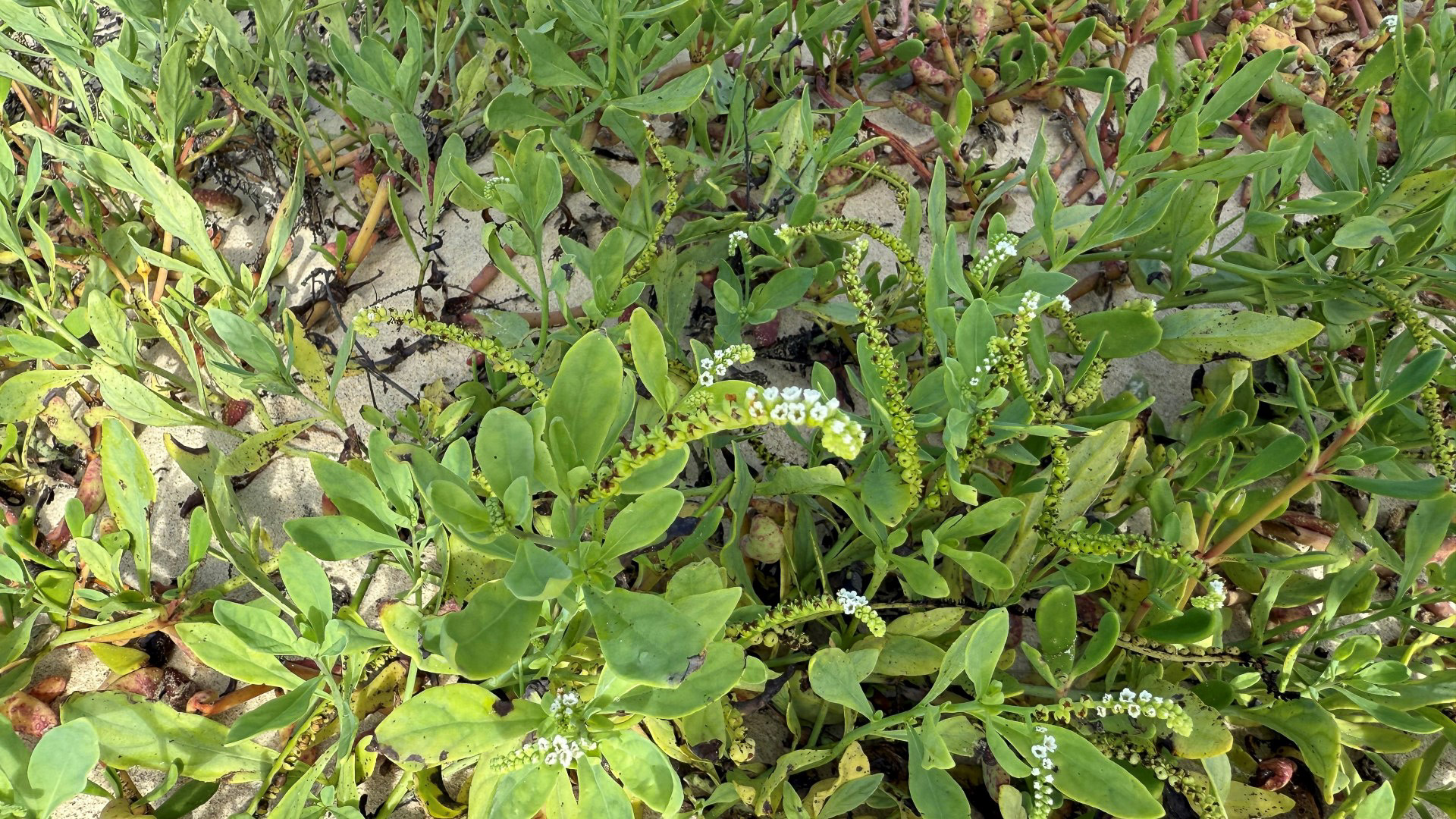
These are Heliotropium curassavicum var. curassavicum · 4/3/2025 · Cruise Line Photos, Galápagos Islands, Ecuador 

These are Heliotropium curassavicum var. curassavicum · 4/3/2025 · Cruise Line Photos, Galápagos Islands, Ecuador 
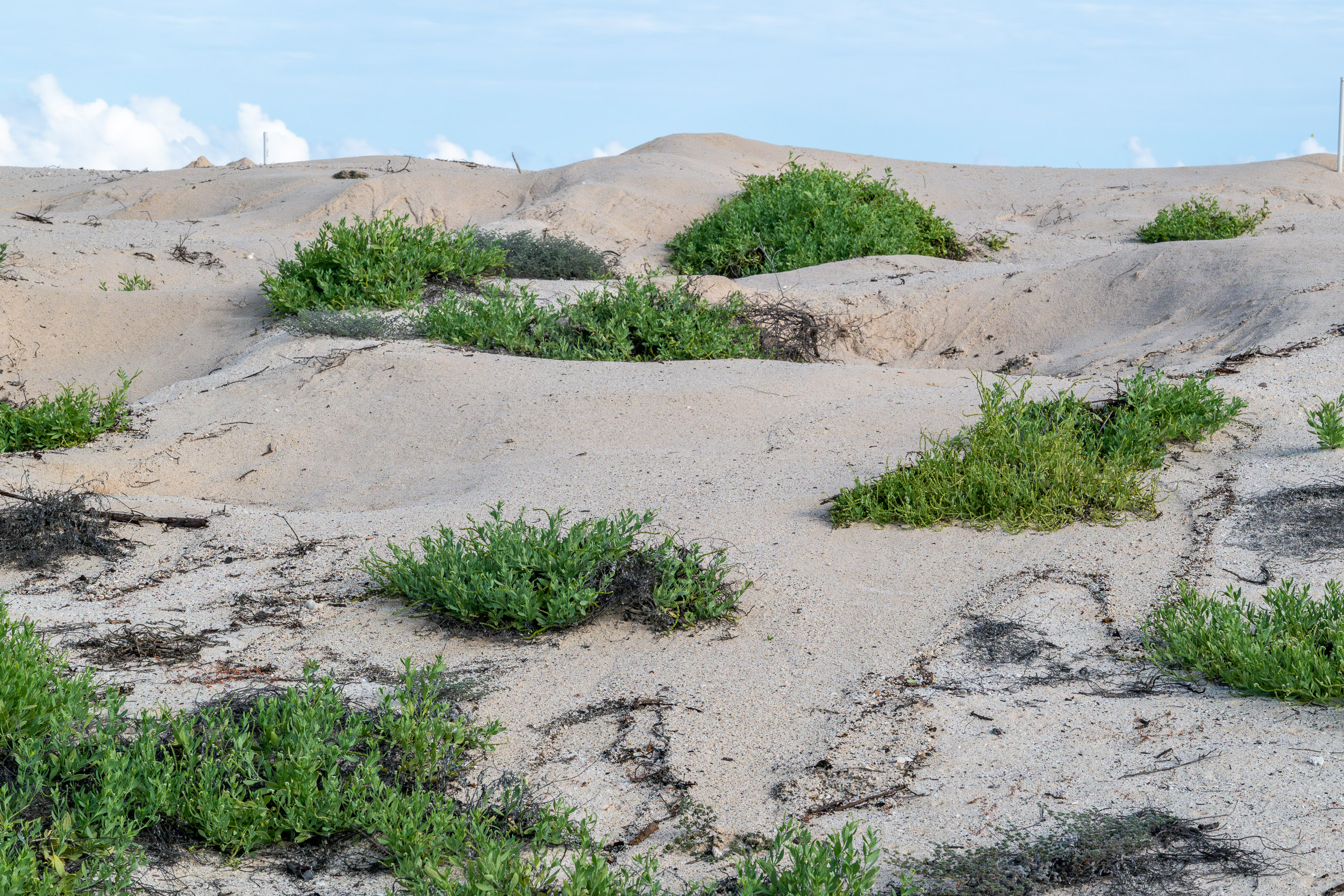
4/3/2025 · Las Bachas Beach, Santa Cruz, Galápagos Islands, Ecuador 
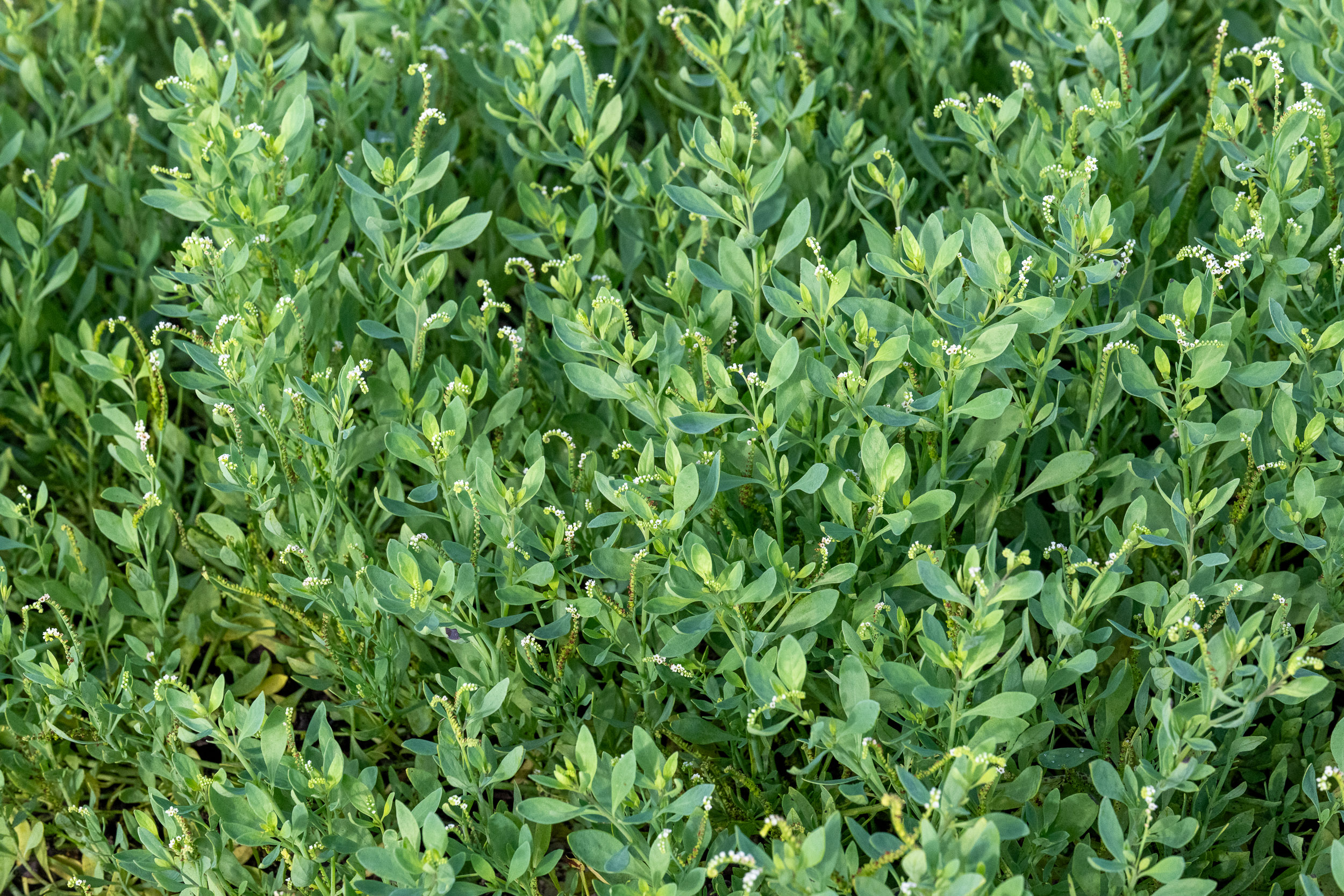
4/3/2025 · Las Bachas Beach, Santa Cruz, Galápagos Islands, Ecuador · ≈ 2 × 1′ (57 × 38 cm) 
| Kingdom | Plantae | Plants, but not fungi, lichens, or algae (from Stearn's Botanical Latin) |
| Subkingdom | Tracheobionta | Vascular plants—plants with a “circulatory system” for delivering water and nutrients |
| Division | Magnoliophyta | Flowering plants, also known as angiosperms |
| Class | Magnoliopsida | Dicotyledons—plants with two initial seed leaves |
| Subclass | Asteridae | A large class that encompasses asters |
| Order | Lamiales | Aromatic herbs and shrubs, including lavender, lilac, olive, jasmine, ash, teak, snapdragon, sesame, psyllium, garden sage, mint, basil, and rosemary |
| Family | Boraginaceae | Borages or forget-me-nots |
| Genus | Heliotropium | From the Greek helios, “sun,” and trope, “turning,” thus meaning “sun-turning,” either a reference to the summer solstice when the first described species bloomed, or to the turning of flowers toward the sun, a characteristic of many species known as heliotropism |
| Species | curassavicum | The -ica suffix indicates that this is a place name from Curacao, an island in the Dutch West Indies where one of the first collections was made |

Heliotropium curassavicum description by Thomas H. Kent, not updated.

© FloraFinder.org. All rights reserved.