Ipomoea nil ‘Tie Dye’
Morning glory
Natural morning glories are North American natives, but this cultivar is not found in the wild.
Plants: These perennial vines reach 12′ (3.7 m) in length. Stems have fuzzy hairs.
Leaves: Heart-shaped.
Flowers: Trumpet-shaped, pink, purple, or blue, up to 6″ (15 cm) around, with uneven colored stripes radiating from the center.
Fruits: ?
Edibility: Poisonous  Seeds and plants are poisonous when
ingested.
Seeds and plants are poisonous when
ingested.
Online References:
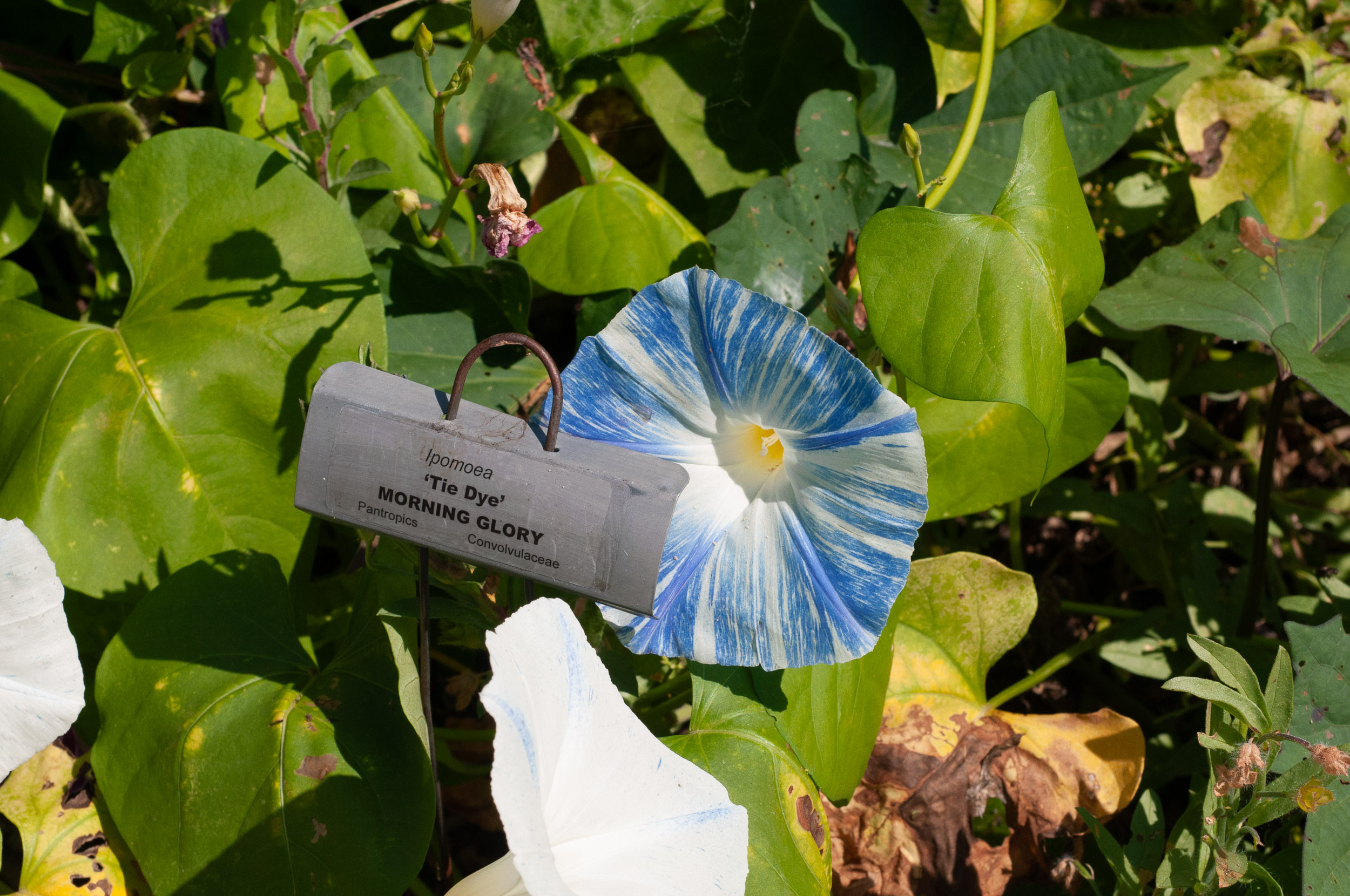
9/7/2010 · New England Botanic Garden at Tower Hill, Boylston, Massachusetts · ≈ 14 × 9″ (35 × 23 cm) 

9/7/2010 · New England Botanic Garden at Tower Hill, Boylston, Massachusetts · ≈ 12 × 8″ (31 × 20 cm) 
| Kingdom | Plantae | Plants, but not fungi, lichens, or algae (from Stearn's Botanical Latin) |
| Subkingdom | Tracheobionta | Vascular plants—plants with a “circulatory system” for delivering water and nutrients |
| Division | Magnoliophyta | Flowering plants, also known as angiosperms |
| Class | Magnoliopsida | Dicotyledons—plants with two initial seed leaves |
| Subclass | Asteridae | A large class that encompasses asters |
| Order | Solanales | Potatoes, eggplants, tomatoes, peppers, tobacco, petunias, sweet potatoes, morning glories, many others |
| Family | Convolvulaceae | Bindweed or morning glory family |
| Genus | Ipomoea | From Greek ips, “a worm,” and homoios, “like,” because of the twining vine |
| Species | nil | Possibly referring to the Nile? I have also read that it is an Arabic name for a species of morning glory |
Ipomoea nil ‘Tie Dye’ description by Thomas H. Kent, not updated.

© FloraFinder.org. All rights reserved.