Ipomoea pes-caprae (L.) R. Br.
Railroad vine, bayhops, beach morning glory, goat’s foot
Beach morning glory is an evergreen perennial, a common resident in coastal tropical and subtropical beaches worldwide.
Plants: Stems creep across the ground, rooting at nodes and producing numerous branches up to 12″ (30 cm) high, and 1/16–⅛″ (3–4 mm) in diameter. Plants can sprawl over 100′ (30 m).
Leaves: Alternate, smooth-edged, dark green, waxy, and smooth. Leaves are variable in shape, but typically ovate, orbicular, or oblong, and 2½–4″ (6.3–10 cm) long. Leaf stalks (petioles) are ¾–6″ (2–15 cm) long, and reddish to yellowish-green.
Flowers: Pinkish lavender funnel-shaped flowers 2½–3″ (6.4–7.6 cm) wide bloom throughout the summer and fall. A rare Hawaiian form of this flower is white.
Fruits: Spherical to somewhat flattened, ½–¾″ (1.3–1.9 cm) in size. Seeds are three-sided, covered with dense hairs, and ½–⅞″ (1.5–2.5 cm) long. Seeds float on ocean water, and are not harmed by it, so they spread easily.
Habitats: Coastal tropical and subtropical beaches worldwide.
Medical: These plants produce a wide variety of phytochemicals—chemicals that play a role in defending the plant from pathogens. They are often used in traditional medicine to treat human ailments, and are under active investigation today.
Online References:
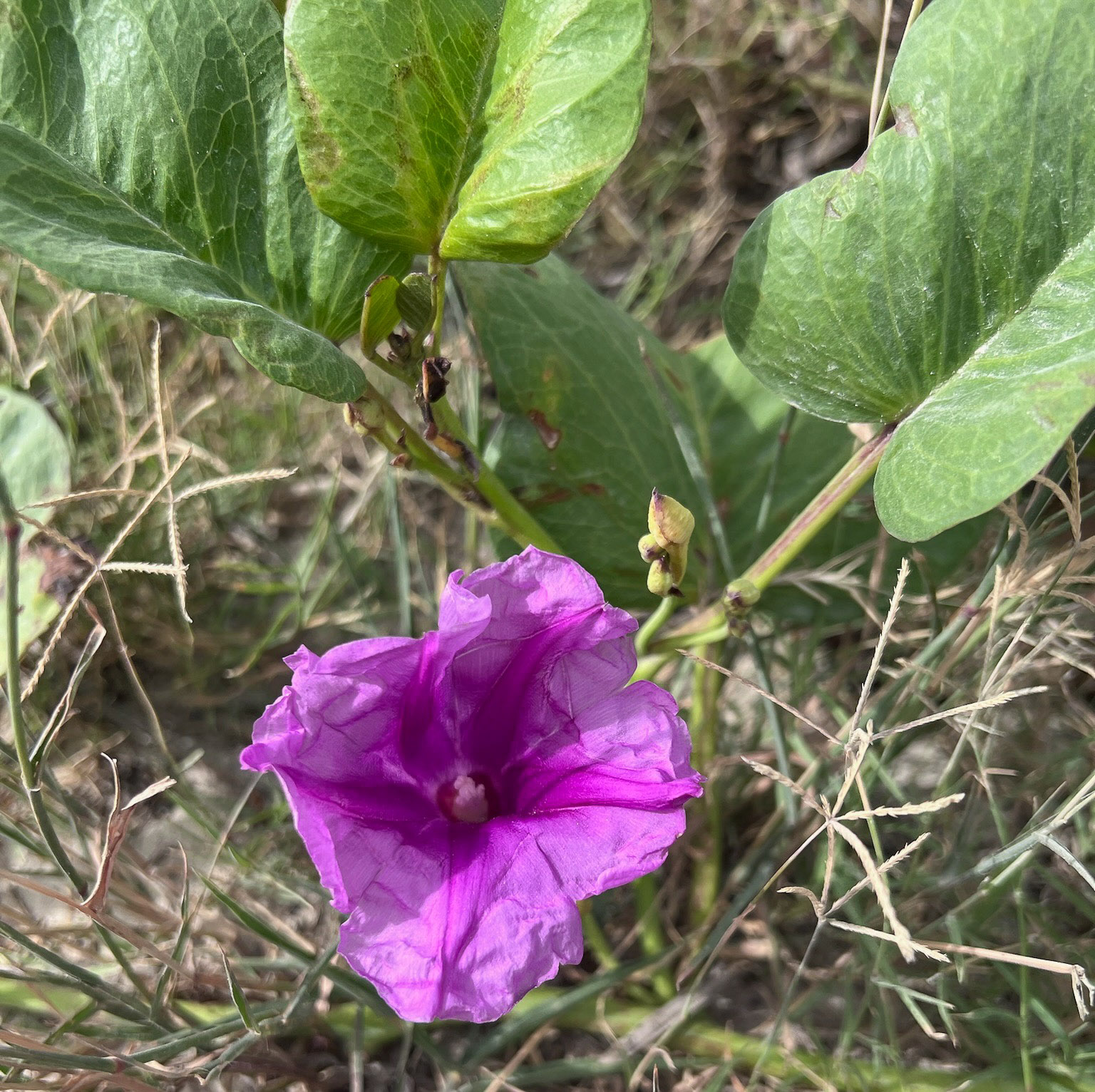
6/7/2024 · Saint Marten, Leeward Islands · By Heather A. Kent 
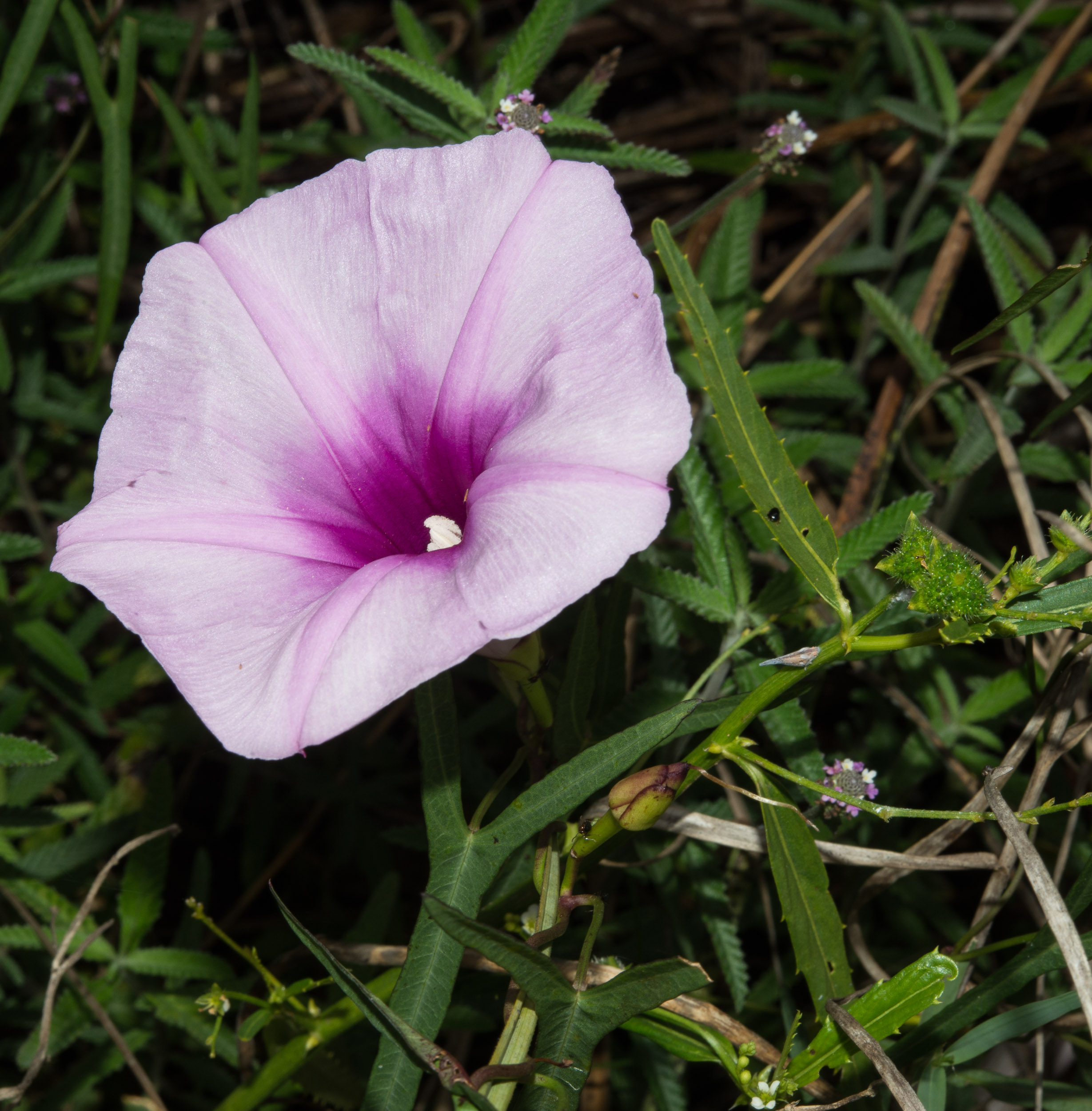
4/12/2015 · Shark Valley, Everglades National Park, Florida · ≈ 6 × 6″ (16 × 16 cm) 
| Kingdom | Plantae | Plants, but not fungi, lichens, or algae (from Stearn's Botanical Latin) |
| Subkingdom | Tracheobionta | Vascular plants—plants with a “circulatory system” for delivering water and nutrients |
| Division | Magnoliophyta | Flowering plants, also known as angiosperms |
| Class | Magnoliopsida | Dicotyledons—plants with two initial seed leaves |
| Subclass | Asteridae | A large class that encompasses asters |
| Order | Solanales | Potatoes, eggplants, tomatoes, peppers, tobacco, petunias, sweet potatoes, morning glories, many others |
| Family | Convolvulaceae | Bindweed or morning glory family |
| Genus | Ipomoea | From Greek ips, “a worm,” and homoios, “like,” because of the twining vine |
| Species | pes-caprae | Means “foot of the goat,” alluding to the shape of the leaflet |

Ipomoea pes-caprae description by Thomas H. Kent, not updated.

© FloraFinder.org. All rights reserved.