Menyanthes trifoliata L.
Buckbean, bog bean, marsh trefoil
Buckbean is a North American native.
Plants: Mats of leaflets, grouped in threes, rise above the shallow water. The mats can be extensive.
Leaves: Each leaf is a trifoliate cluster on a petiole (stem) 4–10″ (10–25 cm) long. Each leaflet in the cluster is up to 1½–2″ (3.8–5 cm) long and 1″ (2.5 cm) wide. Leaflets are oval to oblong in shape, with smooth or slightly scalloped edges.
Flowers: Flowers are in dense clusters of 10-20 atop stems up to 1′ (30 cm) tall. Each flower is white (sometimes tinged with pink, blue or purple), five-petaled, star-shaped, and covered with distinctive wiry white hairs. Each flower is about ½″ (1.3 cm) in diameter, with a tubular base. There are five white stamens in the center of each flower, tipped with dark reddish to black. Flowers appear from May to June.
Fruits: Oval-shaped, ⅛–¼″ (6–9 mm) in size, in clusters of 10-20.
Habitats: Shallow water, such as bogs, fens, or the edges of ponds and lakes.
Edibility: The root masses, treated to remove an acrid taste, have been pressed into service as a famine food in the past. However, salicylic acid in the plants makes them quite toxic if eaten in quantity.
Medical: Bitter teas prepared from the leaves have been used for a wide variety of treatments, notably loss of appetite and peptic discomfort. There are many other unproven folk uses.
Online References:
References:
Menyanthes trifoliata L. var. minor Raf.
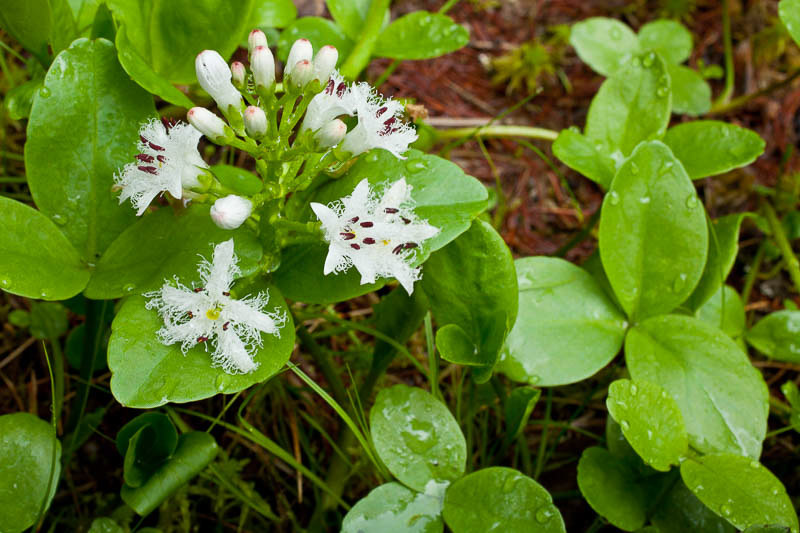
5/27/2011 · Bangor City Forest, Bangor, Maine · By Susan Cole Kelly 

9/28/2013 · Wild Gardens of Acadia, Acadia National Park, Bar Harbor, Maine · ≈ 11 × 8″ (26 × 21 cm) 
| Kingdom | Plantae | Plants, but not fungi, lichens, or algae (from Stearn's Botanical Latin) |
| Subkingdom | Tracheobionta | Vascular plants—plants with a “circulatory system” for delivering water and nutrients |
| Division | Magnoliophyta | Flowering plants, also known as angiosperms |
| Class | Magnoliopsida | Dicotyledons—plants with two initial seed leaves |
| Subclass | Asteridae | A large class that encompasses asters |
| Order | Asterales | Flowering plants with a central disk flower and surrounding petals, like daisies |
| Family | Menyanthaceae | From Ancient Greek μηνύανθος (mēnúanthos, “a water plant”), possibly from μήνη (mḗnē, “month, crescent moon”) or μηνύω (mēnúō, “to disclose”) + ἄνθος (ánthos, “flower”) in reference to the sequential opening of flowers on the inflorescence |
| Genus | Menyanthes | According to Umberto Quattrocchi, Menyanthos was a classical Greek name for a water plant and he suggests that the derivation is either from mene, “moon, crescent moon” and anthos, “flower,” or from minyos, “small, tiny” and anthos |
| Species | trifoliata | Three-leaved |

Menyanthes trifoliata description by Thomas H. Kent, not updated.

© FloraFinder.org. All rights reserved.