Mimulus bigelovii (A. Gray) A. Gray
Bigelow’s monkeyflower, yellow-throat monkeyflower, panamint monkeyflower
Bigelow’s monkeyflower is native to southwestern North America.
Plants: 2–10″ (5–25 cm) high, with hairy stems and leaves. In deserts it remains less than 2″ (5 cm) tall, but plants are larger where it is wetter.
Leaves: Opposite, oval-shaped or circuilar, with sharp tips, 1–1½″ (2.5–3.8 cm) long. Foliage may be green or nearly red.
Flowers: Tubular, pink, with two lips, and a pale yellow center with dark purple-rose spots. There are five partly fused petals, two pairs at either side and one below. Flowers are about ¾″ (2 cm) in diameter, and bloom from March to June.
Fruits: Capsules are ¼–½″ (7–13 mm) in size.
Habitats: In dry, gravelly habitats, such as rocky desert slopes or the margins of washes.
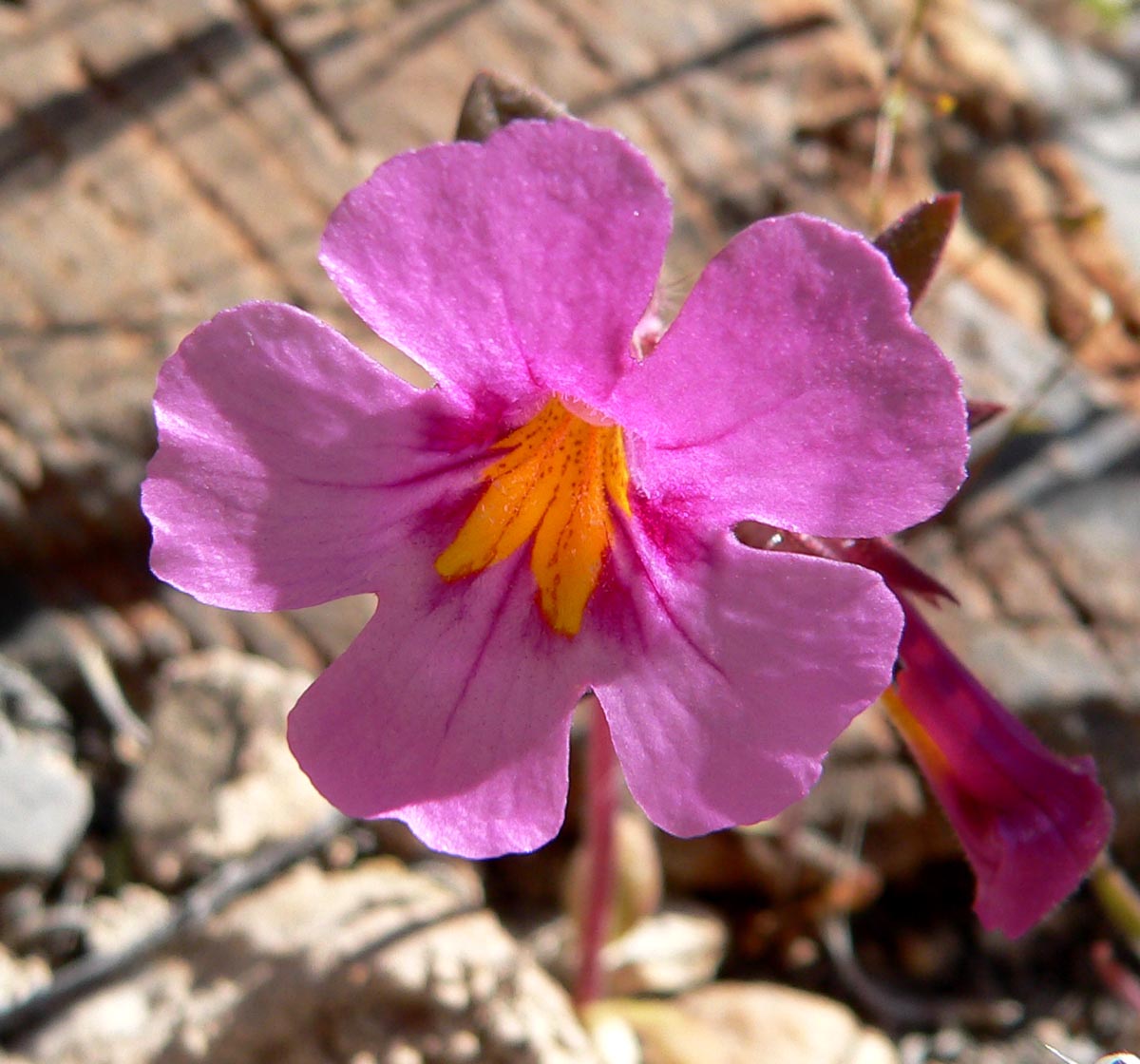
Photo of Mimulus bigelovii (Bigelow’s monkeyflower) in Red Rock Canyon, Nevada, taken April 2005 by Stan Shebs. 
Online References:

2/28/2010 · Anza-Borrego Desert State Park, California · ≈ 4 × 5″ (10 × 13 cm) 

2/28/2010 · Anza-Borrego Desert State Park, California · ≈ 8 × 7″ (19 × 18 cm) 

2/28/2010 · Anza-Borrego Desert State Park, California · ≈ 6 × 4½″ (14 × 12 cm) 

2/28/2010 · Anza-Borrego Desert State Park, California · ≈ 4 × 5″ (10 × 12 cm) 
| Kingdom | Plantae | Plants, but not fungi, lichens, or algae (from Stearn's Botanical Latin) |
| Subkingdom | Tracheobionta | Vascular plants—plants with a “circulatory system” for delivering water and nutrients |
| Division | Magnoliophyta | Flowering plants, also known as angiosperms |
| Class | Magnoliopsida | Dicotyledons—plants with two initial seed leaves |
| Subclass | Asteridae | A large class that encompasses asters |
| Order | Lamiales | Aromatic herbs and shrubs, including lavender, lilac, olive, jasmine, ash, teak, snapdragon, sesame, psyllium, garden sage, mint, basil, and rosemary |
| Family | Phrymaceae | Lopseed family |
| Genus | Mimulus | From Greek mimō, “ape” (from the shape of the corolla); historically the genus was “Scrophulariaceae” |
| Species | bigelovii | Named for Dr. John Milton Bigelow (1804-1878), a professor of botany at Detroit Medical College, who collected in the West under Whipple (see whipplei) in the Pacific Railroad Survey of 1853-1854 |

Mimulus bigelovii description by Thomas H. Kent, not updated.

© FloraFinder.org. All rights reserved.