Opuntia basilaris Engelm. & J.M. Bigelow
Beavertail cactus, beavertail pricklypear
The beavertail cactus is native to the southwestern United States, and to northwestern Mexico. It is a type of prickly pear cactus.
Plants: 2½–16″ (7–40 cm) tall, with as many as hundreds of fleshy, flattened, blue-gray pads.
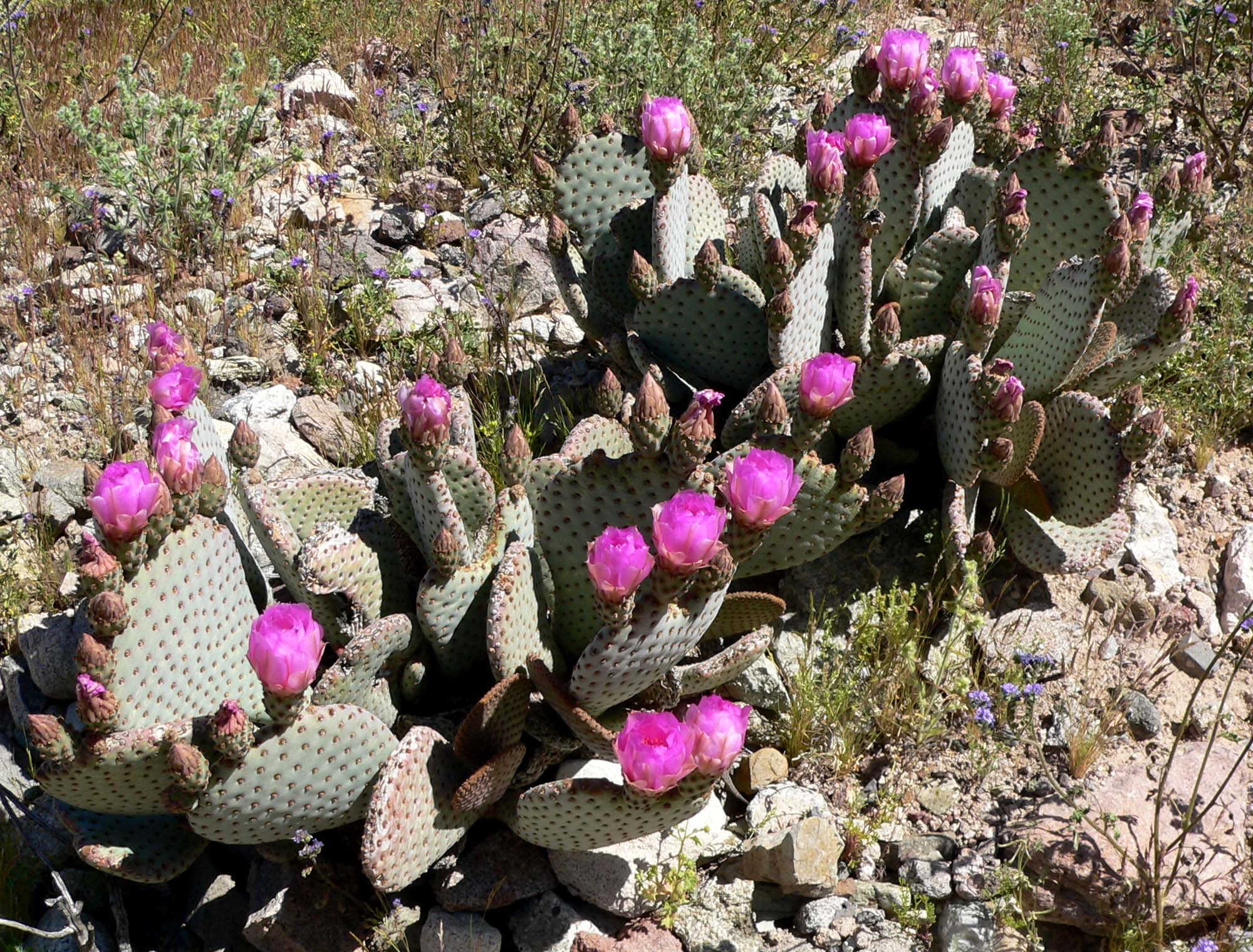
Flowering beavertail cactus, Nelson Canyon, NV. By Stan Shebs. 
Leaves: Instead of the long spines most prickly pear cacti have, beavertails usually lack spines, hence the name. In their place are small, barbed bristles. Don’t underestimate these bristles, called glochids—they easily penetrate the skin. Each pad is 1¾–8 ⨉ 4″ (5–21 ⨉ 10 cm), and ⅜–½″ (1–1.5 cm) thick.
Flowers: Up to 2½ ⨉ 2″ (6.1 ⨉ 5 cm), bright pink, yellow, peach, or salmon-colored.
Fruits: Spherical or obovate in shape, and up to 1½″ (4 cm) in diameter. They contain yellowish to tan seeds.
Habitats: Variable depending on variety; slopes, desert flats, hills sandy to rocky soils; woodlands, Mojave an Great Basin deserts; oak-pine woodlands.
Online References:

5/3/2018 · Park Blvd., Joshua Tree National Park · ≈ 8 × 5″ (20 × 13 cm) 

5/22/2010 · Garden in the Woods, Framingham, Massachusetts · ≈ 1½ × 1′ (49 × 41 cm) 

2/17/2007 · Anza-Borrego Desert, California 

2/17/2007 · Anza-Borrego Desert State Park, California  ID is uncertain

5/3/2018 · Park Blvd., Joshua Tree National Park · ≈ 1 × 1′ (38 × 31 cm) 

5/3/2018 · Park Blvd., Joshua Tree National Park · ≈ 10 × 6″ (24 × 16 cm) 

2/28/2010 · Anza-Borrego Desert State Park, California 

5/3/2018 · Park Blvd., Joshua Tree National Park · ≈ 8 × 5″ (20 × 13 cm) 

5/3/2018 · Park Blvd., Joshua Tree National Park · ≈ 6 × 10″ (16 × 24 cm) 

5/3/2018 · Park Blvd., Joshua Tree National Park · ≈ 7 × 5″ (17 × 13 cm) 

5/2/2018 · Indian Cove, Joshua Tree National Park, Joshua Tree, California · ≈ 1½ × 1′ (52 × 34 cm) 

5/22/2010 · Garden in the Woods, Framingham, Massachusetts 

5/3/2018 · Park Blvd., Joshua Tree National Park 

2/28/2010 · Anza-Borrego Desert State Park, California · ≈ 9 × 6″ (23 × 15 cm) ID is uncertain 

5/3/2018 · Park Blvd., Joshua Tree National Park · ≈ 10 × 6″ (24 × 16 cm) 

5/3/2018 · Park Blvd., Joshua Tree National Park · ≈ 8 × 5″ (20 × 13 cm) 

4/30/2018 · Kelbaker Road, Mojave National Preserve, California · ≈ 8 × 6″ (21 × 14 cm) 

5/3/2018 · Barker Dam, Joshua Tree National Park, California · ≈ 6 × 6″ (15 × 14 cm) 

2/28/2010 · Anza-Borrego Desert State Park, California · ≈ 2 × 1′ (62 × 41 cm) 

5/3/2018 · Barker Dam, Joshua Tree National Park, California · ≈ 7 × 4½″ (17 × 12 cm) 

5/1/2018 · Joshua Tree National Park Visitor Center, Twentynine Palms, California 

5/3/2018 · Park Blvd., Joshua Tree National Park 

5/3/2018 · Barker Dam, Joshua Tree National Park, California · ≈ 1½ × 1′ (52 × 34 cm) 

6/4/2009 · Lake Mead Area ID is uncertain 

5/3/2018 · Park Blvd., Joshua Tree National Park · ≈ 4½ × 7″ (12 × 18 cm) 
| Kingdom | Plantae | Plants, but not fungi, lichens, or algae (from Stearn's Botanical Latin) |
| Subkingdom | Tracheobionta | Vascular plants—plants with a “circulatory system” for delivering water and nutrients |
| Division | Magnoliophyta | Flowering plants, also known as angiosperms |
| Class | Magnoliopsida | Dicotyledons—plants with two initial seed leaves |
| Subclass | Caryophyllidae | Cacti, many other succulents, carnivorous plants, and leadworts |
| Order | Caryophyllales | Includes cacti, carnations, amaranths, ice plants, and many carnivorous plants |
| Family | Cactaceae | Succulent (water-storing) plants, often spiny |
| Genus | Opuntia | Prickly pears |
| Species | basilaris | Basal, stretching from the base |

Opuntia basilaris description by Thomas H. Kent, not updated.

© FloraFinder.org. All rights reserved.