Opuntia caracassana
This cactus is native to the southern Caribbean and northern South America.
Plants: Cactus shrubs are erect, and up to 3′ (1 m) tall. Young cladodes (pads) are obovate or round, green, and 1¾–4½″ long ⨉ 2″ wide (5–12 ⨉ 6 cm), with white spines ⅜–1½″ (1–4 cm) long, and one to two radial spines ⅜–½″ (1–1.5 cm) long. Adult cladodes are 6–7 ⨉ 4–4½″ (15–17 ⨉ 10–12 cm). They have one to two central spines, white with brown tips, ⅞–2″ (2.5–5.5 cm) long; and one to three radial spines ⅛–1¼″ (5–35 mm) long. Areoles are white and rounded.
Flowers: Red-orange buds open to pale yellow flowers about 1½–2″ (3.8–5 cm) in size.
Fruits: Bright red fruits.
Habitats: Seasonally dry shrublands and forests.
Edibility: Fruits are edible.
Online References:
CactiGuide.com (Good photos)
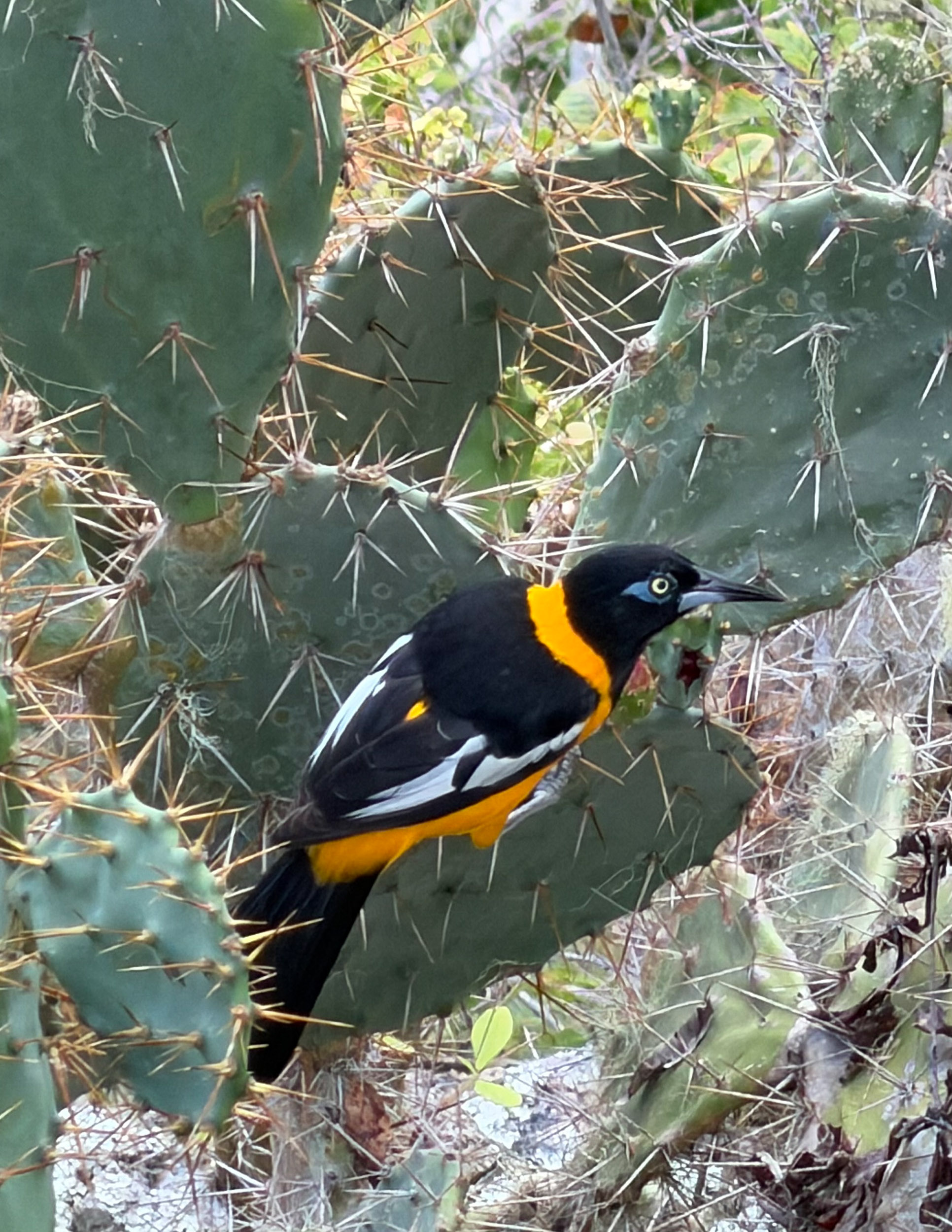
That’s a Venezualen Troupial (Icterus icterus) perched in the cactus. · 2/23/2026 · Curaçao · By Heather A. Kent 
| Kingdom | Plantae | Plants, but not fungi, lichens, or algae (from Stearn's Botanical Latin) |
| Subkingdom | Tracheobionta | Vascular plants—plants with a “circulatory system” for delivering water and nutrients |
| Division | Magnoliophyta | Flowering plants, also known as angiosperms |
| Class | Magnoliopsida | Dicotyledons—plants with two initial seed leaves |
| Subclass | Caryophyllidae | Cacti, many other succulents, carnivorous plants, and leadworts |
| Order | Caryophyllales | Includes cacti, carnations, amaranths, ice plants, and many carnivorous plants |
| Family | Cactaceae | Succulent (water-storing) plants, often spiny |
| Genus | Opuntia | Prickly pears |
| Species | caracassana | From Caracas, the captial of Venezuela |
Opuntia caracassana description by Thomas H. Kent, not updated.

© FloraFinder.org. All rights reserved.