Urechites luteus (L.) Britton
Urechites lutea (L.) Britton var. sericea R.W. Long, orth. var.
Urechites luteus (L.) Britton var. sericeus R.W. Long
Urechites pinetorum Small
Pentalinon luteum (L.) B.F. Hansen & Wunderlin
Hammock viper’s-tail, licebush, wild allamanda, wild wist, yellow mandevilla, yellow dipladenia, bay cedar
Wild alamanda is an evergreen vine native to the Caribbean, Honduras, and Florida.
Plants: A vine or vinelike shrub 3–12′ (91–365 cm) in size. Branches are hairy or hairless, and intertwining.
Leaves: Broadly elliptic or obovate, glossy, opposite, 1–2½ ⨉ ½–1¼″ (3–7 ⨉ 1.5–3.7 cm). Leaves are on stalks ⅛–⅜″ (5–12 mm) long.
Flowers: Bright yellow, with reddish stripes inside, funnel-shaped, up to 2½″ (6.3 cm) around, with five petals. Flowers appear from March to June.
Fruits: Dry fruits are 4½–7 ⨉ ⅛–3/16″ (12–18 cm ⨉ 4–5 mm), containing seeds that are ⅜ ⨉ 1/32″ (1 cm ⨉ 1 mm).
Habitats: Full sun, and mangrove swamps, coastal thickets, and tropical hammocks.
Online References:
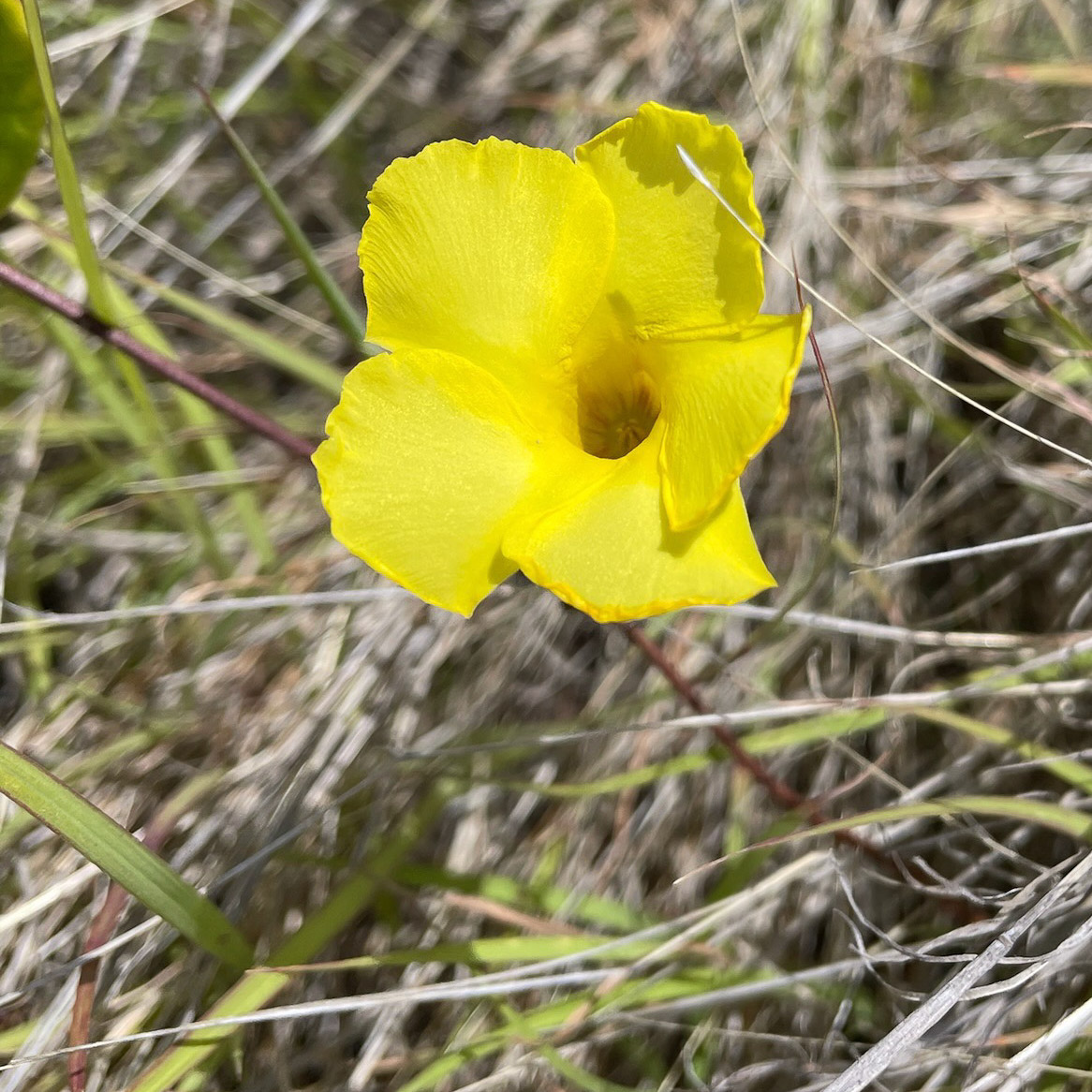
6/7/2024 · Saint Marten, Leeward Islands · By Heather A. Kent 

6/7/2024 · Saint Marten, Leeward Islands · By Heather A. Kent 

6/7/2024 · Saint Marten, Leeward Islands · By Heather A. Kent 

6/7/2024 · Saint Marten, Leeward Islands · By Heather A. Kent 

6/7/2024 · Saint Marten, Leeward Islands · By Heather A. Kent 
| Kingdom | Plantae | Plants, but not fungi, lichens, or algae (from Stearn's Botanical Latin) |
| Subkingdom | Tracheobionta | Vascular plants—plants with a “circulatory system” for delivering water and nutrients |
| Division | Magnoliophyta | Flowering plants, also known as angiosperms |
| Class | Magnoliopsida | Dicotyledons—plants with two initial seed leaves |
| Subclass | Asteridae | A large class that encompasses asters |
| Order | Gentianales | Gentians, coffee, gardenias, frangipani, many others |
| Family | Apocynaceae | Dogbane family |
| Genus | Pentalinon | From Greek penne, “five,” and linon, “rope,” a reference to the elongated flower anthers |
| Species | luteum | Yellow, for the flowers |
Pentalinon luteum description by Thomas H. Kent, not updated.

© FloraFinder.org. All rights reserved.
