Prunella vulgaris L.
Common selfheal, heal-all, heart-of-the-earth
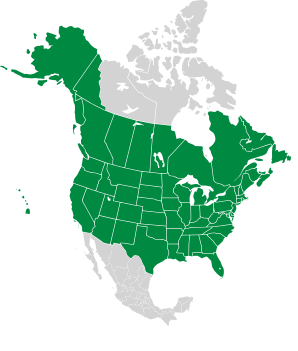
Heal-all is a common native of North America, Europe, and Asia. It is a member of the mint family.
Plants: 1¾–16″ (5–40 cm) high, usually toward the small end of this. It is often found in lawns. Stems are approximately square in cross section, green or reddish, and lightly to densely hairy.
Leaves: 2 ⨉ ¾″ (6 ⨉ 2 cm), oval or sometimes lance-shaped, on fairly long petioles (leaf stems).
Flowers: The flowers appear on spikes at the top. They look uneven and disheveled because they don’t bloom all at once. Each flower is about ⅜″ (1 cm) around, purple on top and white below, and bilaterally symmetrical: if you cut it in half vertically, the halves are mirror images. The lower center petal has a ragged edge. Flowers appear from June to August.
Fruits: Each flower produces four tiny seeds, which are located in the calyx.
Habitats: Roadsides, gardens, waste-places, and woodland edges, usually in basic and neutral soils.
Edibility: Leaves are edible raw, though somewhat bitter; or cooked, which tastes better but forfeits nutrients.
Medical: As heal-all’s name suggests, it has long been used in folk medicine, for a wide range of symptoms. Symptoms include fevers, rheumatism, liver ailments, eye problems, swollen glands, urinary problems, sore throats; heal-all was also used as an antibiotic and general cure-all. Even today, it is sometimes used to treat minor injuries such as sores, burns, or bruises, and as a mouthwash for mouth ulcers. However, I was not able to find any definitive studies on these medicinal properties.
 |
Some similar species. |
Online References:

7/15/2012 · Fort Point State Park, Stockton Springs, Maine · ≈ 4 × 5″ (10 × 13 cm) 

1/5/2026 · Gordon and Kathy’s, Prospect, Maine · By J Gordon Williamson 

8/6/2009 · Nashua River Rail Trail, Groton, Massachusetts · ≈ 12 × 8″ (31 × 20 cm) 

7/11/2016 · Beaver Brook Conservation Area, 

1/5/2026 · Gordon and Kathy’s, Prospect, Maine · By J Gordon Williamson 

10/10/2021 · Witt’s End Trail, Norway, Maine · ≈ 4½ × 3½″ (12 × 9.8 cm) 

8/6/2009 · Nashua River Rail Trail, Groton, Massachusetts · ≈ 6 × 8″ (15 × 20 cm) 

6/30/2013 · Great Hill Conservation Land, Acton, Massachusetts · ≈ 6 × 4½″ (14 × 11 cm) 

6/4/2010 · Nashua River Rail Trail, Ayer, Massachusetts · ≈ 7 × 8″ (18 × 20 cm) 

9/8/2017 · Bates Land and Blackman Land, Groton Conservation Trust, Groton, Massachusetts · ≈ 3½ × 2½″ (9 × 6.4 cm) 

7/6/2017 · Mt. Watatic, access road, Ashby, Massachusetts · ≈ 4 × 4½″ (10 × 11 cm) 

7/11/2016 · Beaver Brook Conservation Area, 

8/8/2010 · Jeff Smith Trail, Beaver Brook Association Conservation Lands, Rte. 130, Hollis, New Hampshire · ≈ 3½ × 4½″ (9.4 × 11 cm) 

6/20/2021 · Maquoit Bay Preserve, Brunswick, Maine · ≈ 5 × 8″ (13 × 20 cm) 

8/6/2009 · Nashua River Rail Trail, Groton, Massachusetts · ≈ 4½ × 5″ (12 × 13 cm) 

7/6/2017 · Mt. Watatic, access road, Ashby, Massachusetts · ≈ 4 × 4½″ (10 × 11 cm) 

7/23/2017 · Pine Grove Furnace State Park, Pennsylvania · ≈ 5 × 4″ (13 × 11 cm) 

7/11/2012 · Jeff Smith Trail, Pepperell, Massachusetts · ≈ 5 × 4½″ (12 × 12 cm)  ID is uncertain

6/27/2012 · Townsend Wildlife Management Area, Townsend, Massachusetts · ≈ 4½ × 3½″ (11 × 9.3 cm) 

7/27/2009 · Nashua River Rail Trail, Groton, Massachusetts · ≈ 11 × 10″ (27 × 24 cm) 

6/20/2021 · Maquoit Bay Preserve, Brunswick, Maine · ≈ 4 × 4″ (10 × 10 cm) 
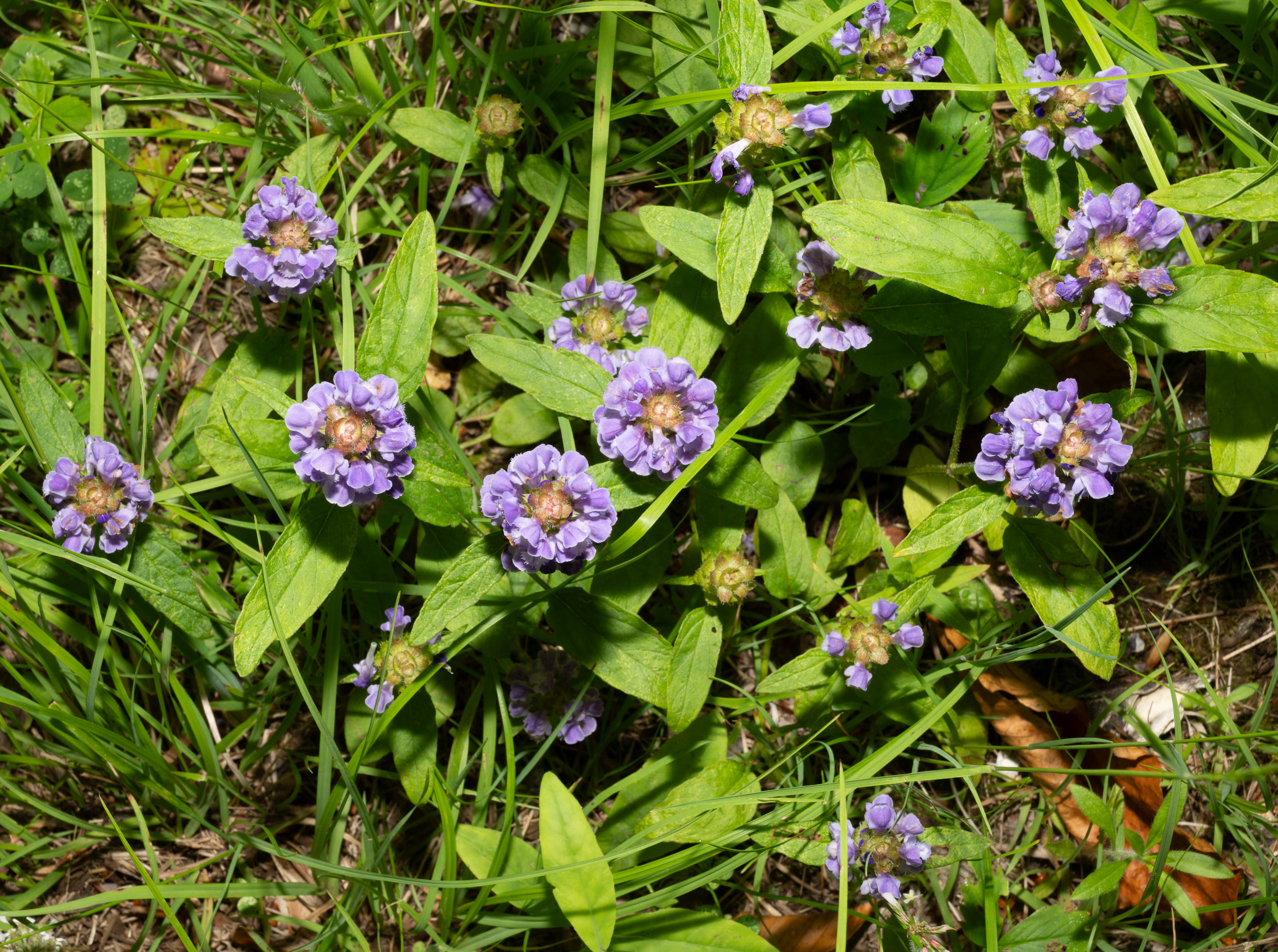
6/30/2025 · Buck's Ledge Community Forest, Bethel, Maine · ≈ 11 × 9″ (29 × 21 cm) 

6/30/2013 · Great Hill Conservation Land, Acton, Massachusetts · ≈ 5 × 6″ (12 × 14 cm) 
| Kingdom | Plantae | Plants, but not fungi, lichens, or algae (from Stearn's Botanical Latin) |
| Subkingdom | Tracheobionta | Vascular plants—plants with a “circulatory system” for delivering water and nutrients |
| Division | Magnoliophyta | Flowering plants, also known as angiosperms |
| Class | Magnoliopsida | Dicotyledons—plants with two initial seed leaves |
| Subclass | Asteridae | A large class that encompasses asters |
| Order | Lamiales | Aromatic herbs and shrubs, including lavender, lilac, olive, jasmine, ash, teak, snapdragon, sesame, psyllium, garden sage, mint, basil, and rosemary |
| Family | Lamiaceae | Mint family |
| Genus | Prunella | From either Latin for “purple;” or German “Braune” and its English cognate, “Brunella,” an illness thought to be cured by this plant |
| Species | vulgaris | Means “common” |
Prunella vulgaris description by Thomas H. Kent, not updated.

© FloraFinder.org. All rights reserved.