Sabatia palmeri A. Gray
Sabatia purpusii Brandegee
Sabatia simulata Britton
Sabatia stellaris Pursh
Rose of Plymouth, marsh pink, salt-marsh pink, sea-pink
Rose of Plymouth is native to the eastern United States, much of Mexico, and some of the Caribbean. Named for Plymouth, Massachusetts, it is much more common further south.
Plants: 8–20″ (20–50 cm), taller further south, with smooth stems that are 4-angled.
Leaves: Opposite, linear to elliptic to obovate, sessile, ⅛–2 ⨉ 1/16–⅜″ (5–60 ⨉ 2–10 mm).
Flowers: Pink or rarely white, with yellow centers, appearing singly or in small groups. Corollas have 4-7 lobes, and are 1½–2½″ (3.8–6.3 cm) around. Flowers appear from July to October.
Fruits: Capsules are ⅛–½″ (4–14 mm) in size.
Habitats: Open ocean sandy soils, and saltwater and brackish marshes.
Online References:

4/14/2015 · Long Pine Key, Everglades National Park, Florida · ≈ 13 × 9″ (32 × 22 cm) 

4/14/2015 · Long Pine Key, Everglades National Park, Florida · ≈ 3 × 3″ (8.1 × 8.2 cm) 

4/14/2015 · Long Pine Key, Everglades National Park, Florida · ≈ 3 × 3″ (8.5 × 7.7 cm) 

4/14/2015 · Long Pine Key, Everglades National Park, Florida · ≈ 4½ × 5″ (11 × 13 cm) 
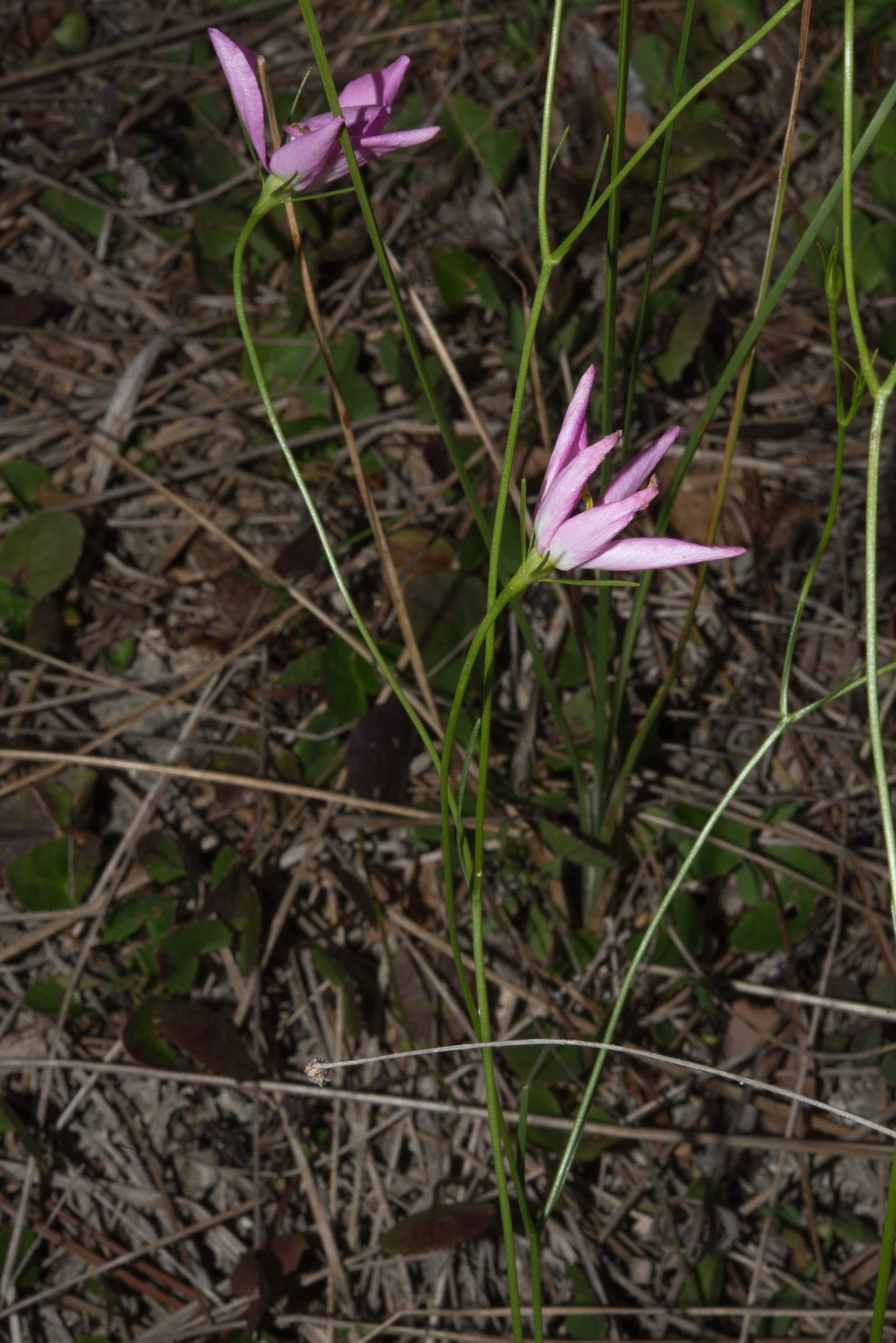
4/14/2015 · Long Pine Key, Everglades National Park, Florida · ≈ 6 × 8″ (14 × 20 cm) 

4/14/2015 · Long Pine Key, Everglades National Park, Florida · ≈ 4 × 4½″ (10 × 11 cm) 
| Kingdom | Plantae | Plants, but not fungi, lichens, or algae (from Stearn's Botanical Latin) |
| Subkingdom | Tracheobionta | Vascular plants—plants with a “circulatory system” for delivering water and nutrients |
| Division | Magnoliophyta | Flowering plants, also known as angiosperms |
| Class | Magnoliopsida | Dicotyledons—plants with two initial seed leaves |
| Subclass | Asteridae | A large class that encompasses asters |
| Order | Gentianales | Gentians, coffee, gardenias, frangipani, many others |
| Family | Gentianaceae | About 1600 species of flowering plants from the genus Gentiana, named after the Illyrian king Gentius |
| Genus | Sabatia | For Italian botanist Liberato Sabbati, who curated a botanical garden in Rome in the early 1700s and wrote an important work for the time, Hortus Romanus |
| Species | stellaris | Starry, star-like, with spreading leaves or petals arranged in a star-shaped fashion |
Sabatia stellaris description by Thomas H. Kent, not updated.

© FloraFinder.org. All rights reserved.
