Trifolium incarnatum L.
Crimson clover
Crimson clover is a native of western and southern Europe that has become naturalized throughout much of North America, after its introduction here. Depending upon who you talk to, it is planted as natural fertilizer, prized as an ornamental (sometimes in lawns), or an evil invasive. Whatever. The flowers sure are pretty.
Plants: 8–20″ (20–50 cm) high. Like other clovers, these plants have roots that work together with bacteria to trap atmospheric nitrogen and convert it to usable nutrition, allowing them to grow in nutritionally poor soils. They are sometimes intentionally planted to improve soil nutrition.
Leaves: Round or oval, trifoliate, on petioles 1–4″ (2.5–10 cm) long. Leaflets are ½–1¼″ (1.3–3.2 cm) long.
Flowers: Deep red, forming rounded conical or cylindrical flowerheads 1–2½ ⨉ ½–¾″ (2.5–6.3 ⨉ 1.3–1.9 cm). Flowering occurs during April to May.
Fruits: Small seedpods about ⅛″ (4 mm) in length), ovoid in shape, and slightly flattened, containing seeds that are 1/16″ (2.5 mm) in size.
Habitats: Cropland, fallow fields, roadsides, disturbed habitats, and lawns.
 |
Similar species. |
Online References:
Trifolium incarnatum L. var. elatius Gibelli & Belli
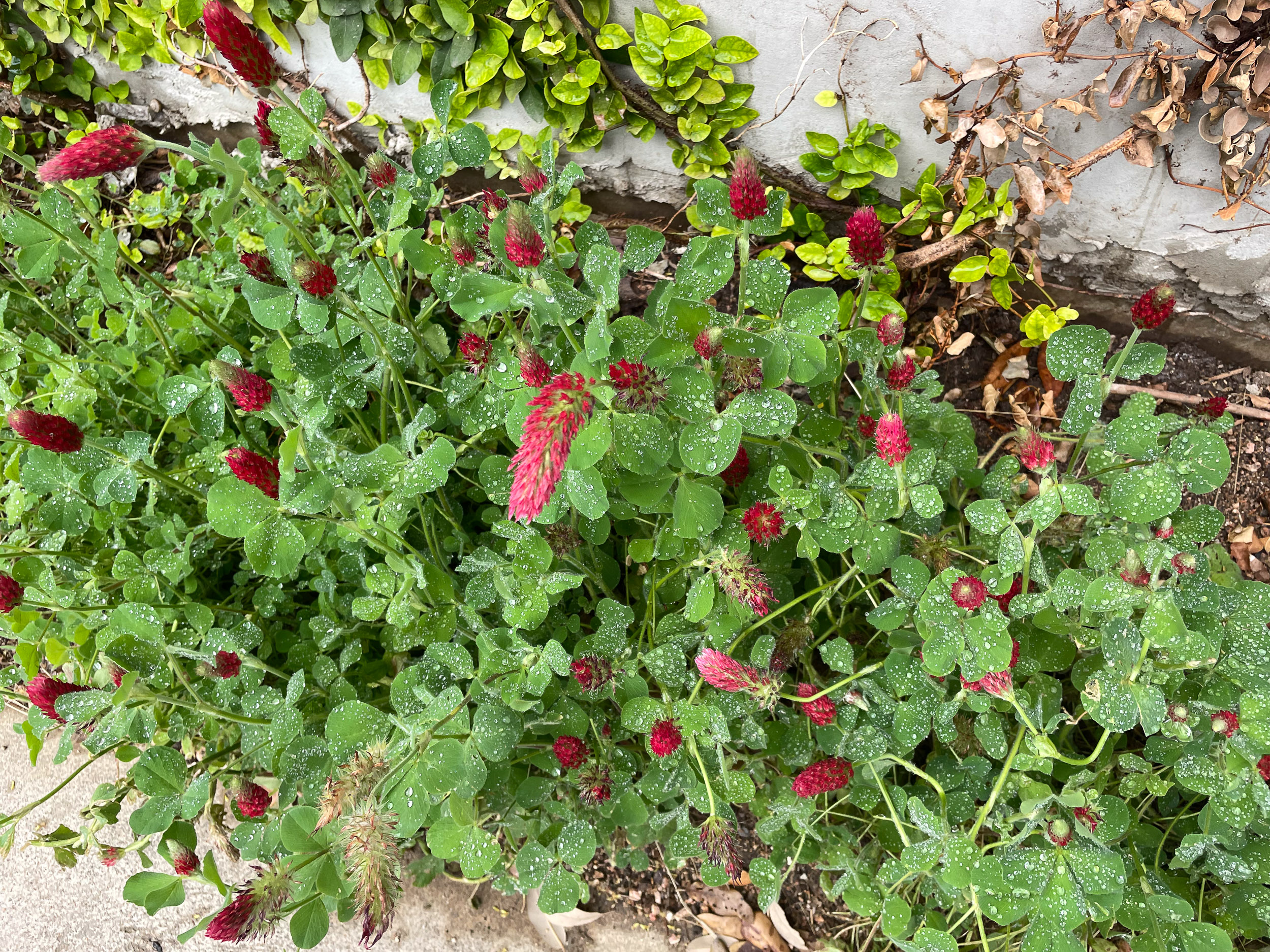
3/24/2023 · South Congress Hotel, Austin, Texas 

3/24/2023 · South Congress Hotel, Austin, Texas 

5/25/2008 · Memphis, Tennessee · By Tim Chandler 
| Kingdom | Plantae | Plants, but not fungi, lichens, or algae (from Stearn's Botanical Latin) |
| Subkingdom | Tracheobionta | Vascular plants—plants with a “circulatory system” for delivering water and nutrients |
| Division | Magnoliophyta | Flowering plants, also known as angiosperms |
| Class | Magnoliopsida | Dicotyledons—plants with two initial seed leaves |
| Subclass | Rosidae | Roses, legumes, proteas, dogwoods, hydrangeas, mistletoes, euphorbias, grapes, many more |
| Order | Fabales | Legumes (pea and bean families) |
| Family | Fabaceae | Legume family (peas and beans) |
| Genus | Trifolium | “Three-leaved,” for the 3-leaf clusters |
| Species | incarnatum | “Flesh-colored” (???) |

Trifolium incarnatum description by Thomas H. Kent, not updated.

© FloraFinder.org. All rights reserved.