Trifolium pratense L. var. sativum (Mill.) Schreb.
Trifolium pratense L.
Pink clover, red clover
Red clover is native to Europe, western Asia, and northwest Africa. It was brought to North America (and many other places), and it is now abundant. Red clover is grown extensively for pasture animals.
Plants: 8–31″ (20–80 cm) tall, multiply branched, often partially lying down. Stems are sometimes purplish and sometimes hairy.
Leaves: Trifoliate. Leaflets are ⅜–2½ ⨉ ⅜–1½″ (1–7 ⨉ 1–4 cm), with a distinctive pale green crescent or chevron on the outer half of the leaf. They vary from roundish to an elongated oval.
Flowers: Pink to rose (rarely white). Flowerheads are about ¾″ (1.9 cm) around. Flowers smell like honey. Flowers appear from late spring to midsummer.
Fruits: Each individual flower in the flowerhead is replaced by a small seedpod containing 1 or 2 heart-shaped seeds.
Habitats: Fields, pastures, meadows, waste areas, and along roadsides.
Edibility: Young leaves can be added to salads or soups, or cooked like spinach. Young flowers can be added to salads. Flowering heads and seed pods may be ground into a flour. (Don’t eat clover if you are pregnant though.)
Medical: As is typically the case with very common plants, various healing properties have been attributed to red clover. One of the more widely believed properties is that clover contains substances that can treat post-menopausal symptoms. A controlled study by the George Washington University School of Medicine, published in the journal Menopause, found that clover has no such effect.
But as a fertilizer...
|
Rolling your own fertilizer Nitrogen is one of the essential building blocks of all life. There is no shortage of nitrogen—it makes up almost four fifths of our atmosphere—but neither plants nor animals can use it directly in its atmospheric form (N₂). It takes energy to convert it to a usable form, for instance, to ammonia or nitrates. Energy from lightning, for example; or energy from the vast amounts of electricity used to create commercial nitrate fertilizers. If a plant could somehow harvest nitrogen directly from the air, it would be able to make its own fertilizer, allowing it to colonize soils that were too poor in nutrients for other plants. Legumes, including alfalfa, clover, peas, beans, lentils, soybeans, and peanuts, have managed exactly this stunt, called "nitrogen fixing"—and without even solving the problem themselves. Instead, they brokered an amazing agreement with the real inventors of nitrogen fixing: symbiotic bacteria known as Rhizobia. The bacteria grow in nodules on the roots of legumes, supplying the plant with usable nitrogen in return for malates and succinates for energy and carbon. The bacteria combine nitrogen, hydrogen, and electrons like this: N₂ + 8H+ + 8e– → 2NH₃ + H₂ We could write this more simply as: nitrogen + hydrogen + electricity → ammonia + hydrogen The eight hydrogen ions (8H+) in this reaction come mostly from water vapor. The electrons (8e–) can be thought of as electricity created by the bacteria. The results of the reaction include ammonia (NH₃) and hydrogen (H₂). The created hydrogen reacts pretty quickly with oxygen, forming more water vapor. And the ammonia is very close to what the plant needs. In water, ammonia quickly reacts with hydrogen ions in the water to create ammonium ions: NH₃ + H+ → NH₄+ or ammonia + hydrogen ions → ammonium ions You are already familiar with this reaction—it is the same one that makes you wrinkle your nose in disgust when you catch a whiff of ammonia. But what smells bad to you is a critical nutrient to most plants. The ammonium ions created by the bacteria are absorbed directly by the roots of the legumes. The trapped nitrogen feeds the plant, with enough left over after the plant dies to foster the growth of other plants as well. Thus legumes are sometimes called green manure. So before you get too irritated with the clover growing in your lawn, consider that it is busy fertilizing your lawn. |
 |
Some common clovers. |
Online References:
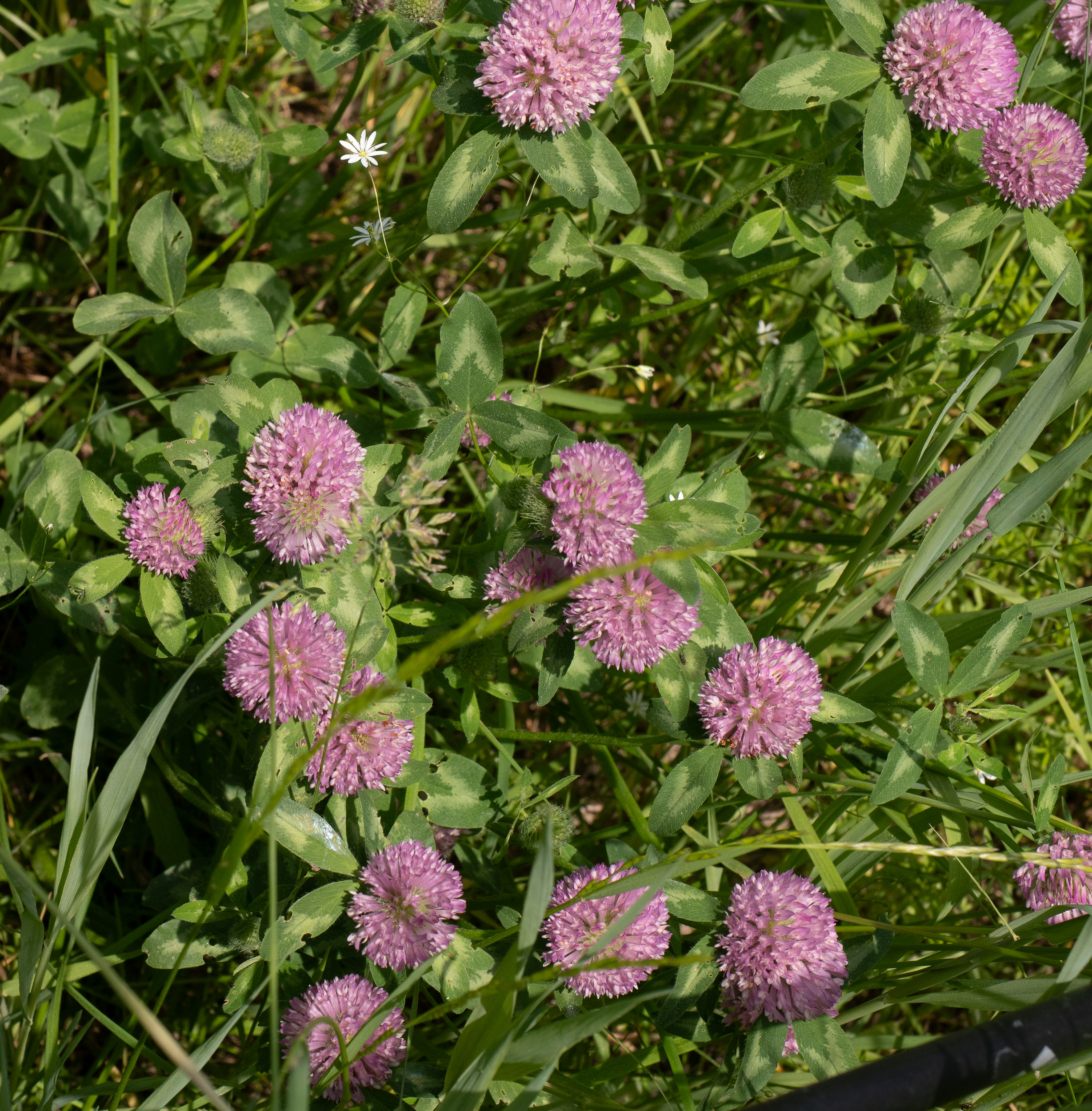
6/13/2025 · River Point Conservation Area, Falmouth, Maine 

Appearance in late fall. · 9/3/2009 · Nashua River Rail Trail, Ayer, Massachusetts · ≈ 3 × 3″ (8.2 × 8.3 cm) 

8/4/2009 · Near Nashoba Hospital, Ayer, Massachusetts · ≈ 4 × 3″ (10 × 7.7 cm) 

10/15/2023 · Mt. Battie, Camden Hills State Park, Camden, Maine 

8/4/2006 · Mt. Mansfield, Stowe, Vermont 

6/10/2016 · Monhegan Island, Maine 

8/8/2021 · Eaton Farm Preserve, Wiscasset, Maine · ≈ 3½ × 2½″ (9 × 6.7 cm) 

6/24/2015 · Nashua River Rail Trail, Groton Ctr, Groton, Massachusetts · ≈ 3½ × 3″ (8.6 × 8.5 cm) 

8/4/2006 · Mt. Mansfield, Stowe, Vermont 

6/24/2024 · Otter Brrok Preserve, Harpswell Heritage Land Trust, Harpswell, Maine · ≈ 4 × 2½″ (11 × 7.3 cm) 

4/29/2010 · Bruce Freeman Rail Trail, Chelmsford, Massachusetts · ≈ 1½ × 1′ (48 × 38 cm) 

6/15/2013 · Sonny and Donna’s, Tenant’s Harbor, Maine · ≈ 3½ × 3″ (9.7 × 8 cm) 

6/26/2024 · Morse Mountain, Phippsburg, Maine · ≈ 12 × 8″ (31 × 20 cm) 
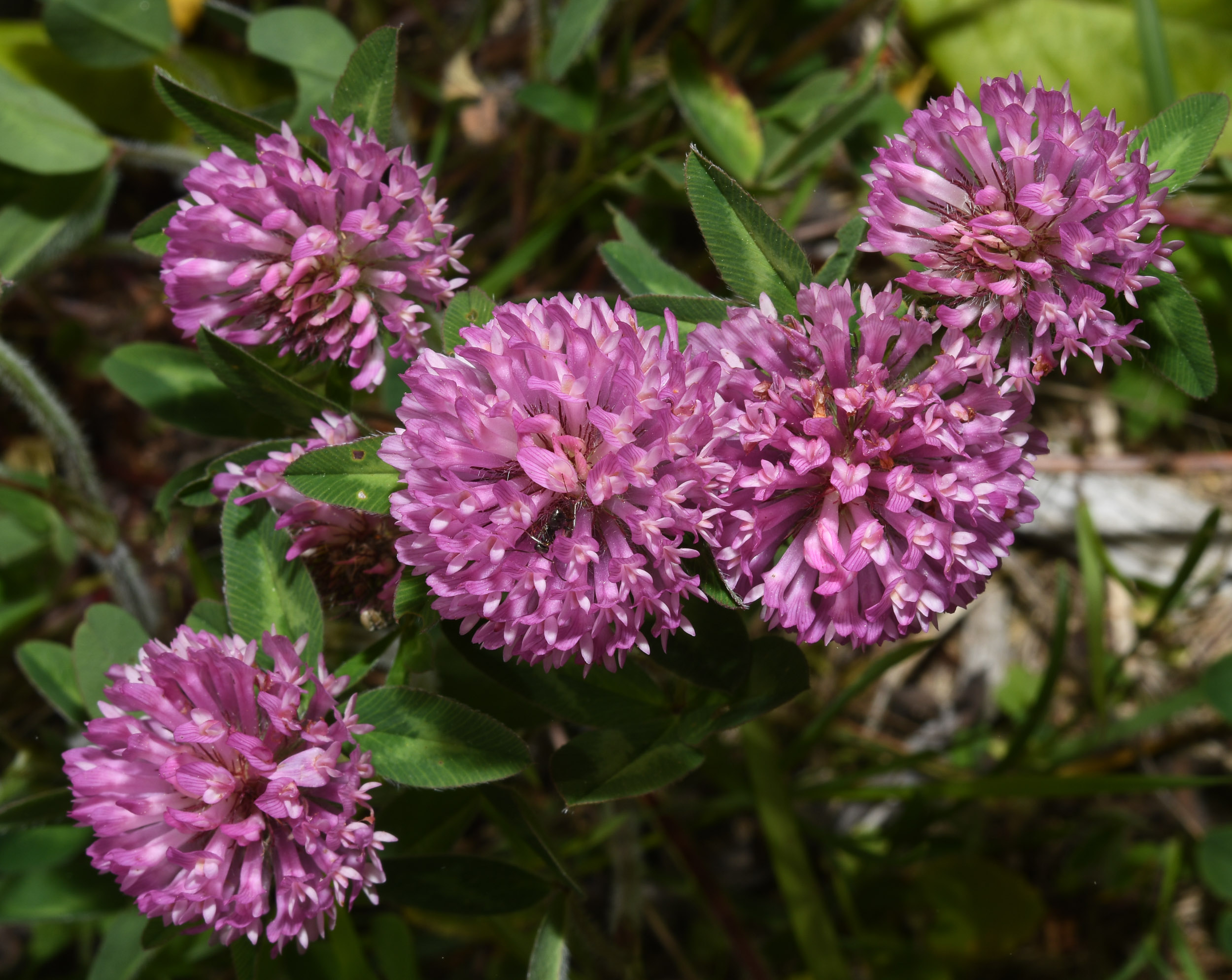
6/10/2016 · Monhegan Island, Maine 

6/16/2010 · Nashua River Rail Trail, Groton Center, Groton, Massachusetts · ≈ 6 × 4″ (15 × 10 cm) 

9/19/2009 · Acadia National Park, Bar Harbor, Maine · ≈ 3½ × 4″ (9.2 × 10 cm) 

6/10/2021 · Otter Brrok Preserve, Harpswell Heritage Land Trust, Harpswell, Maine · ≈ 3 × 4½″ (7.9 × 11 cm) 

6/22/2010 · Nashua River Rail Trail, Ayer, Massachusetts · ≈ 4 × 3″ (10 × 7.8 cm) 

9/27/2021 · Skolfield Shores Preserve, Harpswell, Maine 

8/31/2007 · Silver Falls State Park, Oregon 
| Kingdom | Plantae | Plants, but not fungi, lichens, or algae (from Stearn's Botanical Latin) |
| Subkingdom | Tracheobionta | Vascular plants—plants with a “circulatory system” for delivering water and nutrients |
| Division | Magnoliophyta | Flowering plants, also known as angiosperms |
| Class | Magnoliopsida | Dicotyledons—plants with two initial seed leaves |
| Subclass | Rosidae | Roses, legumes, proteas, dogwoods, hydrangeas, mistletoes, euphorbias, grapes, many more |
| Order | Fabales | Legumes (pea and bean families) |
| Family | Fabaceae | Legume family (peas and beans) |
| Genus | Trifolium | “Three-leaved,” for the 3-leaf clusters |
| Species | pratense | Growing in meadows |
Trifolium pratense description by Thomas H. Kent, not updated.

© FloraFinder.org. All rights reserved.
