Amphicarpaea bracteata (L.) Fernald var. bracteata
American hog-peanut, ground bean, American hogpeanut
American hog-peanut is native to eastern North America.
Plants: Plants look like low-lying mats of foliage, but at close quarters they are actually thin-stemmed vines 2–8′ (60–243 cm) long. Small tendrils hang onto nearby plants. Stems are less than 1/32″ (1 mm) thick, light green to reddish green, and covered with thin flattened (appressed) hairs.
Leaves: Leaves are alternate, in groups of three delicate leaflets, along twining stems. The central leaflet, called the terminal leaflet, is up to 2½″ (6.3 cm) long about about the same width. Leaflets are ovate to ovate-rhombic, with sharp tips. The other two leaflets tend to be a bit smaller. Leaflets are mostly hairless on top, and usually hairier and lighter in color below.
Flowers: Pink to white to pale lavender, ½–¾″ (1.3–1.9 cm) long. Open flowers are cross-pollinated, while closed flowers are self-pollinating. Flowers are tubular in shape, with an upright-facing banner, 2 side wings, and a keel. The edges of the banners are often folded backward. Closed flowers may occur above or below ground. Open flowers occur in compact clusters of 2-15 along the vine. They appear from August to September.
Fruits: Open flowers form flat pods, ½–1½″ (1.5–4 cm) long, pointed at both ends, containing 1-4 seeds. When mature, the dried pods burst to disperse the seeds. Closed flowers produce a pod containing a single seed.
Habitats: Woodlands, thickets, low wooded areas along streams, and moist slopes.
Edibility: Below-ground pear-shaped seeds are “sweet and delicious,” eaten raw or cooked, tasting like shelled garden beans. Seeds from above-ground seed pods are said by some sources to be inedible, and by others to be edible after cooking.
Online References:
References:
Clemants, Steven; Gracie, Carol, Wildflowers in the Field and Forest, Oxford University Press, 2006, p. 101
Amphicarpaea monoica (L.) Elliott

7/23/2017 · Pine Grove Furnace State Park, Pennsylvania · ≈ 6 × 8″ (16 × 19 cm) 

8/25/2019 · Blue Trail, Willard Brook State Park, Ashby, Massachusetts 

8/25/2019 · Blue Trail, Willard Brook State Park, Ashby, Massachusetts 
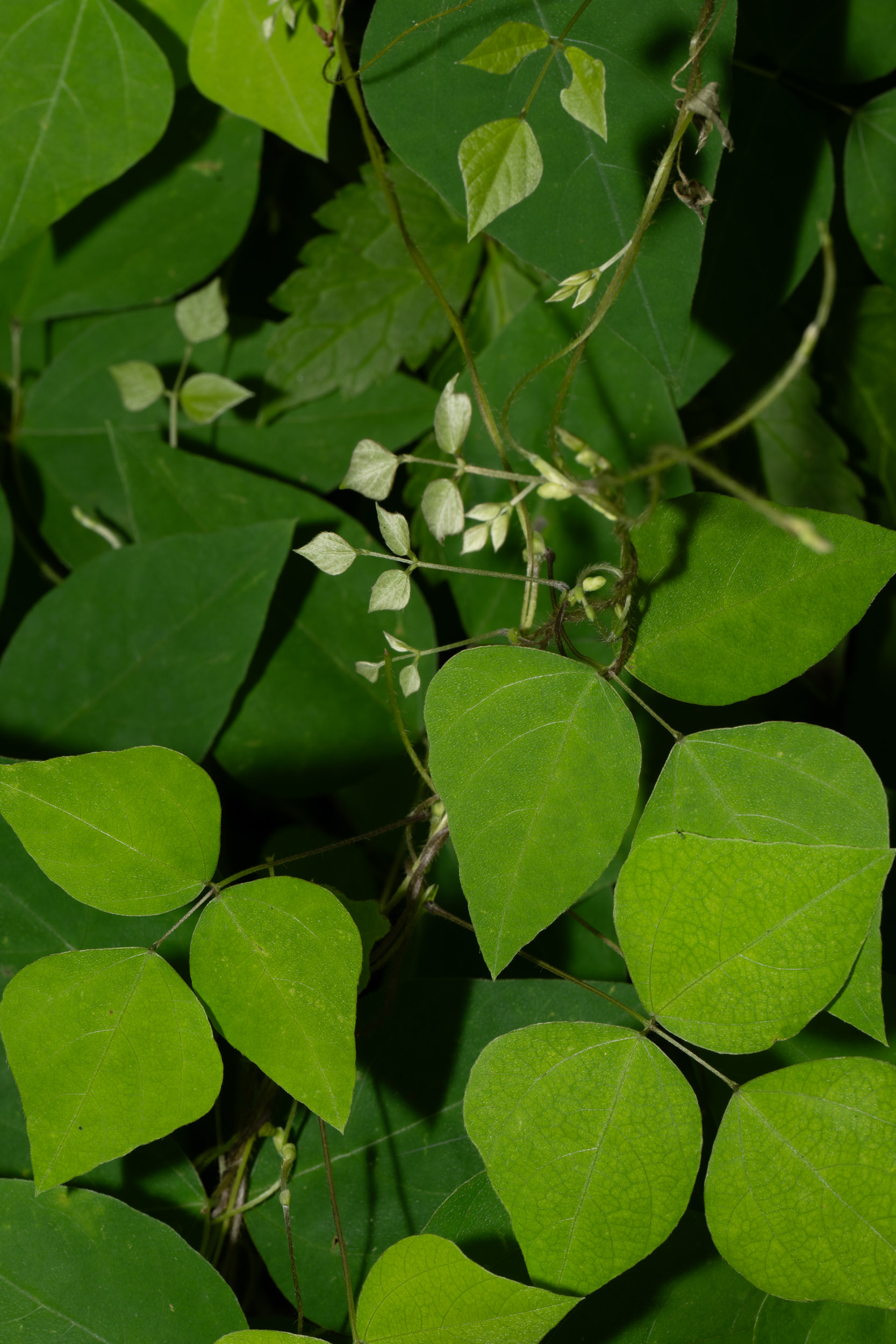
7/25/2025 · River Point Conservation Area, Falmouth, Maine · ≈ 5 × 8″ (12 × 19 cm) 

7/23/2017 · Pine Grove Furnace State Park, Pennsylvania · ≈ 10 × 6″ (24 × 16 cm) 

8/25/2019 · Blue Trail, Willard Brook State Park, Ashby, Massachusetts 

8/25/2019 · Blue Trail, Willard Brook State Park, Ashby, Massachusetts 

8/29/2023 · Stetser Preserve, Jefferson, Maine · ≈ 10 × 6″ (24 × 16 cm) 

8/22/2020 · Crossbill Trail, Hidden Valley Nature Center, Jefferson, Maine · ≈ 2½ × 3″ (6.6 × 8.2 cm) 

7/18/2020 · Woodward Point Preserve, Brunswick, Maine · ≈ 10 × 6″ (24 × 16 cm) 

7/6/2026 · Hideaway Farm, Topsham, Maine · ≈ 8 × 5″ (20 × 13 cm) 

7/1/2023 · Pocahontas State Park, Chesterfield, Virginia 

8/26/2018 · Henry E. Cowdrey Nature Center, Lunenburg, Massachusetts · ≈ 4 × 6″ (11 × 15 cm) 

8/25/2019 · Blue Trail, Willard Brook State Park, Ashby, Massachusetts 

8/29/2023 · Stetser Preserve, Jefferson · ≈ 8 × 5″ (20 × 13 cm) 

7/23/2017 · Pine Grove Furnace State Park, Pennsylvania · ≈ 10 × 6″ (24 × 16 cm) 

8/26/2018 · Henry E. Cowdrey Nature Center, Lunenburg, Massachusetts · ≈ 7 × 4½″ (18 × 12 cm) 

(The wide leaves are Desmodium nudiflorum) · 7/1/2023 · Pocahontas State Park, Chesterfield, Virginia 
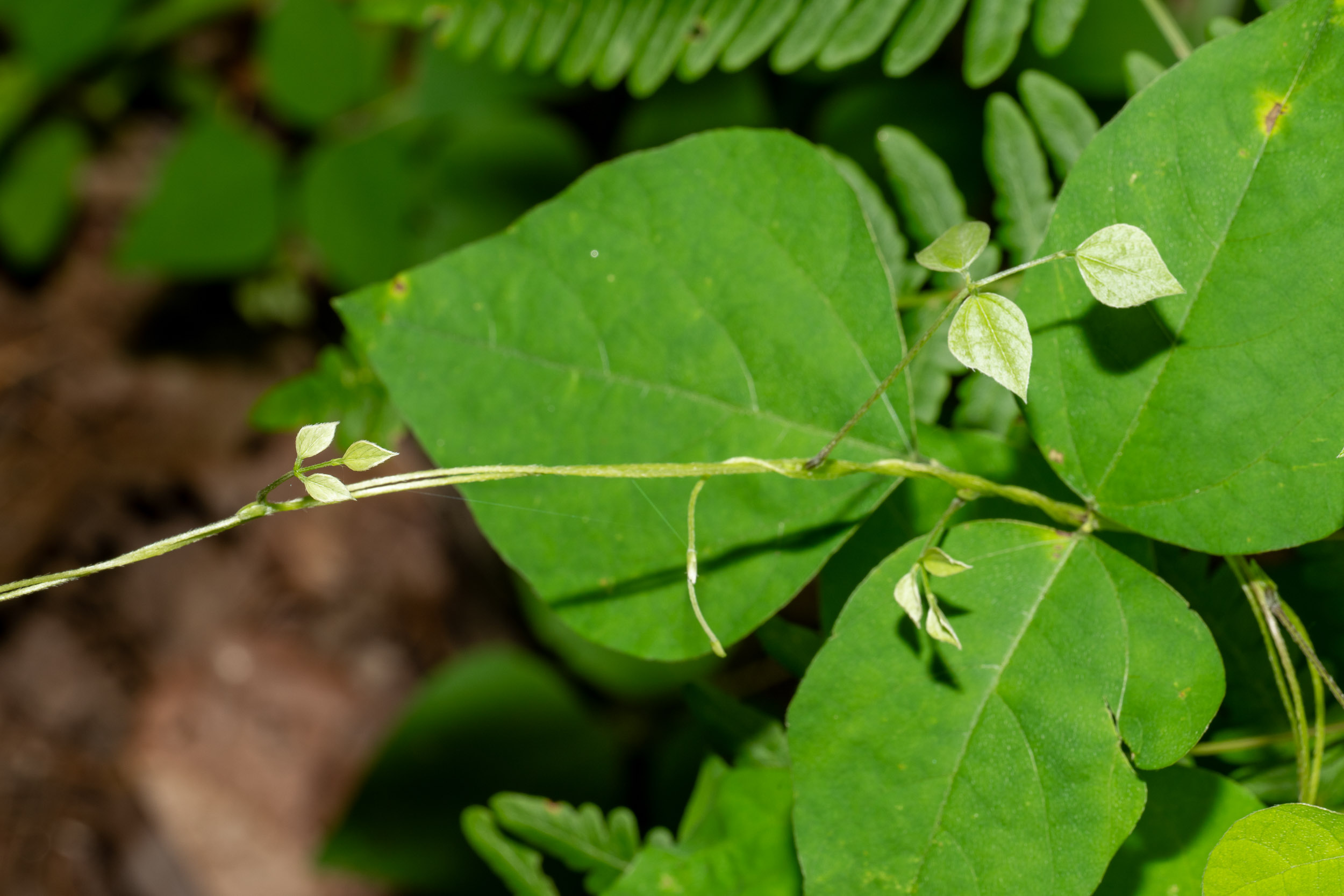
7/6/2026 · Hideaway Farm, Topsham, Maine · ≈ 6 × 4″ (16 × 10 cm) 

8/25/2019 · Blue Trail, Willard Brook State Park, Ashby, Massachusetts 
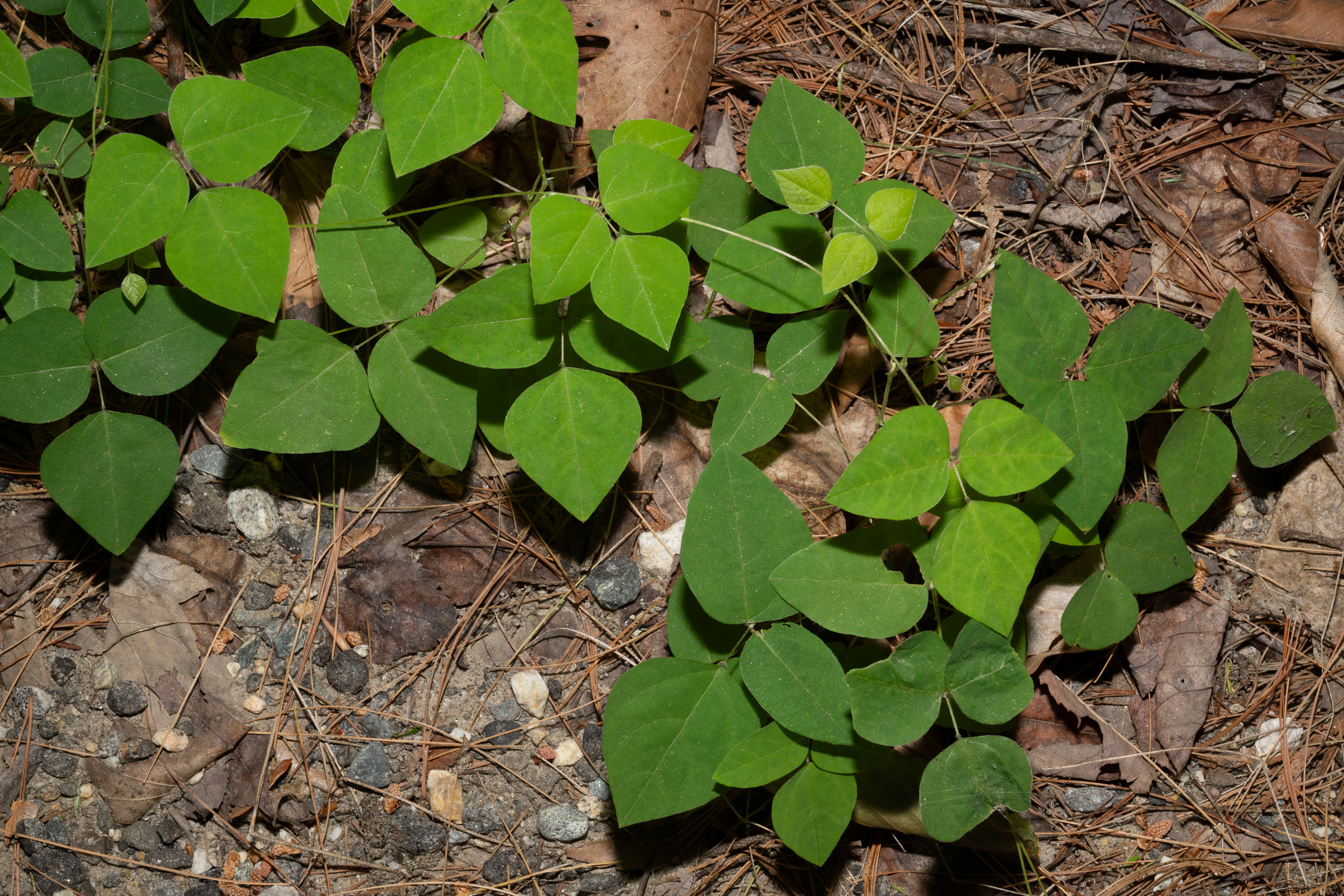
6/27/2025 · Butler Head Preserve, Bath, Maine · ≈ 16 × 11″ (40 × 27 cm) 
| Kingdom | Plantae | Plants, but not fungi, lichens, or algae (from Stearn's Botanical Latin) |
| Subkingdom | Tracheobionta | Vascular plants—plants with a “circulatory system” for delivering water and nutrients |
| Division | Magnoliophyta | Flowering plants, also known as angiosperms |
| Class | Magnoliopsida | Dicotyledons—plants with two initial seed leaves |
| Subclass | Rosidae | Roses, legumes, proteas, dogwoods, hydrangeas, mistletoes, euphorbias, grapes, many more |
| Order | Fabales | Legumes (pea and bean families) |
| Family | Fabaceae | Legume family (peas and beans) |
| Genus | Amphicarpaea | Greek for two-seeded, referring to two types of seeds |
| Species | bracteata | Bearing bracts (modified leaves) |
| var. | bracteata | Bearing bracts (modified leaves) |

Amphicarpaea bracteata var. bracteata description by Thomas H. Kent, not updated.

© FloraFinder.org. All rights reserved.