Cornella canadensis (L.) Rydb.
Cornus canadensis L. var. dutillyi (Lepage) B. Boivin
Cornus canadensis L.
Bunchberry, Canadian dwarf cornel, Canadian bunchberry, crackerberry, bunchberry dogwood
Bunchberry (which has many other common names, not all of which are listed here), is a native of mid- to northern North America.
Plants: Rarely exceeds 8″ (20 cm) in height. It is the smallest member of the dogwood family.
Leaves: It has alternate pairs of oval leaves, oriented for maximum exposure, to sop up the light on the dappled forest floors it favors. I often see these plants in large, almost continuous mats.
Flowers: The four white “flower petals” are really bracts—modified leaves. They surround the real flowers, a tiny cluster of greenish flowers.
Fruits: The flowers grow into a dense group of bright red berries.
The flower structure forms a powerful, spring-loaded launch facility for the pollen, a unique mechanism among flowering plants, as described by its discoverer, Dr. Ted Mosquin:
Then with dissecting needles I began opening one of the buds, only to discover that it seemed to transform itself in a fraction of a second into a fully open flower. I turned to a second bud, opened it and found four normal-looking, fully developed, undehisced anthers. I tried a third and was again surprised by what appeared to be a tiny explosion and what seemed like a small amount of pollen flying in all directions. I realized then that I might be looking at a unique phenomenon-perhaps never before witnessed by humans and perhaps undescribed. It was then that I began to pay more attention to another unusual characteristic of each flower. On the abaxial side and near the tip of one of the four petals of each unopened flower and projecting upward was a miniature “antenna” just over one mm long. It did not take long to establish that even the slightest touch of the dissecting needle to the antenna of any “ready to pop” flower would trigger the explosive mechanism; the petals would reflex, the anthers would spring out simultaneously like four tiny catapults and shoot their entire pollen loads into the air above the inflorescence.
(See “”The explosive pollination mechanism in Cornus canadensis” for details.)
Habitats: Forest floors, bogs.
Edibility: Ripe berries are edible, though they contain a hard seed and are fairly tasteless. They can be cooked into puddings.
Online References:
References:

5/15/2010 · By Constance B. Kent 

5/14/2010 · Beaver Brook Conservation Area, Hollis, New Hampshire · ≈ 3½ × 3½″ (9.3 × 9.8 cm) 

6/2/2023 · Ovens Mouth West, Blue Trail, Boothbay, Maine 

7/20/2023 · Curtis Farm Preserve, Harpswell, Maine 

6/6/2026 · Lincoln, New Hampshire · By Heather A. Kent 

8/8/2015 · Mt. Wachusett · ≈ 6 × 6″ (16 × 15 cm) 

8/15/2015 · Grafton Notch State Park, Newry, Maine · ≈ 2½ × 1½′ (79 × 53 cm) 

7/5/2021 · Curtis Farm Preserve, Harpswell, Maine · ≈ 7 × 4½″ (16 × 11 cm) 

8/15/2015 · Grafton Notch State Park, Newry, Maine · ≈ 10 × 7″ (25 × 16 cm) 

4/19/2010 

6/9/2025 · Curtis Farm Preserve, Harpswell, Maine · ≈ 10 × 9″ (26 × 24 cm) 

7/12/2015 · Mt. Kearsarge, Wilmot/Warner, New Hampshire · ≈ 4½ × 4″ (11 × 9.9 cm) 

5/20/2021 · Eaton Farm Preserve, Wiscasset, Maine · ≈ 3½ × 4″ (9 × 11 cm) 
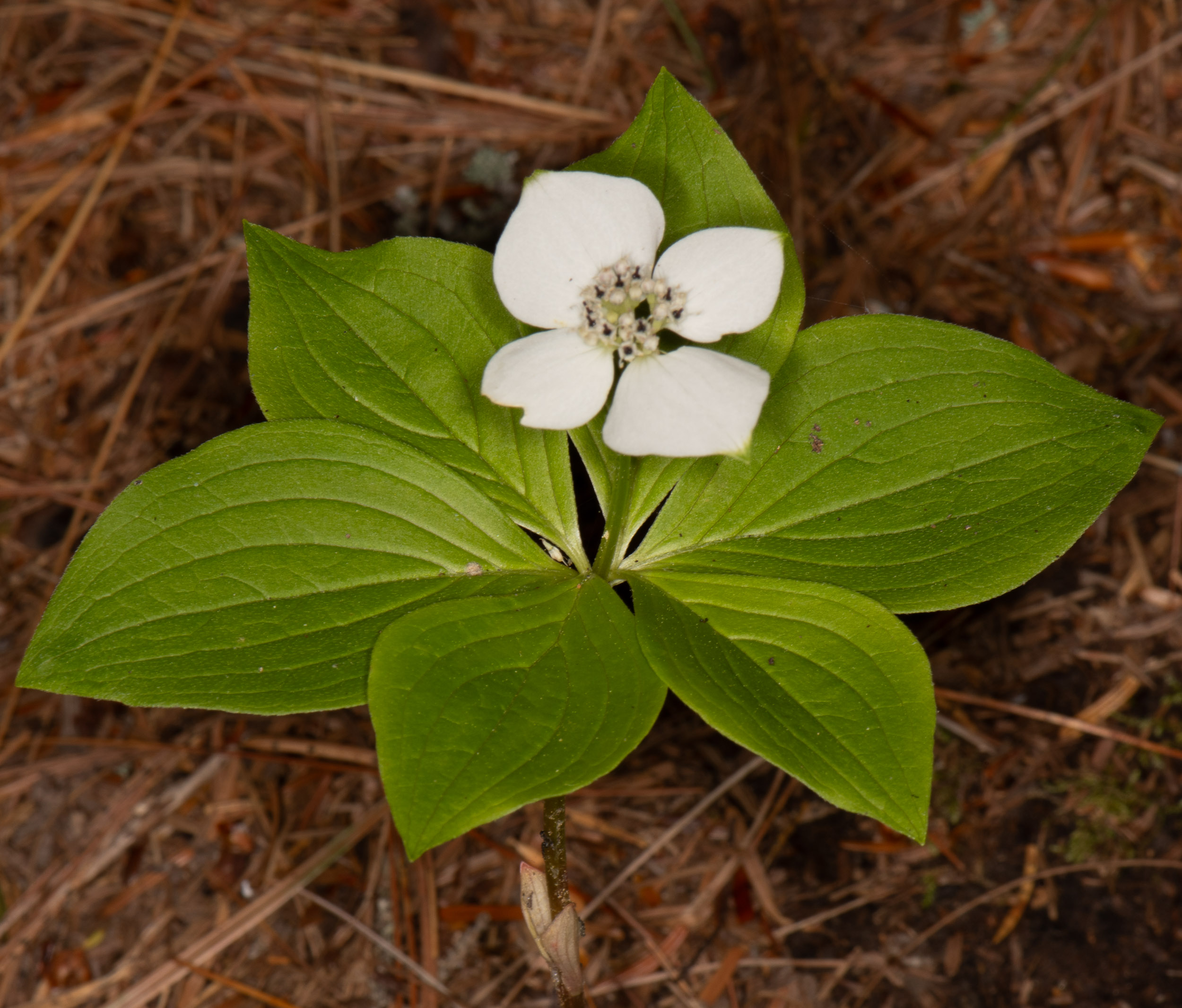
6/3/2021 · ≈ 5 × 4½″ (13 × 11 cm) 
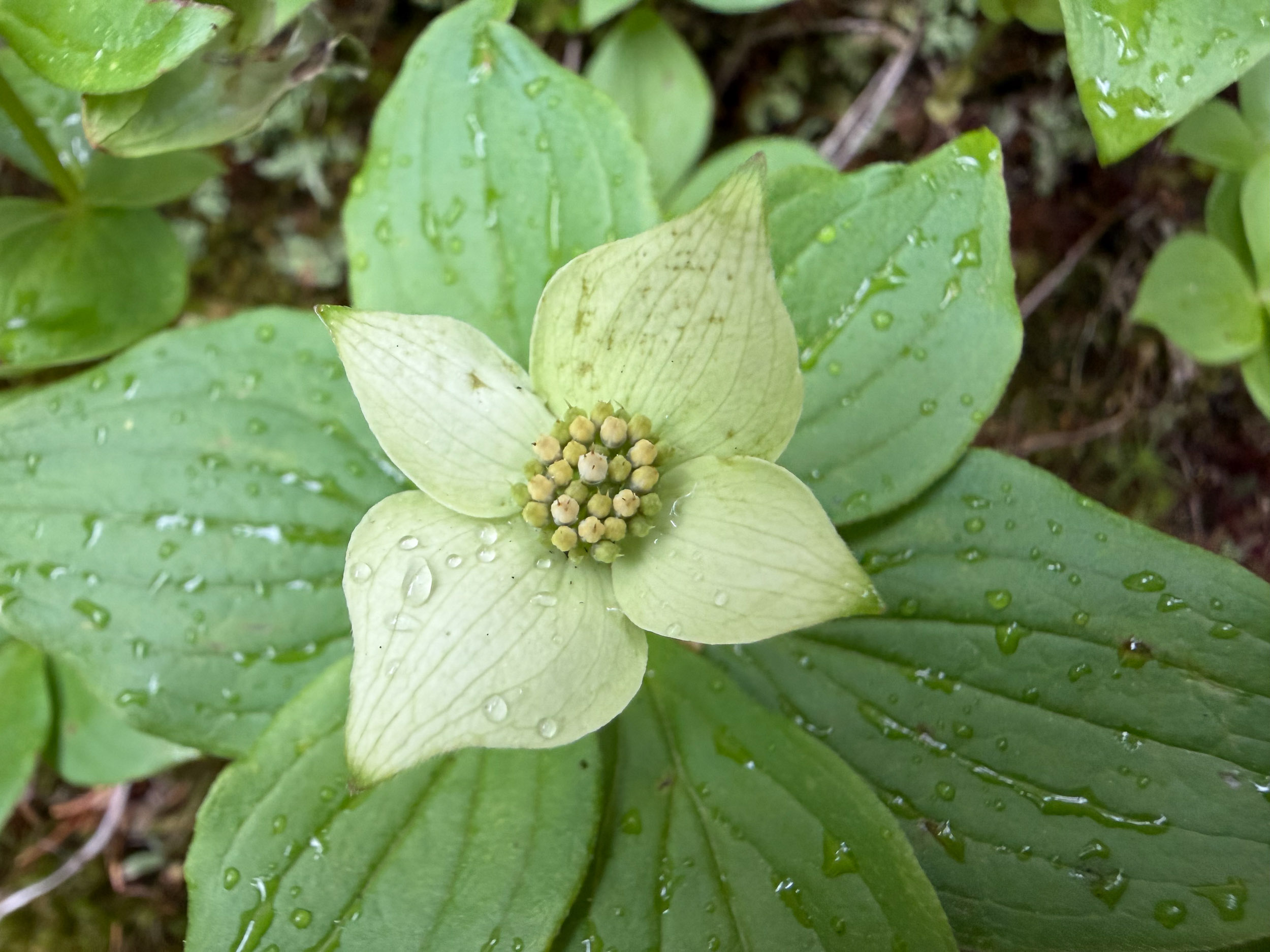
6/6/2026 · Lincoln, New Hampshire · By Heather A. Kent 

6/9/2026 · Lost Pond Trail, Pinkham Notch, New Hampshire · ≈ 7 × 6″ (17 × 14 cm) 

3/12/2024 · Chase Preserve, Brunswick, Maine 

6/9/2016 · Monhegan Island, Maine 

The white “flower petals,” actually bracts, start out green, since they are really repurposed leaves. · 5/12/2023 · Long Reach Preserve, Harpswell, Maine 

7/26/2020 · Eaton Farm Preserve, Wiscasset, Maine · ≈ 5 × 4″ (13 × 10 cm) 

5/26/2016 · Pearl Hill State Park, Ashby, Massachusetts 

6/2/2013 · Beaver Brook Conservation Area, Hollis, New Hampshire · ≈ 6 × 4½″ (14 × 11 cm) 

7/12/2020 · Harraseeket Trail, Wolfe’s Neck Woods State Park, Freeport, Maine · ≈ 6 × 8″ (16 × 21 cm) 

8/1/2009 · Coastal Maine Botanical Gardens, Boothbay, Maine · ≈ 5 × 4″ (13 × 10 cm) 

5/25/2023 · Maquoit Bay Conservation Land, Brunswick, Maine 
| Kingdom | Plantae | Plants, but not fungi, lichens, or algae (from Stearn's Botanical Latin) |
| Subkingdom | Tracheobionta | Vascular plants—plants with a “circulatory system” for delivering water and nutrients |
| Division | Magnoliophyta | Flowering plants, also known as angiosperms |
| Class | Magnoliopsida | Dicotyledons—plants with two initial seed leaves |
| Subclass | Asteridae | A large class that encompasses asters |
| Order | Cornales | Includes dogwoods, hydrangeas, stickleafs, tupelos, even sillyberries |
| Family | Cornaceae | Dogwood family |
| Genus | Cornus | Latin for “a horn” |
| Species | canadensis | “From Canada” |
Cornus canadensis description by Thomas H. Kent, not updated.

© FloraFinder.org. All rights reserved.
