Craterellus cornucopioides (L.) Pers.
Black trumpet, horn of plenty, black chanterelle, trumpets du mort
The black trumpet is a coveted North American native. One common name for this fungus is trompette de la mort (trumpet of death), but this is based on appearance, not edibility.
Black trumpets are found in the woods, under oak, tanoak, manzanita, madrone, or huckleberry, usually nestled among mosses. Sometimes they’re practically invisible. I first encountered them in Ellen Zachos’ rural Pennsylvania back yard (downanddirtygardening.com). I was bewildered when she pointed them out. “Where are they?” “You’re standing on them.” These were only about a half inch tall, though she later wrote that they subsequently became much larger. Here in midcoast Maine, when conditions are right, these mushrooms are plentiful.
Identification: These chanterelles are 1¾–4½″ (5–12 cm) tall and ⅜–1¾″ (1–5 cm) wide. They may be dark gray, tan, dark brown, even nearly black. Instead of a dome-shaped cap, black trumpets have a trumpet- or funnel-shaped appearance. Gills run down the sides of the stalk, though they aren’t always visible. Black trumpets used to have a nearly identical twin, Craterellus fallax, and a lighter-brown near twin, Craterellus konradii, but recent DNA studies have confirmed that these are all the same species. Spore prints may be whitish, pale yellow, or pink.
Habitats: In woods under oak, tanoak, manzanita, madrone, or huckleberry.
Edibility: Black trumpets are delicious, prized for their odor, a mixture of woodsy and an apricot-like sweetness. They are added to spaghetti sauces, stir fries, and eggs.
Online References:
References:
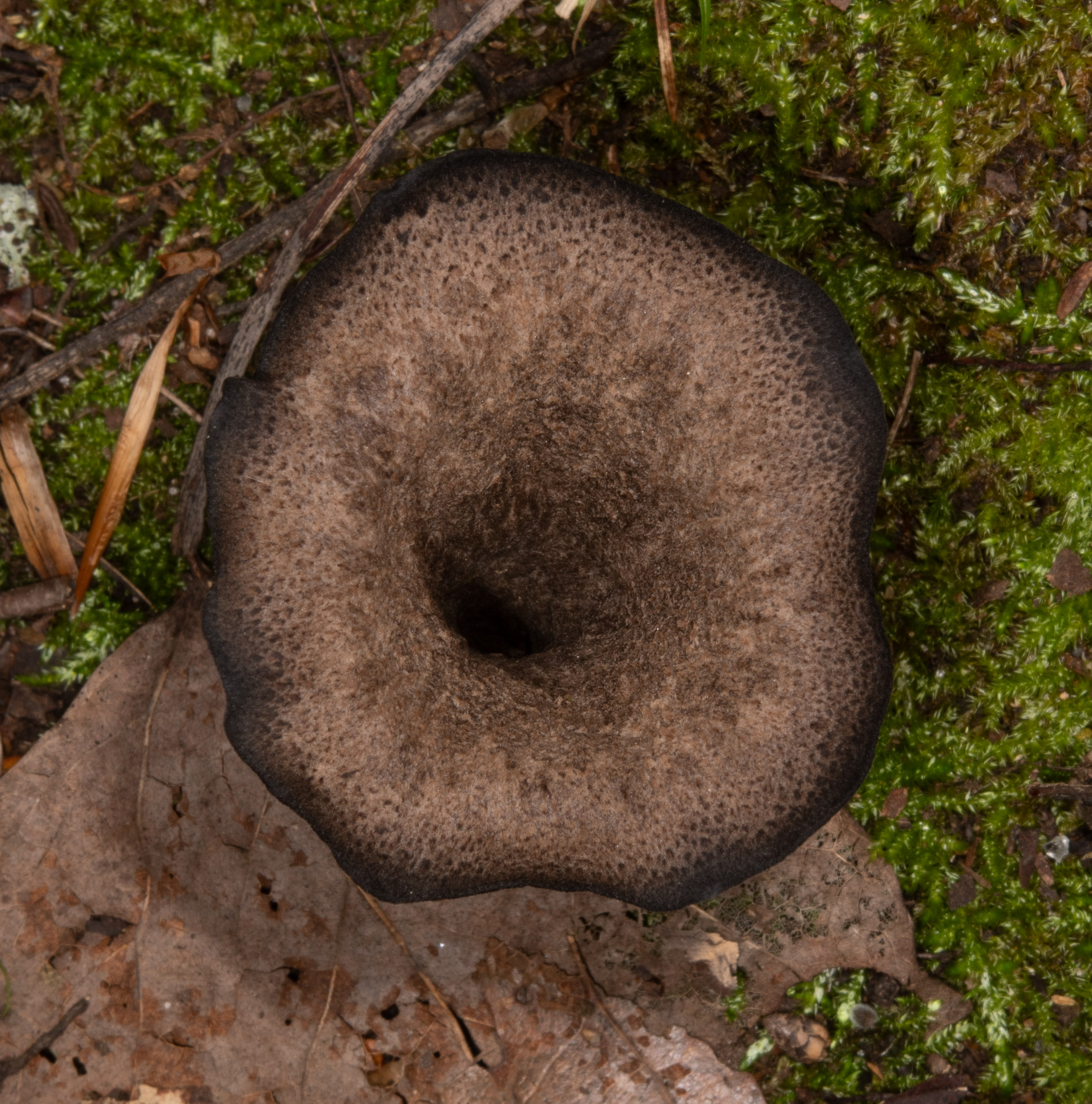
7/21/2020 · Cathance River Nature Preserve, Topsham, Maine · ≈ 3½ × 3½″ (8.6 × 8.7 cm) 

8/21/2018 · Oak Hill, Littleton, Massachusetts · ≈ 3½ × 2½″ (9.5 × 7.3 cm) 
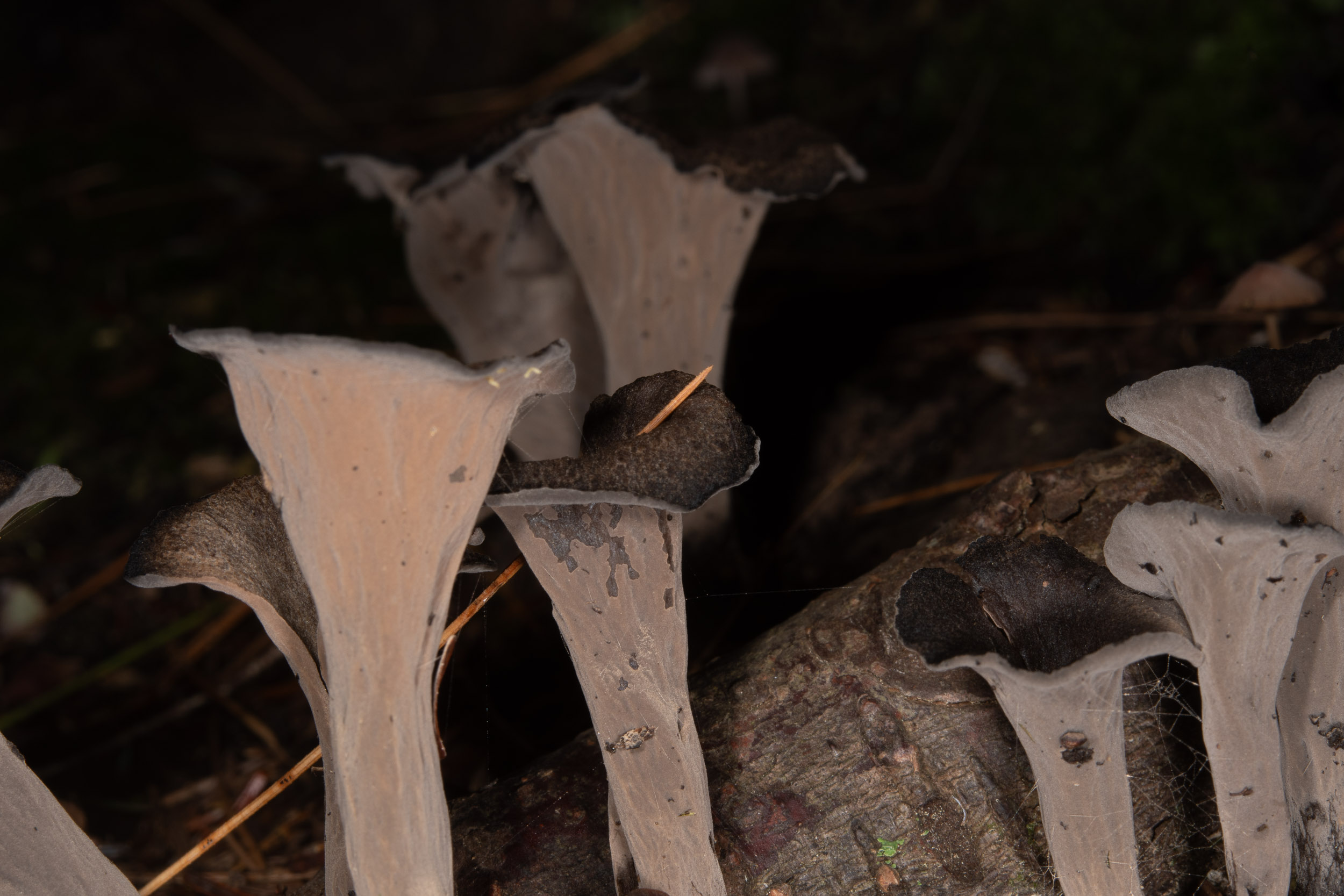
7/19/2020 · Heath Trail, Cathance River Nature Preserve, Topsham, Maine · ≈ 5 × 3″ (12 × 8.4 cm) 

8/24/2018 · Old Long Loop, Beaver Brook Conservation Area, Hollis, New Hampshire · ≈ 5 × 4″ (12 × 10 cm) 

8/12/2023 · Highlands Trail via Pismire Bluffs Trail, Raymond Community Forest, Raymond, Maine · ≈ 4 × 5″ (10 × 12 cm) 

8/21/2018 · Oak Hill, Littleton, Massachusetts · ≈ 3 × 3″ (8.5 × 7.4 cm) 

7/2/2011 · Mike and Ellen’s, Milford, Pennsylvania · ≈ 4 × 2½″ (10 × 7.3 cm) 

8/24/2018 · Old Long Loop, Beaver Brook Conservation Area, Hollis, New Hampshire · ≈ 4 × 5″ (9.9 × 12 cm) 

8/26/2018 · Henry E. Cowdrey Nature Center, Lunenburg, Massachusetts · ≈ 2½ × 3½″ (7.3 × 9.1 cm) 

9/4/2021 · Bradbury Mountain State Park, Pownal, Maine · ≈ 4½ × 3″ (11 × 7.9 cm) 

8/24/2018 · Old Long Loop, Beaver Brook Conservation Area, Hollis, New Hampshire · ≈ 3 × 3″ (8.3 × 7.9 cm) 

8/26/2018 · Henry E. Cowdrey Nature Center, Lunenburg, Massachusetts · ≈ 2½ × 3″ (7.1 × 7.4 cm) 

7/14/2013 · Ball Hill Trail, Leominster State Forest, Leominster, Massachusetts · ≈ 6 × 7″ (16 × 17 cm) 

7/2/2011 · Mike and Ellen’s, Milford, Pennsylvania · ≈ 2 × 2½″ (5.9 × 7.2 cm) 

8/14/2015 · Roost Trail, Grafton Notch State Park, Newry, Maine · ≈ 4 × 3½″ (10 × 9.8 cm) 

8/24/2018 · Old Long Loop, Beaver Brook Conservation Area, Hollis, New Hampshire · ≈ 6 × 6″ (15 × 16 cm) 

8/12/2023 · Highlands Trail via Pismire Bluffs Trail, Raymond Community Forest, Raymond, Maine · ≈ 7 × 4½″ (18 × 12 cm) 

10/16/2013 · Blue Trail, Willard Brook State Park, Ashby, Massachusetts · ≈ 5 × 4″ (13 × 10 cm) 

7/14/2013 · Ball Hill Trail, Leominster State Forest, Leominster, Massachusetts · ≈ 3½ × 4″ (9.5 × 9.9 cm) 

7/14/2013 · Ball Hill Trail, Leominster State Forest, Leominster, Massachusetts · ≈ 7 × 5″ (16 × 12 cm) 

8/17/2021 · Center Pond Preserve, Red Trail, Phippsburg, Maine · ≈ 5 × 3½″ (12 × 9.7 cm) 

8/12/2023 · Highlands Trail via Pismire Bluffs Trail, Raymond Community Forest, Raymond, Maine · ≈ 5 × 4″ (13 × 10 cm) 

8/24/2018 · Old Long Loop, Beaver Brook Conservation Area, Hollis, New Hampshire · ≈ 6 × 4″ (14 × 10 cm) 

7/2/2011 · Mike and Ellen’s, Milford, Pennsylvania · ≈ 3 × 2″ (8.4 × 5.9 cm) 

7/28/2017 · Porcupine Trail, Beaver Brook Conservation Area, Hollis, New Hampshire · ≈ 2 × 2″ (5.2 × 5.2 cm) 

7/28/2017 · Porcupine Trail, Beaver Brook Conservation Area, Hollis, New Hampshire · ≈ 2 × 3″ (5.8 × 7.7 cm) 
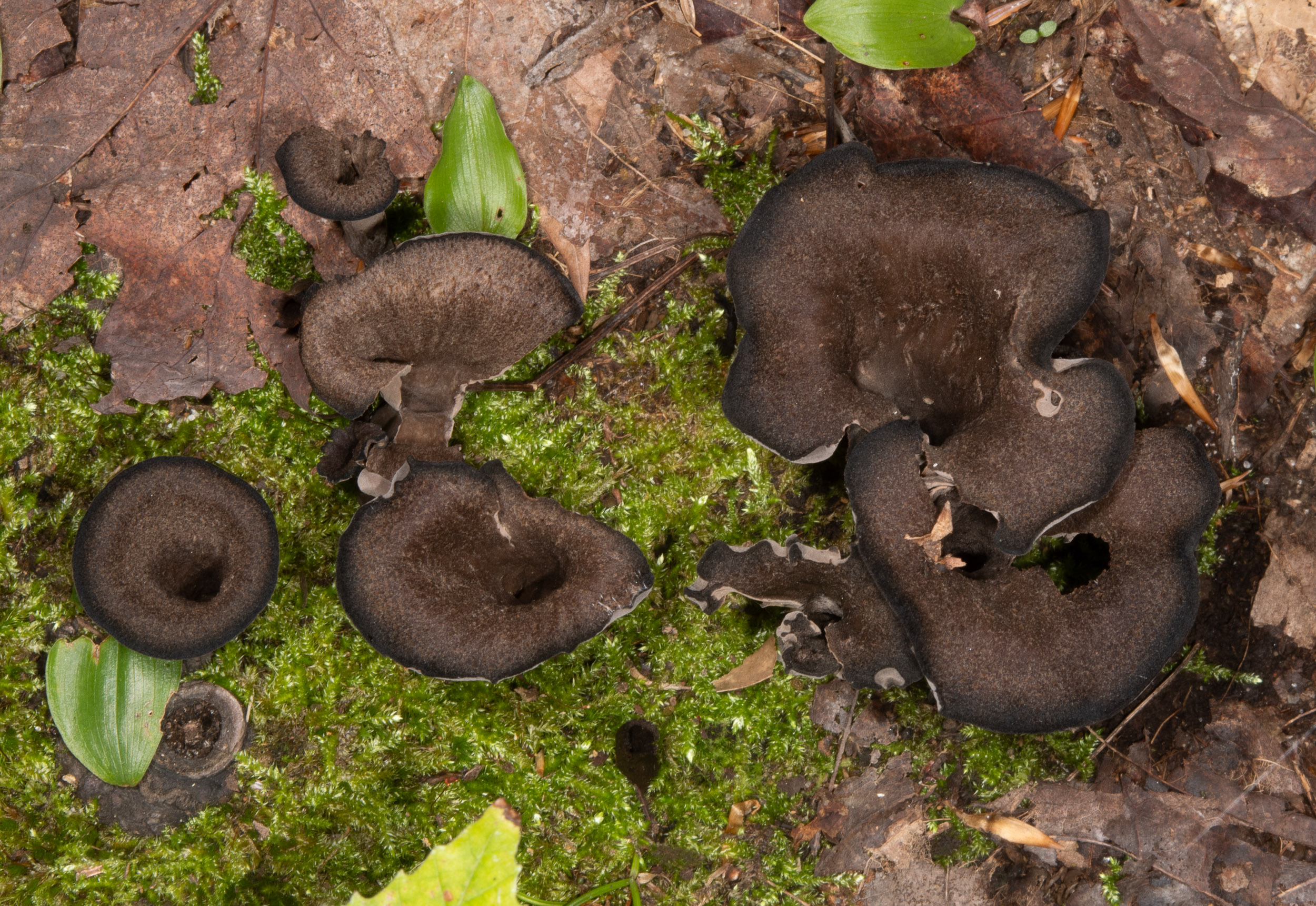
7/21/2020 · Cathance River Nature Preserve, Topsham, Maine · ≈ 7 × 5″ (19 × 13 cm) 
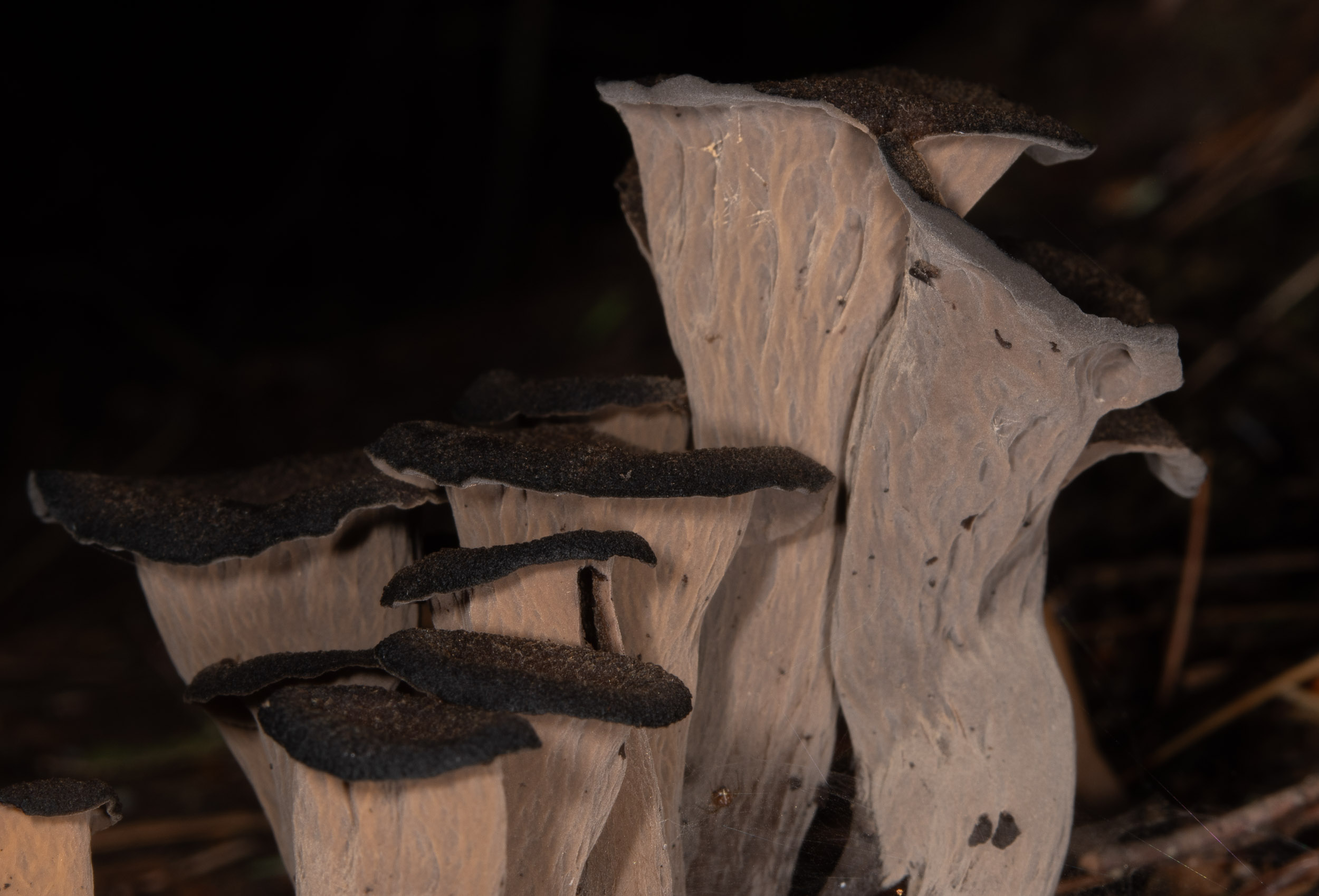
7/19/2020 · Heath Trail, Cathance River Nature Preserve, Topsham, Maine · ≈ 3½ × 2½″ (9.5 × 6.5 cm) 

8/21/2018 · Oak Hill, Littleton, Massachusetts · ≈ 3½ × 3″ (9.2 × 7.9 cm) 

7/2/2011 · Mike and Ellen’s, Milford, Pennsylvania · ≈ 3½ × 2½″ (9.8 × 6.6 cm) 

10/16/2008 · 43° 10' 16" N, 4° 59' 50.5" W, Sajambre, León, Spain · By David Perez 

10/16/2013 · Blue Trail, Willard Brook State Park, Ashby, Massachusetts · ≈ 5 × 4½″ (13 × 12 cm) 
| Roughly 75 people in North America are poisoned each year by mushrooms, often from eating a poisonous species that resembles an edible species. Though deaths are rare, there is no cure short of a liver transplant for severe poisoning. Don’t eat any mushroom unless you are absolutely certain of its identity! Please don’t trust the identifications on this site. We aren’t mushroom experts and we haven’t focused on safely identifying edible species. |
Craterellus cornucopioides description by Thomas H. Kent, not updated.

© FloraFinder.org. All rights reserved.