Equisetum pratense Ehrh.
Meadow horsetail
Meadow horsetails, like other members of the genus, prefer moist habitats.
Plants: Meadow horsetails have thin light green fragile-looking branches, in symmetric whorls off the main stem, and don’t exceed about 2′ (60 cm) in height. Branches tend to be straight, or to droop somewhat, while in other species the branches are ascending. Stems are 1/32–⅛″ (1–4 mm) in diameter, with 8-18 ridges. A cross-section of a sterile stem reveals that up to half the diameter of the stem is hollow, more so than with marsh horsetail. Fertile stems are 8–10″ (20–25 cm) tall, and pale pink or brownish at first, tipped by a cone-like sporangia. After fruiting, though, the fertile stems become green and develop branches, looking like the sterile stems. Sterile stems are 8–24″ (20–60 cm) tall, and very rough.
Leaves: Tiny, non-photosynthetic leaves called scales are fused to the stem at branch nodes, or sheaths. Sheaths are 1/16–⅛″ (2–6 mm) long, with 8-10 brown, white-edged teeth.
Fruits: Fertile stems are tipped by a single blunt-tipped cone-like strobilus, ½–1½″ (1.5–4 cm) long, atop a stalk. Spores are released in April.
Habitats: Moist habitats such as woods, thickets, river edges, and meadows, in sunlight or partial shade.
Edibility: These aren’t eaten by people, but caribou, moose, grizzly bears, geese, and sheep consume it. (Horses may consume this, but some species of Equisetum are toxic to horses.)
See Equisetum for a comparison chart.
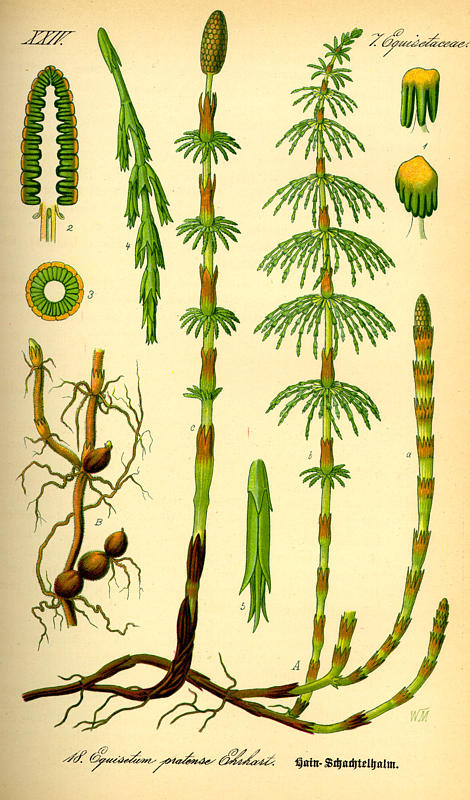
From Thomé, Prof. Dr. Otto Wilhelm, Flora von Deutschland Österreich und der Schweiz., 1885 
Online References:
Discover Life (Equisetum)
References:

9/29/2013 · Compass Harbor, Acadia National Park, Bar Harbor, Maine · ≈ 8 × 6″ (20 × 14 cm)  ID is uncertain

5/9/2012 · Nashua River Rail Trail, Groton Center, Groton, Massachusetts · ≈ 12 × 8″ (31 × 20 cm) ID is uncertain 

4/30/2010 · Nashua River Rail Trail, Ayer, Massachusetts · ≈ 11 × 7″ (27 × 18 cm) ID is uncertain 

5/21/2013 · Beaver Brook Conservation Area, Hollis, New Hampshire · ≈ 12 × 8″ (31 × 21 cm) 

8/17/2020 · Otter Brrok Preserve, Harpswell Heritage Land Trust, Harpswell, Maine · ≈ 8 × 5″ (20 × 13 cm) 

5/2/2010 · Nashua River Rail Trail, Groton Center, Groton, Massachusetts · ≈ 10 × 14″ (26 × 35 cm) ID is uncertain 

8/17/2020 · Otter Brrok Preserve, Harpswell Heritage Land Trust, Harpswell, Maine · ≈ 7 × 6″ (17 × 16 cm) 

5/13/2021 · Otter Brrok Preserve, Harpswell Heritage Land Trust, Harpswell, Maine · ≈ 5 × 6″ (13 × 16 cm) 

8/2/2009 · Gordon & Kathy’s, Prospect, Maine · ≈ 10 × 10″ (25 × 26 cm) ID is uncertain 

About 8 x 5" · 9/4/2010 · Old Rail Trail near Wilkins Farm, Pepperell, Massachusetts ID is uncertain 

5/13/2021 · Otter Brrok Preserve, Harpswell Heritage Land Trust, Harpswell, Maine · ≈ 6 × 8″ (16 × 19 cm) 

8/30/2010 · Old RR bed near Wilkins Farm, Pepperell, Massachusetts · ≈ 9 × 12″ (23 × 31 cm) ID is uncertain 

5/13/2021 · Otter Brrok Preserve, Harpswell Heritage Land Trust, Harpswell, Maine · ≈ 4½ × 6″ (12 × 15 cm) 

6/20/2021 · Heath, Cathance River Nature Preserve, Highland Green, Topsham, Maine · ≈ 6 × 4″ (16 × 10 cm) 

9/29/2013 · Compass Harbor, Acadia National Park, Bar Harbor, Maine · ≈ 6 × 8″ (14 × 20 cm) ID is uncertain 
| Kingdom | Plantae | Plants, but not fungi, lichens, or algae (from Stearn's Botanical Latin) |
| Subkingdom | Tracheobionta | Vascular plants—plants with a “circulatory system” for delivering water and nutrients |
| Division | Equisetophyta | Horsetails, which date back to the Devonian era |
| Class | Equisetopsida | Horsetails, spore-bearing plants related to ferns |
| Order | Equisetales | Living horsetails (most are extinct) |
| Family | Equisetaceae | Living horsetails |
| Genus | Equisetum | From equus, horse; and seta, bristle |
| Species | pratense | Growing in meadows |

Equisetum pratense description by Thomas H. Kent, not updated.

© FloraFinder.org. All rights reserved.