Aster carmesinus Burgess
Aster castaneus Burgess
Aster claytonii Burgess
Aster divaricatus L.
Aster excavatus Burgess
Aster flexilis Burgess
Aster stilettiformis Burgess
Aster tenebrosus Burgess
Eurybia divaricata (L.) G.L. Nesom
White heart-leaved aster, white star aster, white wood aster, wood aster
White wood aster is native to northeastern North America, primarily in the United States, less commonly in Canada.
Plants: Plants are typically 12–35″ (30–90 cm) tall. A single, erect stem, mostly hairless except at the base, supports the flowers.
Leaves: The leaves are a bit complicated. All the leaf types are sharply serrated, with 6-15 teeth per side, and small hairy projections along the leaf margins. But:
Flowers: Flowerheads are corymbs of 4 to 50 dense white flowers with yellow or red centers. Flower stalks are up to ½″ (1.5 cm) long, and densely hairy.
Fruits: Cypselae are brown in colour, and roughly cylindrical or egg-shaped. They are 1/16–⅛″ (2.6–3.8 mm) long, with stiff bristly hairs, and 7-10 ribs. The pappi—parachutes for wind distribution, have reddish to cream-coloured bristles.
Habitats: Dry open woods, edges of woods, and clearings, in partial shade.
 |
Similar species. |
Online References:

8/14/2009 · Nashua River Rail Trail, East Pepperell, Massachusetts · ≈ 14 × 9″ (35 × 23 cm) 

8/14/2009 · Nashua River Rail Trail, East Pepperell, Massachusetts · ≈ 8 × 12″ (20 × 31 cm) 

8/18/2010 · J. Harry Rich Woods, off Nod Rd., Groton, Massachusetts · ≈ 4½ × 3½″ (11 × 9 cm) 

8/14/2009 · Nashua River Rail Trail, East Pepperell, Massachusetts · ≈ 6 × 9″ (14 × 22 cm) 

8/14/2009 · Nashua River Rail Trail, East Pepperell, Massachusetts · ≈ 11 × 7″ (27 × 18 cm) 

8/14/2009 · Nashua River Rail Trail, East Pepperell, Massachusetts · ≈ 11 × 7″ (27 × 18 cm) 
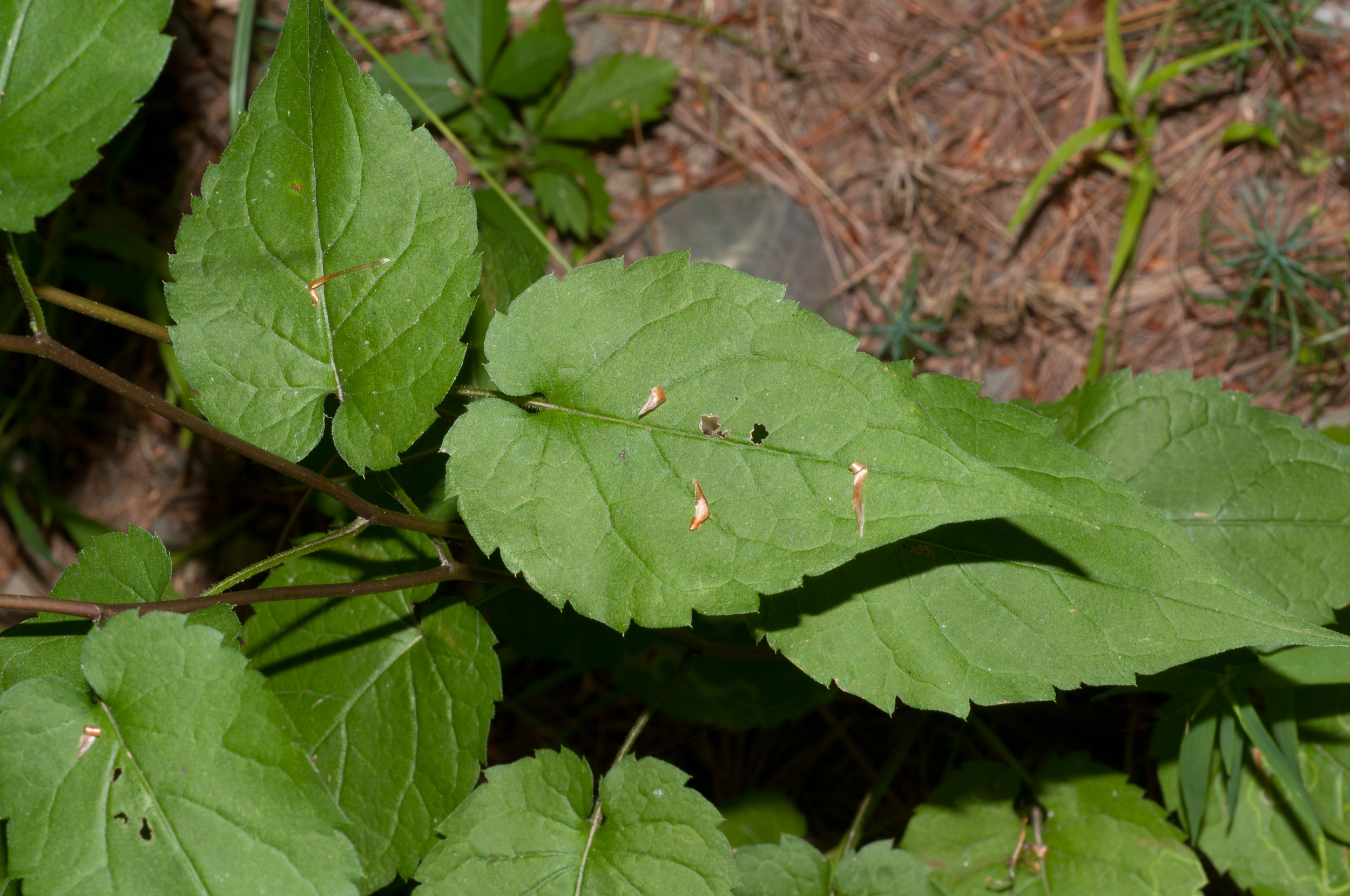
8/18/2010 · J. Harry Rich Woods, off Nod Rd., Groton, Massachusetts · ≈ 9 × 6″ (23 × 15 cm) 

8/18/2010 · J. Harry Rich Woods, off Nod Rd., Groton, Massachusetts · ≈ 8 × 5″ (19 × 13 cm) 
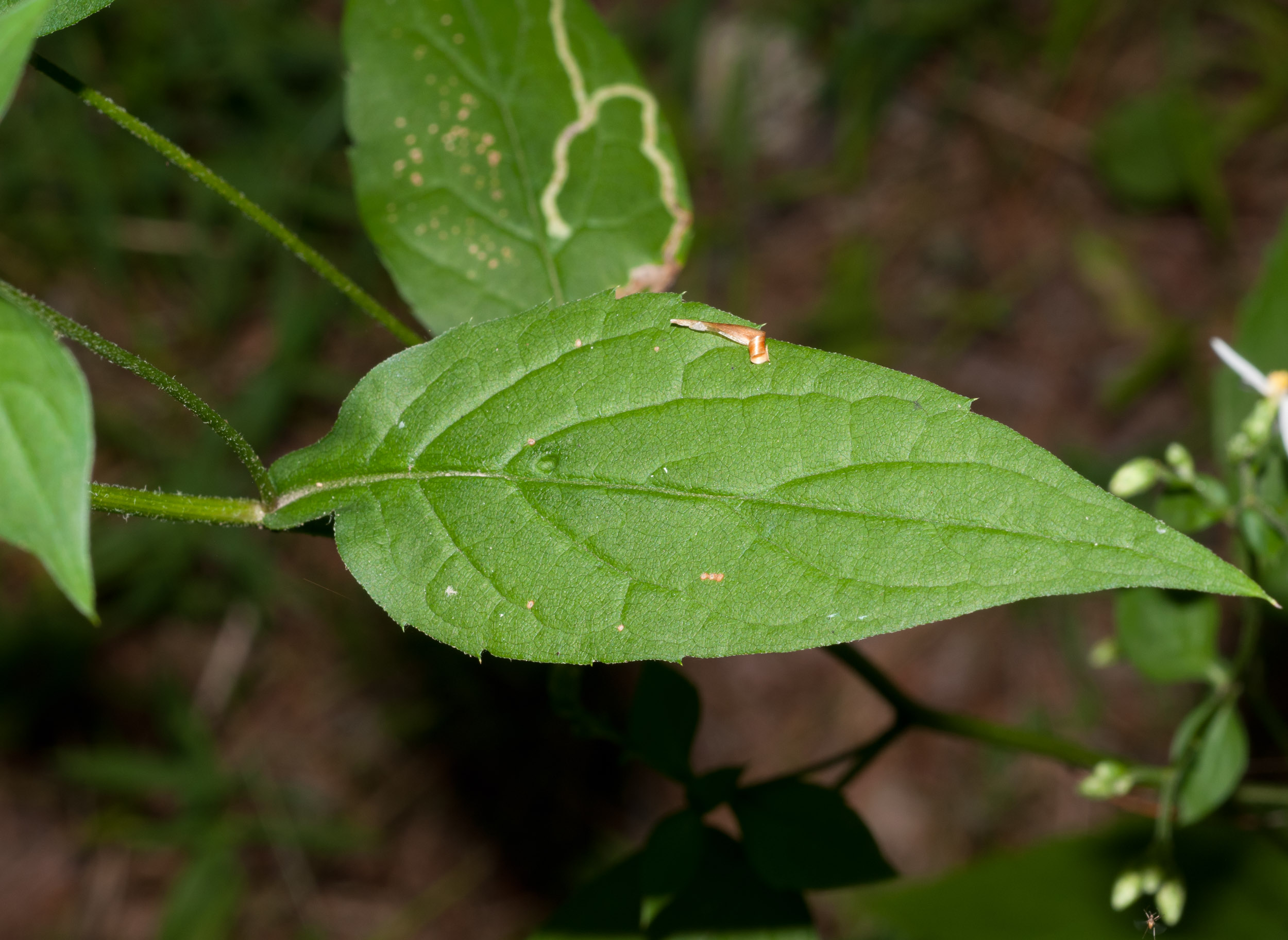
8/18/2010 · J. Harry Rich Woods, off Nod Rd., Groton, Massachusetts · ≈ 6 × 4″ (14 × 10 cm) 

8/18/2010 · J. Harry Rich Woods, off Nod Rd., Groton, Massachusetts · ≈ 7 × 4½″ (16 × 12 cm) 
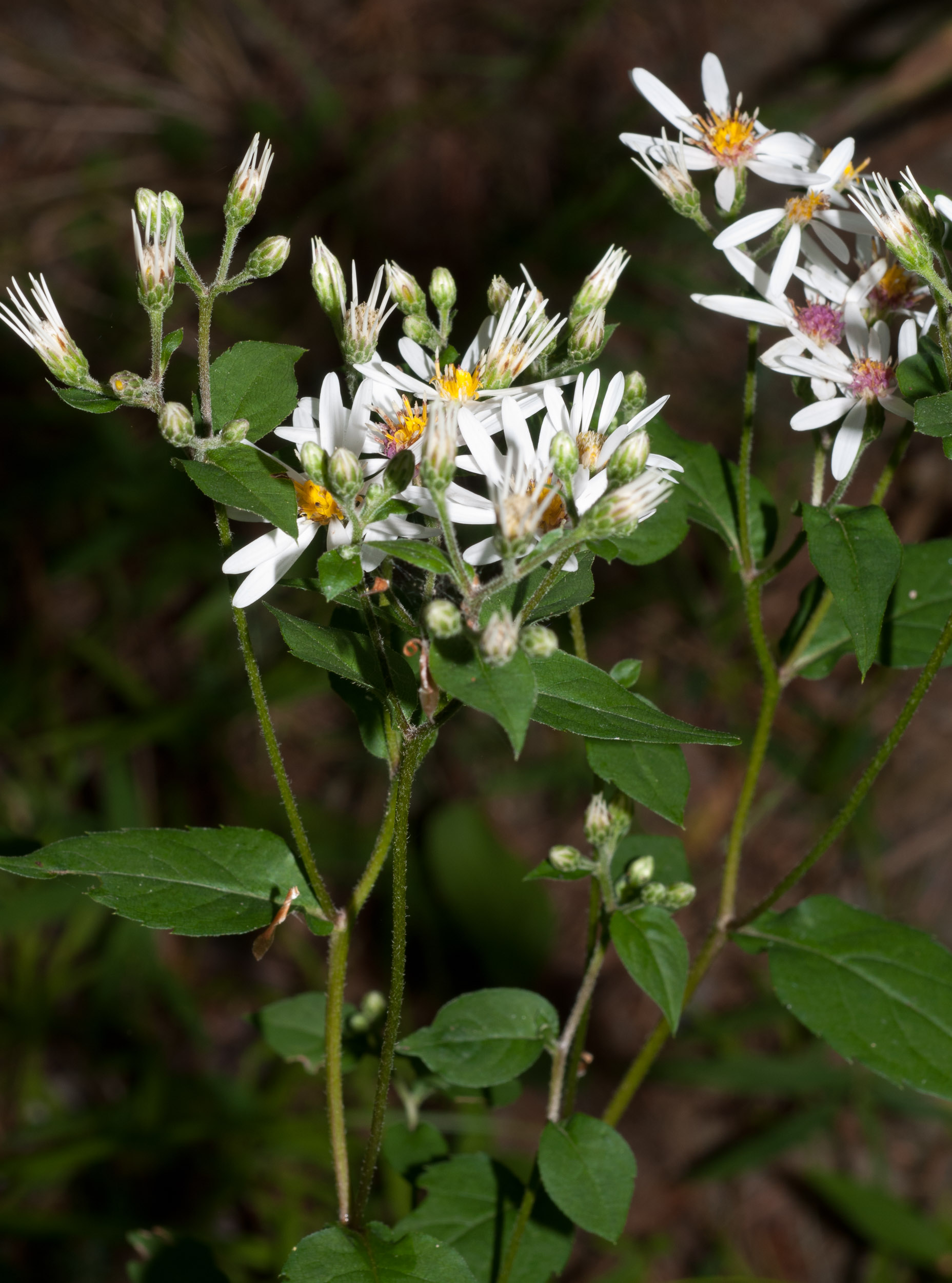
8/18/2010 · J. Harry Rich Woods, off Nod Rd., Groton, Massachusetts · ≈ 7 × 5″ (17 × 13 cm) 
| Kingdom | Plantae | Plants, but not fungi, lichens, or algae (from Stearn's Botanical Latin) |
| Subkingdom | Tracheobionta | Vascular plants—plants with a “circulatory system” for delivering water and nutrients |
| Division | Magnoliophyta | Flowering plants, also known as angiosperms |
| Class | Magnoliopsida | Dicotyledons—plants with two initial seed leaves |
| Subclass | Asteridae | A large class that encompasses asters |
| Order | Asterales | Flowering plants with a central disk flower and surrounding petals, like daisies |
| Family | Asteraceae | The aster family, which also includes daisies and sunflowers; from the Greek ἀστήρ, “star,” for the star-shaped flowers |
| Genus | Eurybia | From the Greek eurybies or eurybia, “far and wide, wide spreading” |
| Species | divaricata | Spreading out, growing in a straggly manner |
Eurybia divaricata description by Thomas H. Kent, not updated.

© FloraFinder.org. All rights reserved.
