|
Eurybia divaricata (L.) G.L. Nesom
White heart-leaved aster, white star aster, white wood aster, wood aster
Similar species
|
| |
Eurybia macrophylla |
You are here
Eurybia divaricata |
| Common Name |

bigleaf aster |

white heart-leaved aster |
| Plant |
These perennials begin as a basal rosette of leaves about 6–12″ (15–30 cm) in size. They reach heights of 3′ (91 cm) rarely, but are usually half that. They often form colonies of basal leaves with no flowers. |
Plants are typically 12–35″ (30–90 cm) tall. A single, erect stem, mostly hairless except at the base, supports the flowers. |
| Leaves |
Basal leaves are up to 8 ⨉ 6″ (20 ⨉ 15 cm), and cordate (heart-shaped), simple (unlobed), rough-textured, on petioles up to 6″ (15 cm) long. Upper leaves become progressively smaller and more ovate in shape. Stems are light green, sometimes tinged with red, with few if any branches and alternate leaves. Leaves are coarsely serrated or crenate, and leaf bases are winged, the wings becoming more prominant further up the stalk. |
The leaves are a bit complicated. All the leaf types are sharply serrated, with 6-15 teeth per side, and small hairy projections along the leaf margins. But: - Basal leaves are ovate, or egg-shaped, with heart-shaped (cordate) bases. These leaves are ¾–2½ ⨉ ⅝–2″ (1.9–6.5 ⨉ 1.7–6 cm), with petioles from ¾–2½″ (2–7 cm).
- Cauline leaves, appearing on the stem starting about halfway up, are ovate, with cordate (heart-shaped) or rounded bases. They are ¾–8 ⨉ ⅜–4″ (2–20 ⨉ 1–10 cm)—much longer—with petioles that are also ¾–2½″ (2–7 cm) long. The petioles are winged.
- Finally, distal leaves, at the plant extremities, are ovate to lanceolate, and usually sessile, with rounded bases. They are ⅛–¾ ⨉ 1/32–¼″ (5–20 ⨉ 1–8 mm) in size.
|
| Flowers |
Corymbs of flowerheads are about 3–8″ (7.6–20 cm) around. Each flower is a composite flower, with violet to pale blue ray flowers and a center comprised of yellow disc flowers that darken to reddish brown as they age. They are on short-haired pedicels up to 1½″ (3.8 cm) long. Clusters of up to 90 flowers are known, but 11 to 50 are more common. Flowers appear from July to October. |
Flowerheads are corymbs of 4 to 50 dense white flowers with yellow or red centers. Flower stalks are up to ½″ (1.5 cm) long, and densely hairy. |
| Fruit |
Dry seeds—cypselae—have small tufts of pappi, yellow-brown to orange-brown, for wind distribution. |
Cypselae are brown in colour, and roughly cylindrical or egg-shaped. They are 1/16–⅛″ (2.6–3.8 mm) long, with stiff bristly hairs, and 7-10 ribs. The pappi—parachutes for wind distribution, have reddish to cream-coloured bristles. |
| Range/ Zones |
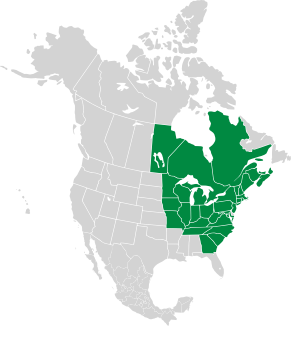
USDA Zones: 3-8 |

USDA Zones: 3-8 |
| Habitats |
Moist to dry soils in hemlock–northern hardwood, beech–maple, pine, or Appalachian spruce–fir forests. It occurs in thickets, clearings or along roadsides, in partial shade. |
Dry open woods, edges of woods, and clearings, in partial shade. |
© FloraFinder.org. All rights reserved.