Lythrum salicaria L. var. tomentosum (Mill.) DC.
Lythrum salicaria L. var. vulgare DC.
Lythrum salicaria L.
Purple loosestrife
Purple loosestrife is native to Eurasia—throughout Great Britain, and across central and southern Europe to central Russia, Japan, Manchuria China, southeast Asia and northern India. In the U.S., it is an alien, introduced in the 1800s, now found throughout most of the US and Canada. It rapidly takes over both freshwater and brackish wet areas, even regions that are only seasonally damp, out-competing nearly everything in its path.
I try to stay neutral about terms like “invasive” and even “weed.” Not that I don’t curse when I’m weeding the landscaping or the vegetable garden. But many of the plants that have acquired these unsavory descriptions were originally introduced intentionally, for their beauty or cultivation potential, sometimes even to control other “invasives.” Purple loosestrife is such a plant. “So wait a minute,” loosestrife might think, if it could think, “I’m just doing my job. You’ve thrown me into some new place, and I’m growing, and doing it rather well if I do say so myself. But I’m getting blamed for it. What’s that about?”
But I guess I have my limits. Although oriental bittersweet is probably at the top of my annoying plant list, purple loosestrife is number two. It can turn a thriving beaver pond ecosystem into a barren purple monoculture in a space of about two years—I’m watching it happen to my beaver pond right now.
Plants: A tall, narrow plant, 1½–5′ (50–150 cm) in height, rarely up to 9½′ (3 m). Multiple stems emerge from the same root mass. Stems are reddish-purple, square in cross-section, somewhat hairy, and heavily branched distally.
Leaves: Opposite, lanceolate, ¾–4 ⨉ ⅛–¾″ (2–10 cm ⨉ 5–20 mm), attached directly to the stem (“sessile“). Leaf bases are cordate or rounded. Leaves become bright red in the fall.
Flowers: A beautiful conical purple flowerhead visible during much of the summer, disappearing at the first frost. Each flower is rose purple, with six narrowly oblong to obovate petals, and 12 stamens.
Fruits: Narrow urn-shaped capsules are 1/16–⅛″ (3–4 mm) around, containing large numbers of tiny seeds.
Habitats: Formerly glaciated wetlands, ditches, beaver ponds, marshes, and disturbed wet areas.
Online References:
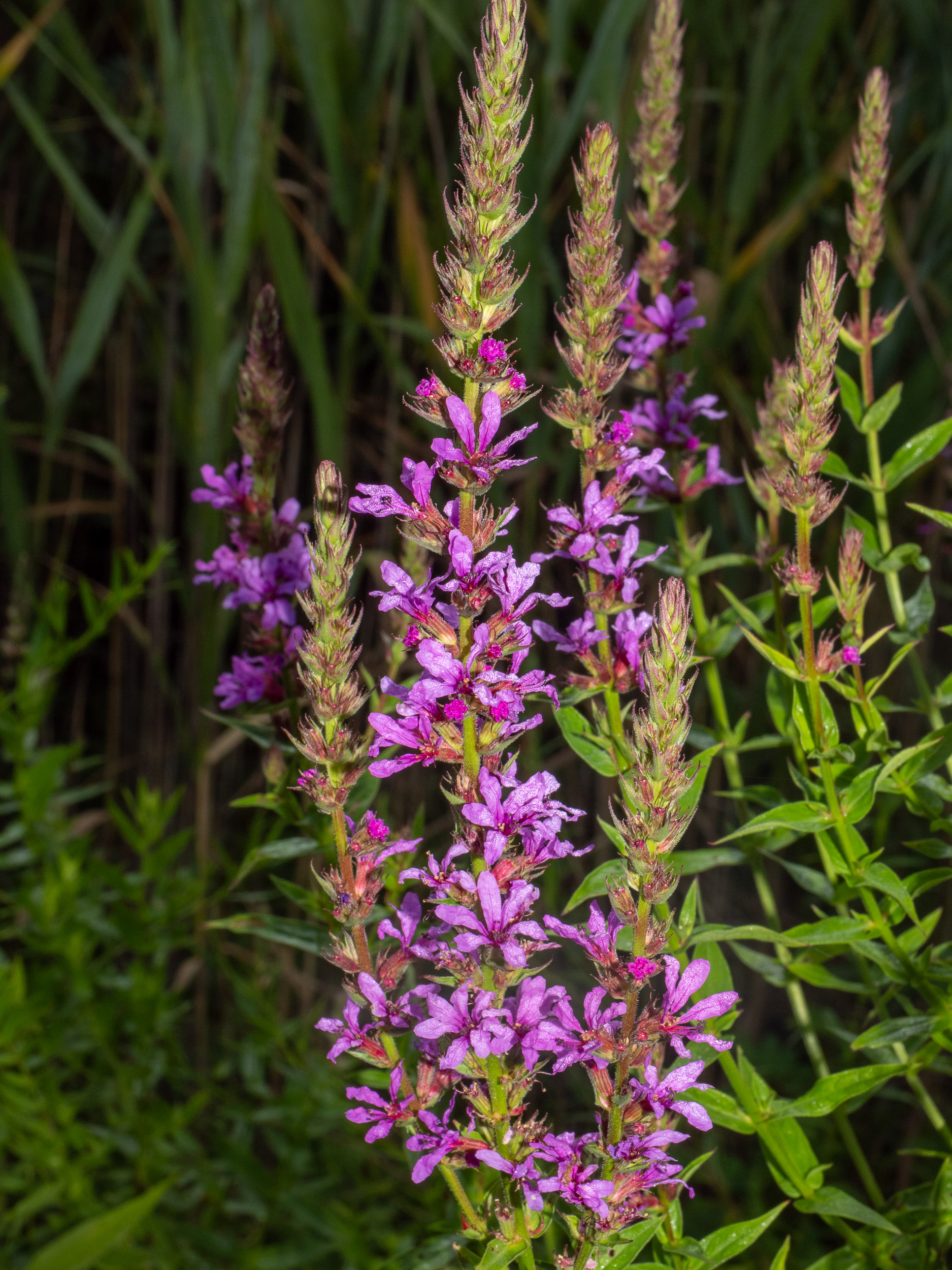
7/27/2024 · Moh-He-Con-Nuck Nature Preserve, Selkirk, New York 

7/26/2025 · River Point Conservation Area, Falmouth, Maine 

9/22/2013 · Squannacook River Wildlife Management Area, off route 119, Townsend, Massachusetts · ≈ 7 × 10″ (16 × 25 cm) 

9/17/2012 · Blood Dragon Ravine, Jeff Smith Trail, Pepperell, Massachusetts · ≈ 5 × 8″ (13 × 19 cm) 

9/3/2009 · Nashua River Rail Trail, Ayer, Massachusetts · ≈ 3½ × 5″ (9.2 × 12 cm) 

8/7/2017 · Groton Rail Trail, Groton Center, Groton, Massachusetts · ≈ 8 × 5″ (20 × 13 cm) 
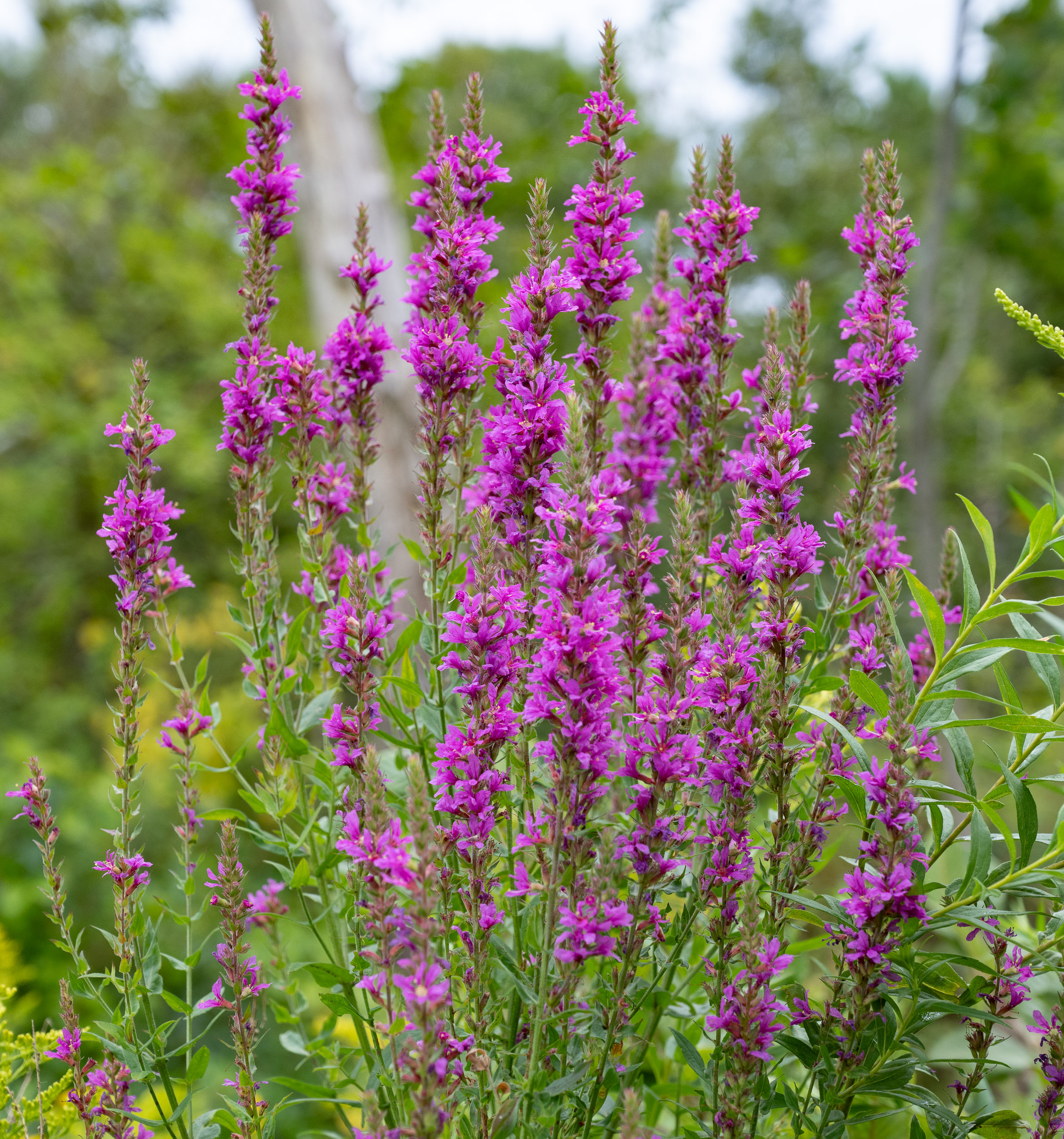
8/20/2025 · Peaks Island, Maine · ≈ 1 × 1½′ (40 × 43 cm) 

8/20/2025 · Peaks Island, Maine · ≈ 9 × 6″ (22 × 15 cm) 

9/22/2013 · Squannacook River Wildlife Management Area, off route 119, Townsend, Massachusetts · ≈ 6 × 9″ (15 × 22 cm) 

8/4/2009 · Near Nashoba Hospital, Ayer, Massachusetts 

8/1/2009 · Stan & Connie’s, Falmouth, Maine · ≈ 1 × 1½′ (34 × 42 cm) 

9/22/2013 · Squannacook River Wildlife Management Area, off route 119, Townsend, Massachusetts · ≈ 6 × 9″ (16 × 23 cm) 

9/17/2012 · Blood Dragon Ravine, Jeff Smith Trail, Pepperell, Massachusetts · ≈ 3 × 4½″ (7.9 × 11 cm) 

7/27/2024 · Moh-He-Con-Nuck Nature Preserve, Selkirk, New York 

11/7/2009 · Nashua River Rail Trail, Groton Center, Groton, Massachusetts · ≈ 6 × 9″ (14 × 22 cm) 

8/15/2021 · Bass Falls Preserve, Alna, Maine · ≈ 3½ × 5″ (9 × 13 cm) 

9/17/2012 · Blood Dragon Ravine, Jeff Smith Trail, Pepperell, Massachusetts · ≈ 3½ × 5″ (9.2 × 13 cm) 

8/15/2021 · Bass Falls Preserve, Alna, Maine · ≈ 3½ × 5″ (9 × 13 cm) 

9/17/2012 · Blood Dragon Ravine, Jeff Smith Trail, Pepperell, Massachusetts · ≈ 3½ × 5″ (9.2 × 13 cm) 

The flowers have passed, and the stalks will turn brown and persist through the winter. · 9/18/2010 · Nashua River Rail Trail, Groton Center, Groton, Massachusetts · ≈ 9 × 6″ (23 × 15 cm) 

8/1/2009 · Stan & Connie’s, Falmouth, Maine · ≈ 6 × 8″ (15 × 20 cm) 

8/4/2009 · Near Nashoba Hospital, Ayer, Massachusetts · ≈ 5 × 8″ (12 × 19 cm) 

8/3/2009 · 111 Near 119, Pepperell, Massachusetts · ≈ 11 × 17″ (28 × 42 cm) 

8/6/2009 · Nashua River Rail Trail, Groton, Massachusetts · ≈ 3 × 4½″ (7.9 × 11 cm) 
| Kingdom | Plantae | Plants, but not fungi, lichens, or algae (from Stearn's Botanical Latin) |
| Subkingdom | Tracheobionta | Vascular plants—plants with a “circulatory system” for delivering water and nutrients |
| Division | Magnoliophyta | Flowering plants, also known as angiosperms |
| Class | Magnoliopsida | Dicotyledons—plants with two initial seed leaves |
| Subclass | Rosidae | Roses, legumes, proteas, dogwoods, hydrangeas, mistletoes, euphorbias, grapes, many more |
| Order | Myrtales | Includes myrtles, leadwoods, loosestrifes, pomegranates, evening primroses, many others |
| Family | Lythraceae | Loosestrife family, also Includes henna, pomegranates, crape myrtles, others |
| Genus | Lythrum | From Greek lythron, “blood,” for its use as a styptic (blood-clotting agent) |
| Species | salicaria | Means “willow-like” |
Lythrum salicaria description by Thomas H. Kent, not updated.

© FloraFinder.org. All rights reserved.
