Polemonium reptans L.
Spreading Jacob’s ladder, creeping Jacob’s ladder, false Jacob’s ladder, abscess root, American Greek valerian, blue bells, stairway to heaven, sweatroot, Greek valerian
Spreading Jacob’s ladder is a North American native. It prefers partial shade and rich, moist woods, and is often found along streambanks. The common name “Jacob’s ladder” refers to the neat pairs of opposite leaflets in the compound leaves, resembling a series of steps on a ladder, from a dream by the biblical Jacob.
Plants: These perennials are 6–18″ (15–45 cm) tall, and somewhat branched. The rather weak stems sag under the weight of the leaves, sprawling across the ground. They are light or reddish green, somewhat angular, and hollow.
Leaves: Leaves are odd-pinnate and alternate, with 7-17 leaflets. Leaflets are ¾–1¼ ⨉ ¼–⅜″ (1.9–3.2 cm ⨉ 6.3–10 mm), and oval-shaped (elliptic) to lance-shaped (lanceolate). Lower leaflets are attached by stems (petioles), but the stems shorten and disappear in the upper leaflets.
Flowers: Loose panicles of flowers are 1½–3″ (3.8–7.6 cm) across. Additional groups of flowers are sometimes produced from leaf axils, and may be up to 6″ (15 cm) long. Each flower is light blue, bell-shaped, with five petals fused at the base, and up to ⅝″ (1.6 cm) across. (Rarely, flowers are lavendar, pink, purple, or white.) Flowers appear April-June.
Fruits: An oval pod with three chambers, ⅛″ (6 mm) long, which is enclosed by the green calyx.
Habitats: Partial shade and rich, moist woods, and is often found along streambanks. The common name “Jacob’s ladder” refers to the neat pairs of opposite leaflets in the compound leaves, resembling a series of steps on a ladder, from a dream by the biblical Jacob.
Online References:
References:
Clemants, Steven; Gracie, Carol, Wildflowers in the Field and Forest, Oxford University Press, 2006, p. 30

5/14/2012 · Acton Arboretum, Acton, Massachusetts · ≈ 14 × 9″ (35 × 23 cm) 

5/26/2024 · McLaughlin Garden and Homestead, South Paris, Maine 

5/26/2024 · McLaughlin Garden and Homestead, South Paris, Maine 

5/14/2013 · Beaver Brook Conservation Area, Hollis, New Hampshire · ≈ 7 × 4½″ (18 × 12 cm) 

5/14/2012 · Acton Arboretum, Acton, Massachusetts · ≈ 5 × 4″ (13 × 10 cm) 

5/14/2013 · Beaver Brook Conservation Area, Hollis, New Hampshire · ≈ 6 × 4½″ (15 × 11 cm) 

5/16/2014 · Acton Arboretum, Action, Massachusetts · ≈ 4½ × 3½″ (11 × 9.2 cm) 

5/14/2012 · Acton Arboretum, Acton, Massachusetts · ≈ 10 × 15″ (26 × 39 cm) 
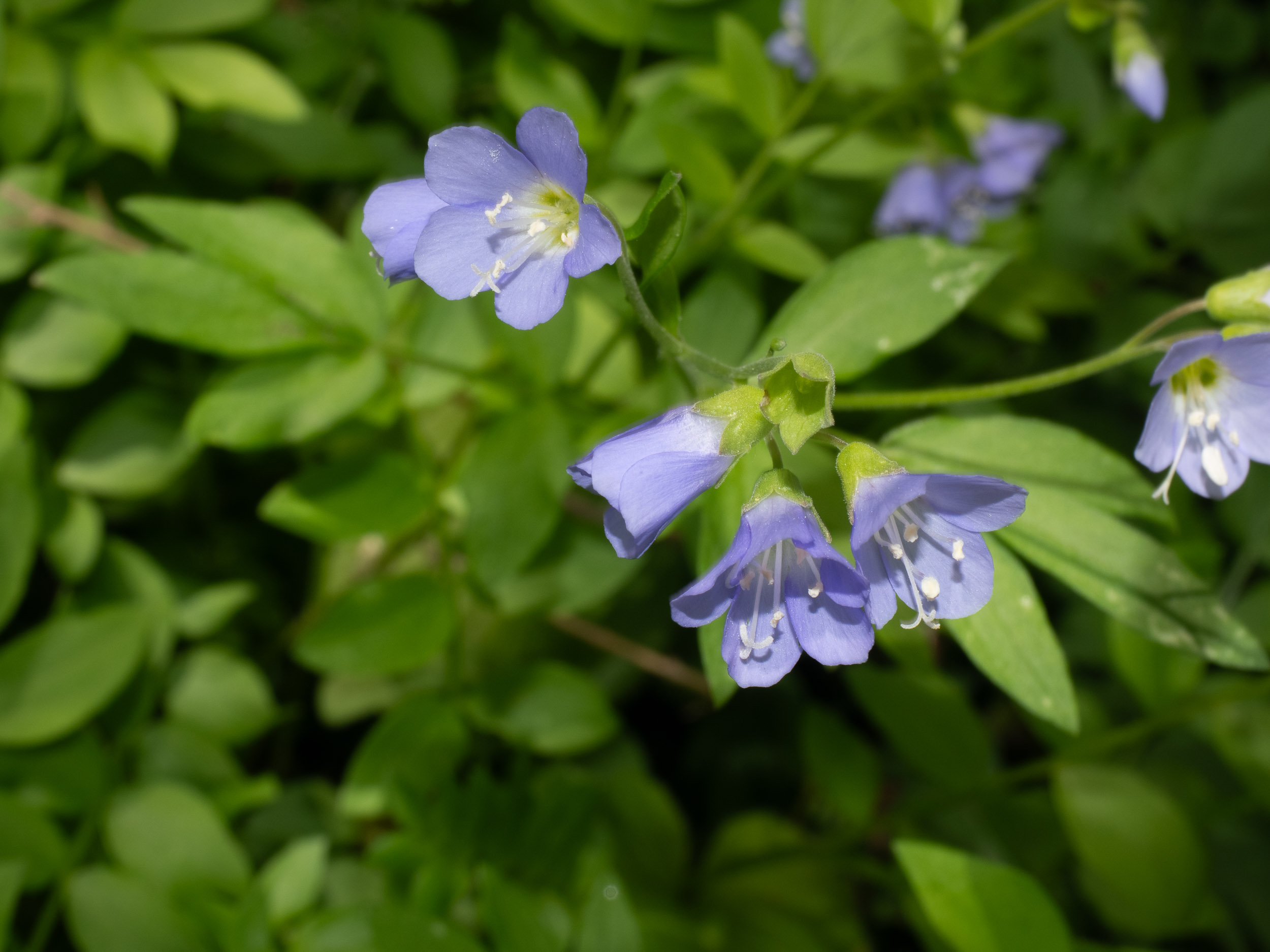
5/26/2024 · McLaughlin Garden and Homestead, South Paris, Maine 

5/14/2013 · Beaver Brook Conservation Area, Hollis, New Hampshire · ≈ 6 × 5″ (14 × 12 cm) 

5/16/2014 · Acton Arboretum, Action, Massachusetts · ≈ 4½ × 3″ (12 × 8.3 cm) 

5/16/2014 · Acton Arboretum, Action, Massachusetts · ≈ 8 × 6″ (20 × 14 cm) 

5/14/2013 · Beaver Brook Conservation Area, Hollis, New Hampshire · ≈ 7 × 6″ (17 × 14 cm) 
| Kingdom | Plantae | Plants, but not fungi, lichens, or algae (from Stearn's Botanical Latin) |
| Subkingdom | Tracheobionta | Vascular plants—plants with a “circulatory system” for delivering water and nutrients |
| Division | Magnoliophyta | Flowering plants, also known as angiosperms |
| Class | Magnoliopsida | Dicotyledons—plants with two initial seed leaves |
| Subclass | Asteridae | A large class that encompasses asters |
| Order | Ericales | Tea, persimmon, blueberry, Brazil nut, azalea, many others |
| Family | Polemoniaceae | Phlox, Jabob’s-ladder |
| Genus | Polemonium | Greek herbalist and healer Polemon of Cappadocia may be the source of this name |
| Species | reptans | Having creeping and rooting stems |

Polemonium reptans description by Thomas H. Kent, not updated.

© FloraFinder.org. All rights reserved.