|
Solanum elaeagnifolium Cav.
Silverleaf nightshade, prairie berry, silverleaf nettle, white horsenettle, silver nightshade, bull nettle, tomato weed, trompillo, buena mujer, tomatito de buena mujer, pera
Similar species
|
| |
You are here
Solanum elaeagnifolium |
Solanum carolinense |
| Common Name |

silverleaf nightshade |

Carolina horsenettle |
| Plant |
Plants are up to 3′ (1 m) tall. Stems are covered, sometimes sparsely, sometimes densely, with nettle-like spines. Spines are more common in more arid climates. Tiny hairs lying flat against the stem impart a silvery gray appearance. |
Up to 3′ (1 m) tall, with round, hairy, spiny stems that become a bit woody with age. |
| Leaves |
6″ long ⨉ ⅛–⅞″ wide (15 cm ⨉ 5–25 mm), also silvery gray from fine hairs. They are alternate, lanceolate to narrowly oblong, shallowly scalloped, with wavy edges. |
Alternate, glossy, on petioles (stems) up to ¾″ (2 cm) long. They are elliptic-oblong to ovate. Smaller leaves are unlobed, while larger ones are often lobed, vaguely resembling oak leaves. They are up to 8 ⨉ 2½″ (20 ⨉ 7 cm), and emit a potato-like odor when crushed. |
| Flowers |
Each flower is purple, blue, lavendar, or sometimes white, and shaped like a five-pointed star, the petals fused together. Five yellow stamens tipped with yellow or orange anthers, and a pistil, project from the center. Flowers appear from May to October. |
Flowers appear in small racemes at angles to the main stem. The racemes lengthen when the flowers begin producing fruit. Each flower is white to lilac to purple in color, a five-pointed star, with five yellow stamens like a miniature bunch of bananas in the center. They appear from May to October. |
| Fruit |
Glossy yellow, orange, or red berries. |
Berries are green when immature, streaked with different shades of green, turning yellow when mature. |
| Range/ Zones |
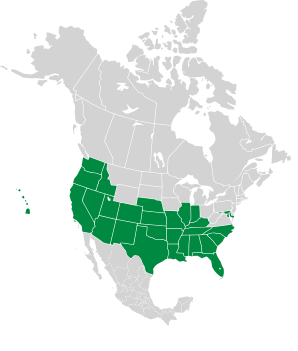
|

|
| Habitats |
Prairies, roadsides, pastures, open woods, and human-disturbed habitats, at elevations up to 1.0 mi (1.7 km). |
Pastures, roadsides, railroad margins, and disturbed areas. |
© FloraFinder.org. All rights reserved.