Symphyotrichum novi-belgii (L.) G.L. Nesom
New York aster
New York aster is a North American native.
Plants: 7–39″ (17–100 cm) high, occurring in colonies, with branching stems that are often reddish. Stems lack hairs near the bottom, but toward the top, small hairs, typically lying against the stem, occur in rows along the stem.
Leaves: Thick, unlobed, ovate to lanceolate, sessile (attached directly to stems) or clasping, ⅝–2 ⨉ ⅛–⅜″ (1.7–6 cm ⨉ 6–11 mm). Leaves near the bottom are already drying out and falling by flowering time, while those higher on the stem remain, becoming smaller further up. Leaves sometimes have teeth.
Flowers: Flowers consist of a central disc with 28-68 tiny florets and 15-35 rays that are bluish to purple, rarely pink or white. The central disc is yellow, aging to reddish brown or purple. Flowers are about 1–1¼″ (2.5–3.2 cm) in diameter, appearing from August to October. New York aster tends to be paler in color than New England aster.
Fruits: Dry achenes with pappi (hairy tufts) for wind distribution.
Habitats: Moist meadows, thickets, shorelines.
See our aster comparison table here.
Online References:
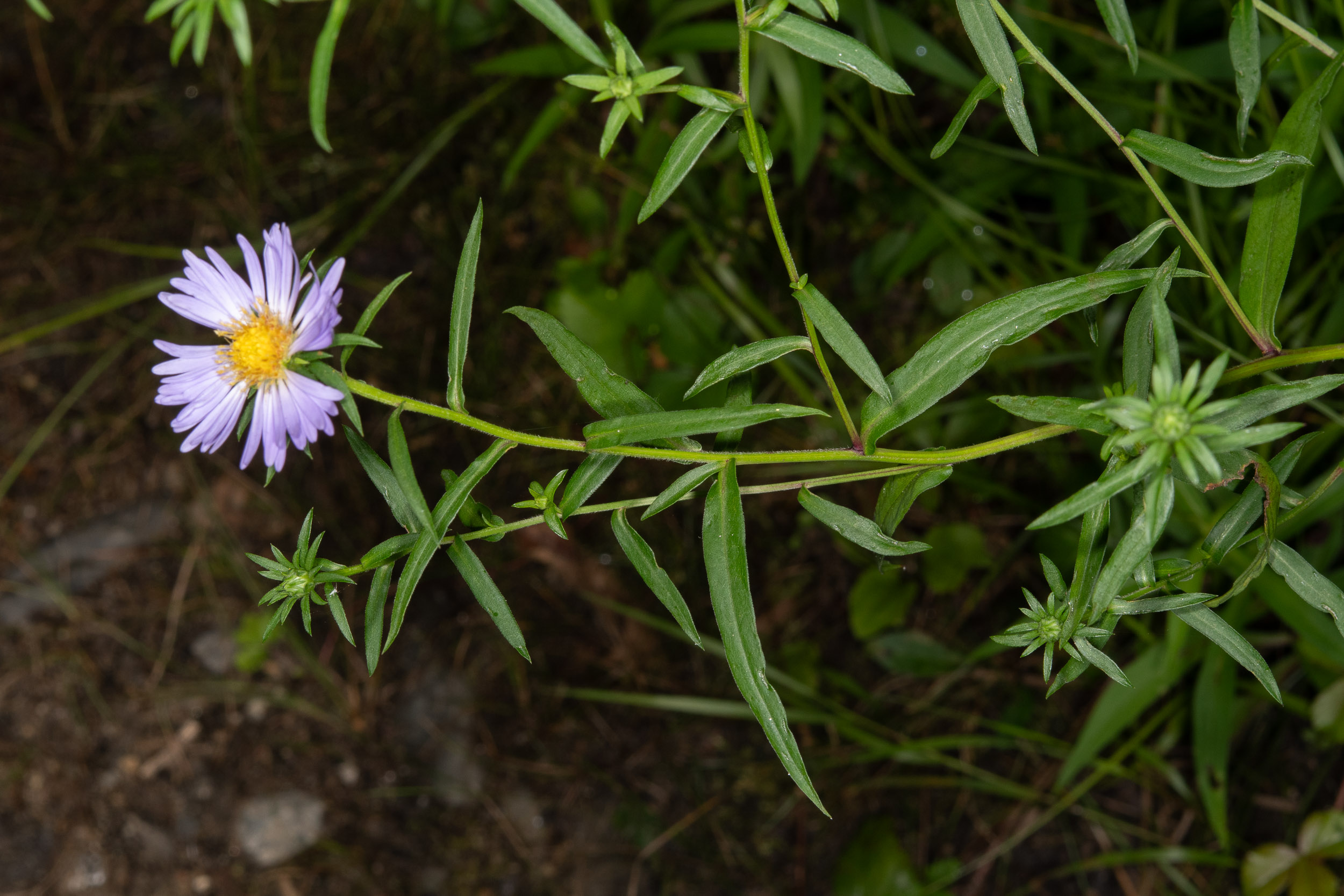
8/24/2023 · Morse Mountain, Phippsburg, Maine · ≈ 10 × 6″ (24 × 16 cm) 

9/9/2023 · Salt marsh, Flying Point, Georgetown, Maine · ≈ 10 × 6″ (24 × 16 cm) 
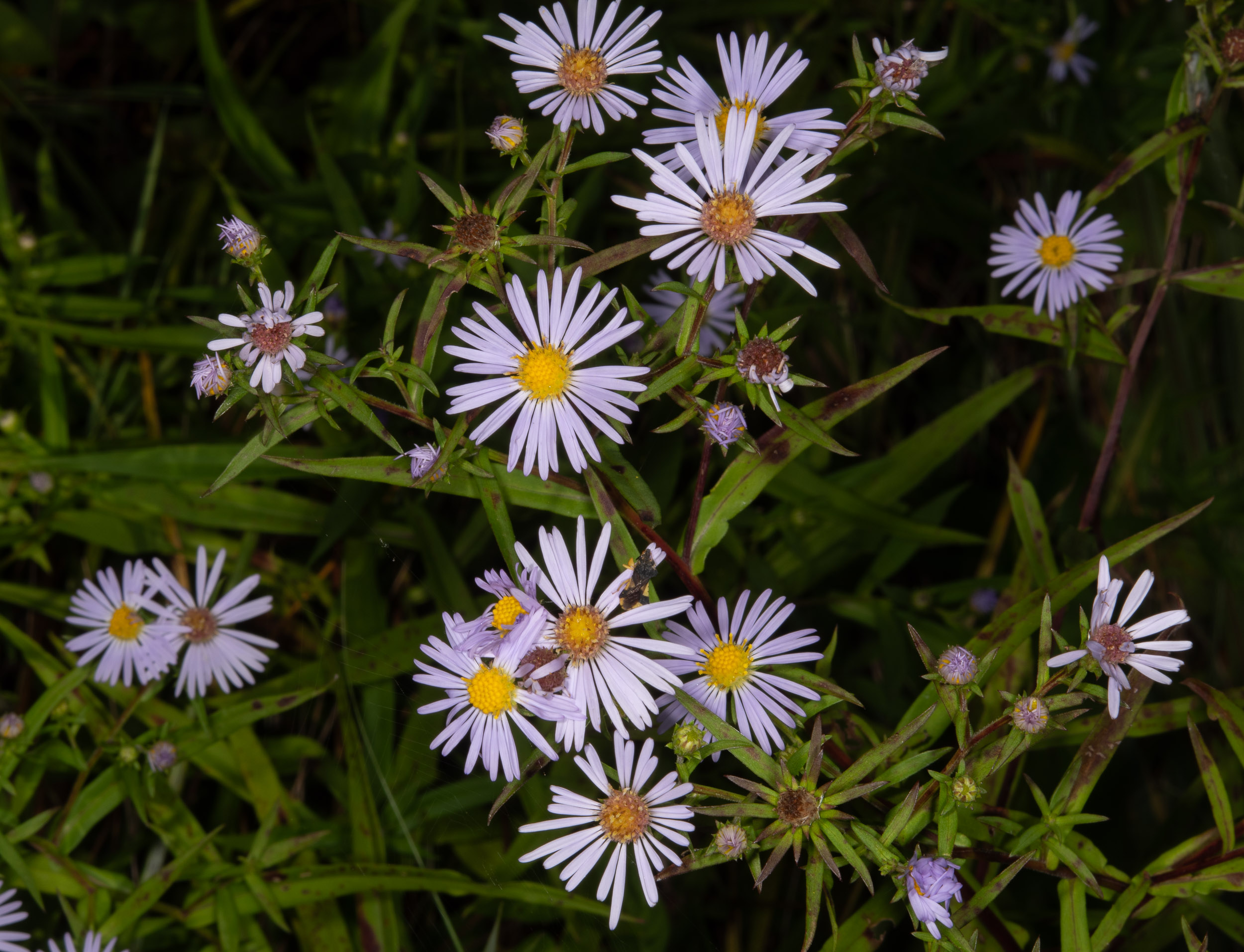
9/9/2023 · Flying Point, Georgetown, Maine · ≈ 9 × 6″ (21 × 16 cm) 
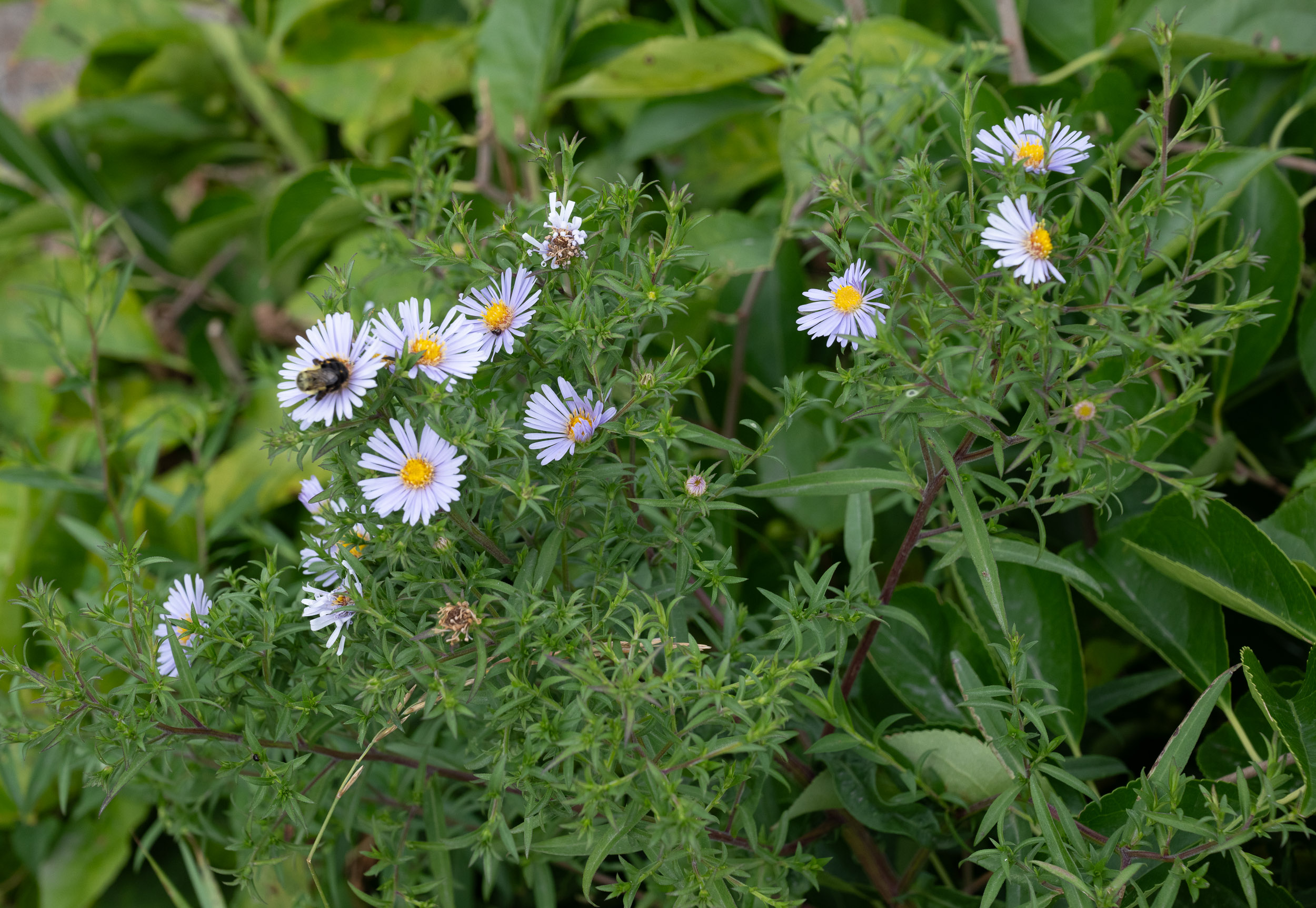
8/20/2025 · Peaks Island, Maine · ≈ 15 × 10″ (37 × 25 cm) 

9/16/2013 · Townsend Wildlife Management Area, Townsend, Massachusetts · ≈ 7 × 6″ (16 × 15 cm)  ID is uncertain

8/24/2023 · Morse Mountain, Phippsburg, Maine · ≈ 8 × 5″ (20 × 13 cm) 

9/16/2013 · Townsend Wildlife Management Area, Townsend, Massachusetts · ≈ 4½ × 7″ (12 × 18 cm) ID is uncertain 

9/16/2016 · Sieur de Monts Botanical Gardens, Bar Harbor, Maine 

9/16/2013 · Townsend Wildlife Management Area, Townsend, Massachusetts · ≈ 4½ × 7″ (11 × 16 cm) ID is uncertain 

9/16/2013 · Townsend Wildlife Management Area, Townsend, Massachusetts · ≈ 5 × 7″ (13 × 17 cm) ID is uncertain 

9/22/2013 · Squannacook River Wildlife Management Area, off route 119, Townsend, Massachusetts · ≈ 6 × 9″ (16 × 23 cm) ID is uncertain 

9/22/2013 · Squannacook River Wildlife Management Area, off route 119, Townsend, Massachusetts · ≈ 6 × 6″ (16 × 14 cm) ID is uncertain 

9/16/2013 · Townsend Wildlife Management Area, Townsend, Massachusetts · ≈ 4½ × 7″ (12 × 18 cm) ID is uncertain 

9/22/2013 · Squannacook River Wildlife Management Area, off route 119, Townsend, Massachusetts · ≈ 6 × 4½″ (15 × 11 cm) ID is uncertain 
| Kingdom | Plantae | Plants, but not fungi, lichens, or algae (from Stearn's Botanical Latin) |
| Subkingdom | Tracheobionta | Vascular plants—plants with a “circulatory system” for delivering water and nutrients |
| Division | Magnoliophyta | Flowering plants, also known as angiosperms |
| Class | Magnoliopsida | Dicotyledons—plants with two initial seed leaves |
| Subclass | Asteridae | A large class that encompasses asters |
| Order | Asterales | Flowering plants with a central disk flower and surrounding petals, like daisies |
| Family | Asteraceae | The aster family, which also includes daisies and sunflowers; from the Greek ἀστήρ, “star,” for the star-shaped flowers |
| Genus | Symphyotrichum | From Greek symphysis, “borne together or growing together, coalescing,” and trichinos, “hair, a single hair” |
| Species | novi-belgii | “New York,” or more precisely, “New Belgium,” a region that once encompassed an area much larger than present-day New York |

Symphyotrichum novi-belgii description by Thomas H. Kent, not updated.

© FloraFinder.org. All rights reserved.