Deciduous trees are up to 35′ (10 m) tall. Bark is gray to pale brown, vertically fissured in older trees. Some branchlets are corky or “winged.”
20–30′ (6.1–9.1 m) tall and up to 25′ (7.6 m) wide. The peeling, papery bark is a standout characteristic of this species. It varies from cinnamon-colored to dark, almost purplish brown as it ages, leaving a patchwork of color gradations on the trunk and branches.
Trees are up to 69′ (21 m) high and about 26′ (8 m) around. Unevenly branched, with thin, shallowly furrowed gray or light brown bark. Young branches are light green.
Leaves
Simple, palmate, and opposite, and 1¾–6″ (5–16 cm) long. Dark green, uniformly colored, somewhat hairy below when young, with smooth edges. They usually have 5 lobes, but may have 3 or 7. The base of each leaf stem exudes a milky sap when broken off.
Opposite, in groups of three, serrated, green on top, pale bluish-green or silvery below, 3–6″ long ⨉ 1–2″ wide (7.6–15 ⨉ 2.5–5 cm). In the fall, they turn red/orange.
Variable: pointed ovals, ovals with two side points similar to poison ivy leaves, or leaves similar to red maple.
Flowers
Yellowish-green, in clusters 1½–2″ (4–6 cm) across of about 10 flowers, appearing from April to May.
Yellow-green, inconspicuous flowers appear in April.
Male and female flowers occur on separate trees.
Fruit
samaras are about 1¼″ (3.5 cm) long, each with two wings that are nearly horizontal. Most maples have similar wings, but at an angle to each other.
Winged samaras; each wing is about 1″ (3 cm) long.
These small trees rarely exceed 6½′ (2 m) in height or width. They may have multiple trunks. They often have a rounded habit.
A small tree, reaching heights of 16–33′ (5–10 m). It may appear shrub-like in the forest, where it is often found as an understory plant. The bark is a smooth green on young plants or branches, with white vertical striations as the tree ages.
Up to 100′ (30 m) in height. Bark is gray and shallowly grooved, rather than shaggy.
Leaves
Foliage may be purple or green. Leaves are palmate, with 5-9 lobes, and are 1½–4½″ (4–12 cm) around, with doubly serrated margins. In this cultivar, they are very thin, as thin as grass blades.
Opposite, and 3–6 ⨉ 2–4½″ (8–15 ⨉ 6–12 cm) in size. The leaves' rounded bottom and three points are significantly different in appearance than other maple leaves.
Norway maple leaves are opposite and palmate, with sharp tips that become hairlike, while most other maples have more rounded tips. Leaves are 2½–6 ⨉ 3–10″ (7–14 ⨉ 8–25 cm) in size. Leaf stalks (petioles) are 3–8″ (8–20 cm) long. Sugar maples produce clear sap, while a plucked Norway maple leaf exudes a white sap. It is easily distinguished from other maples by its leaf shape. The leaves are typically bright yellow or orange-red in the fall.
Flowers
Small cymes, with five red or purple sepals and five whitish petals.
Corymbs of 15–30, yellow to yellow-green, with five sepals and five petals 1/16–⅛″ (3–4 mm) long. Flowering occurs in early spring before the new leaves emerge.
Fruit
Samaras are in winged pairs. Each samara is ¾–1″ (2–3 cm) in size.
Up to 66–115′ (20–35 m) in height, with a broad crown that is oval or rounded in shape. As the tree ages, smooth gray bark becomes brown, and begins breaking into scales, peeling to reveal pale brown, pinkish, or green inner bark. Don’t confuse the sycamore maple tree with the dissimilar sycamore tree, Ficus sycomorus.
59–89′ (18–27 m) high. Trunk is 1½–2½′ (45–76 cm) around.
49–82′ (15–25 m) in height, with a max of 115′ (35 m). Bark is gray, smooth when young, becoming shaggy with age.
Leaves
Palmate, five-lobed, similar to those of sugar maples in overall shape, but with more serrations. They are 4–10″ (10–25 cm) in size.
Typically with three tips, unlike other maples. Bright red or orange in the fall. Leaves are 3½–4½″ (8.9–11 cm) long.
In five sections, with deep notches and narrow lobes, 3–6″ (8–16 cm) × 2–4½″ (6–12 cm), silvery-white underneath.
Small, yellowish green, in tufts along twig ends; not very conspicuous.
Fruit
Samaras are in pairs, twirling to the ground like little helicopters when ripe.
Clusters of two-winged samaras. Each wing is ½–⅞″ (1.5–2.5 cm) long. Wings are at an angle of 50-60°.
As with other maples, fruits are winged pairs opposite each other. These pairs are the largest of any maple, about 1¼″ (3.2 cm), forming an angle between about 45-90°.
Range/ Zones
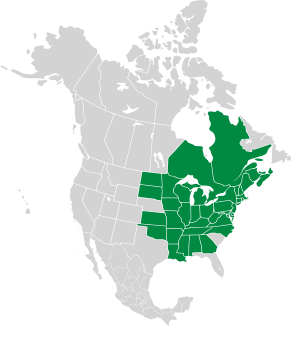
USDA Zones: 4-7
Habitats
Mixed deciduous forests at altitudes between 2297–6562′ (700–2000 m)
Almost any soil, from swamps to poor dry soils, below 2953′ (900 m)
Often found near water, especially along riverbanks
Trees are deciduous, reaching 80–115′ (24–35 m) in height, rarely up to 150′ (45 m).
Trees, or sometimes multistemmed shrubs, are deciduous, and up to 20′ (6.1 m) high and 20′ (6.1 m) around. These have hairless shoots, unlike the similar Acer japonicum and A. sieboldianum. Also, this cultivar has red flowers, while A. sieboldianum has yellow flowers.
A small tree or shrub, up to 33′ (10 m) in height, but usually much smaller, especially at the northern end of its range. The trunk is short, often crooked, and often shrublike. Bark is thin, dull gray-brown, and smooth, becoming somewhat scaly at the tree ages. This is easily confused with striped maple—both are found in mountain forests, and both are small trees with three-lobed leaves—but mountain maple is found at higher elevations. To further confuse matters, there is a western species, Acer glabrum, that is also called mountain maple. (See Acer for comparisons.)
Leaves
Leaves are palmate, up to 8″ (20 cm) in size. Sugar maples are similar to Norway maples, but the leaves have more teeth. Sap from the base of a leaf stem is clear, vs. milky in Norway maples. Silver maples have much more deeply lobed leaves (both species are found in about the same range). Black maples have leaves with 3 lobes and softer curves. Florida maples have leaves with velvety undersides and more rounded leaf tips, while sugar maples are not hairy. Florida maples are also found predominantly in Alabama, Mississippi, and Georgia (and some parts of Florida and nearby states), while sugar maples occur throughout much of the eastern United States.
Leaves are green in the spring, turning yellow, sometimes edged with red, during the summer. In the fall, they turn bright gold, orange, or even dark red. They are shaped like most maple leaves—roughly round in overall shape, but with 9-13 sharp-tipped lobes. Leaves are opposite, 1¾–3″ long ⨉ 2–4½″ wide (4.5–8 ⨉ 6–12 cm). Stems (petioles) are 1–2½″ (3–7 cm) long.
Usually 3 lobes, sometimes 5, with small, coarse teeth.
Flowers
Flowers are in panicles of five to ten, yellow-green, and lacking petals. Trees don’t start producing flowers until they are at least ten years old.
Reddish purple flowers appear in April, in attractive corymbs or sprays of 10-20 flowers, each about ⅜″ (1 cm) in diameter.
Upright or nodding, column-shaped panicles 1½–3″ tall ⨉ 1″ wide (3.8–7.6 ⨉ 2.5 cm). Flowers appear after leaves are fully developed. Male and female flowers are typically present in same cluster. All flowers are greenish yellow, ⅛″ (4.8 mm) across, with five thin linear petals 1/16–⅛″ (1.6–3.2 mm) long, and five sepals less than 1/16″ (1.6 mm) long. Male flowers have 7-8 stamens, while female flowers have two small pink stigmas. Flower stalks (pedicels) are hairy, and ¼–5/16″ (6.3–8.3 mm) long.
Fruit
The seedpods of Norway maples are almost completely opposite each other, while they typically form an angle of about 120° in sugar maples. The “wings” of the seeds, called samaras, are ¾–1″ (2–3 cm) long, with seeds that are ¼–⅜″ (7–10 mm) around.
Red samaras are comprised of a pair of nutlets, each ⅛–⅜″ (5–10 mm) around, and wings, each ¾–⅞″ (2–2.5 cm) long.
Paired reddish or bright red samaras, ¾–1″ (2–3 cm) in size.
Range/ Zones
USDA Zones: 5-7
Habitats
Prefers rich forests, especially areas rich in magnesium and iron, and lime. It is also commonly found in dry forests and woodlands.
Reaches 20–30′ (6.1–9.1 m) (max 45′ (13 m) in height. Trunk is light- to cinnamon brown, with peeling bark.
Leaves
Clusters of 3 leaflets, dark green, relatively narrow, un-maple-like leaves. Each leaf is 2–3″ (5–7.6 cm) long and 1–1½″ (2.5–3.8 cm) wide. Leaves brilliantly colored in the fall: reds, golds, orange-reds, purples.
Flowers
Flowers pink to greenish-yellow, in clusters of 3.
Fruit
Samaras 1–1¼″ (2.5–3.2 cm) long, joined at a wide angle.