Gaultheria procumbens L.
Creeping wintergreen, wintergreen, Eastern teaberry, checkerberry, boxberry, American wintergreen
Creeping wintergreen is a native of northeastern North America, and as far south as Alabama. Wintergreen is “minty,” but not related to the mint family, which includes spearmint (Mentha spicata), and peppermint (Mentha × piperita).
Plants: Creeping wintergreen is a low, spreading plant, typically 4–6″ (10–15 cm) tall, sometimes as low as 1″ (2.5 cm). See also the somewhat similar-appearing but unrelated partridgeberry, (Mitchella repens). It is often found in the same habitats.
Leaves: Oval, evergreen, glossy, dark in color, ¾–1¾″ (2–5 cm) long and ⅜–¾″ (1–2 cm) across. When broken, the leaves smell of wintergreen.
Flowers: About ¼″ (6.3 mm) long, white, urn-shaped, nodding, resembling blueberry flowers.
Fruits: Bright red, ¼–½″ (6.3–12 mm) in diameter, and hard (like an apple).
Habitats: Hardwood forests with light to moderate shade and acidic soil.
Edibility: Berries are edible, but bland, tasting only faintly of wintergreen. To prepare a tea, sterilize a jar by boiling it, as you would for preparing jams and jellies. Pack it with wintergreen leaves, fill with sterile water, and store the sealed jar in a warm spot for several days. The water will become bubbly with fermentation, which releases the wintergreen flavor. Heat the fermented beverage and dilute it to taste. This tea is the derivation of the name “teaberry,” which also served as the name for Teaberry gum.
 |
Somewhat similar species. |
Online References:
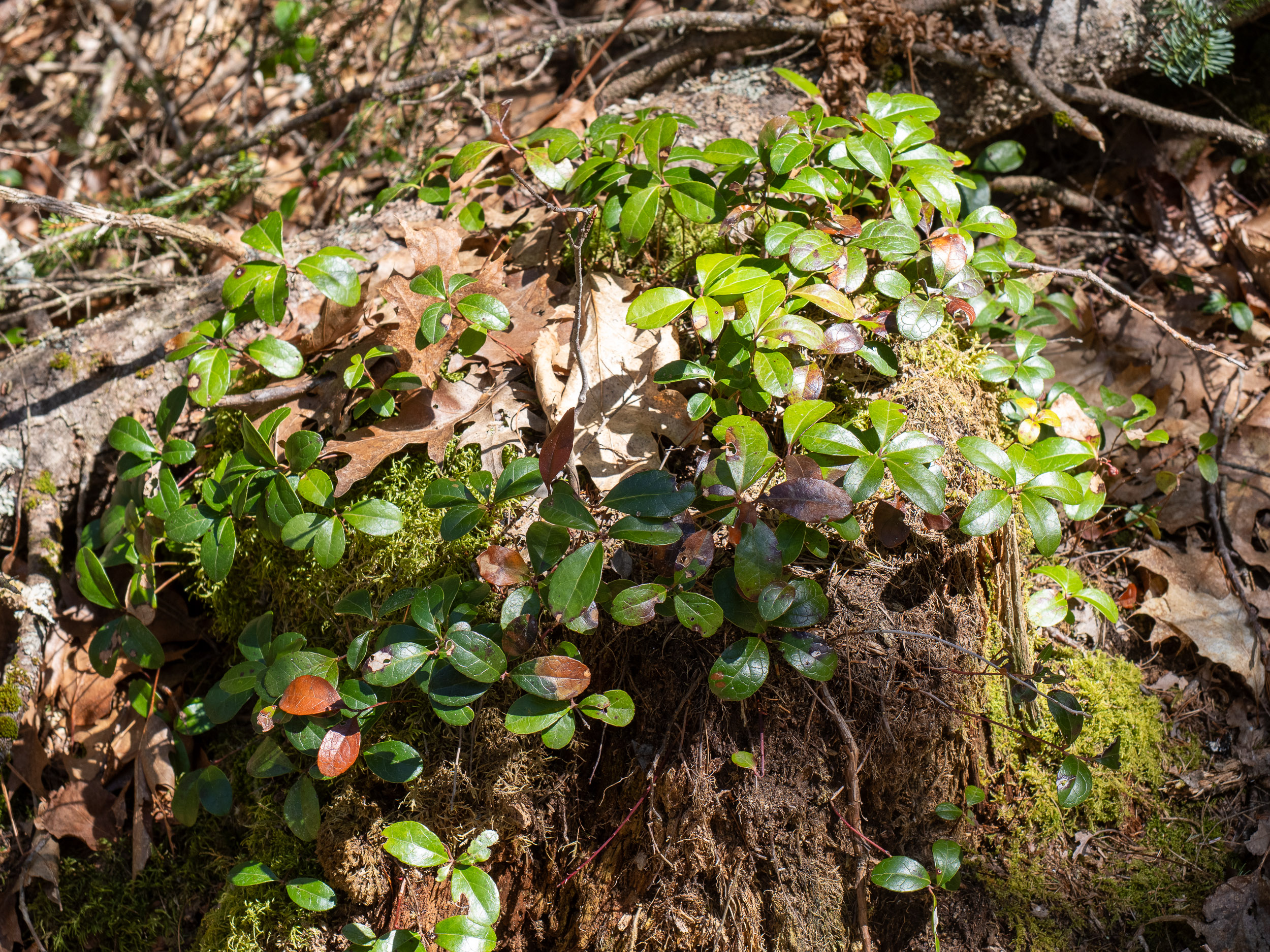
4/25/2024 · Bliss Woods Trail, South Freeport, Maine 

10/27/2017 · Bemis Road Conservation Area, Pepperell, Massachusetts · ≈ 3½ × 2½″ (9.7 × 6.8 cm) 

7/15/2021 · Brunswick Commons, Brunswick, Maine · ≈ 4 × 3½″ (10 × 9.8 cm) 

4/24/2007 · Tom and Susan’s, Pepperell, Massachusetts 

6/5/2021 · Long Reach Preserve, Harpswell, Maine · ≈ 5 × 3½″ (13 × 9 cm) 

10/16/2016 · Guilder Pond, Mount Everett, Mt. Washington, Massachusetts · ≈ 3 × 3″ (7.6 × 7.9 cm) 

6/7/2017 · Burns Loop Trail, Beaver Brook Conservation Area, Burns/Holland Farm, Milford, New Hampshire · ≈ 8 × 5″ (20 × 13 cm) 

7/20/2021 · Otter Brrok Preserve, Harpswell Heritage Land Trust, Harpswell, Maine · ≈ 6 × 4½″ (14 × 11 cm) 

9/18/2016 · Shore Acres Preserve 

9/4/2020 · Wilson’s Cove Trail, Harpswell Heritage Land Trust, Harpswell, Maine · ≈ 5 × 3½″ (12 × 8.7 cm) 

7/3/2012 · Yellow Trail from Pearl Hill State Park to Willard Brook State Park, Ashby, Massachusetts · ≈ 4 × 5″ (10 × 13 cm) 

7/3/2012 · Yellow Trail from Pearl Hill State Park to Willard Brook State Park, Ashby, Massachusetts · ≈ 5 × 3½″ (13 × 9.2 cm) 

4/8/2021 · Long Reach Preserve, Harpswell, Maine · ≈ 3½ × 3″ (8.9 × 8.5 cm) 

10/27/2017 · Bemis Road Conservation Area, Pepperell, Massachusetts · ≈ 4 × 4″ (11 × 10 cm) 

7/11/2021 · Hackett and Minot Trails, Harpswell, Maine · ≈ 2 × 2½″ (5.3 × 7.2 cm) 

10/11/2011 · Pearl Hill State Park, Townsend, Massachusetts · ≈ 4½ × 4″ (12 × 10 cm) 

10/3/2010 · Tarkill Interpretive Trail, Rte 402, Poconos, Peck’s Pond, Pennsylvania · ≈ 6 × 7″ (16 × 18 cm) 

8/27/2010 · Beaver Brook Conservation Area, Rte. 130, Hollis, New Hampshire · ≈ 9 × 6″ (22 × 16 cm) 

7/3/2012 · Yellow Trail from Pearl Hill State Park to Willard Brook State Park, Ashby, Massachusetts · ≈ 7 × 4½″ (17 × 11 cm) 

5/25/2023 · Maquoit Bay Conservation Land, Brunswick, Maine 

5/12/2023 · Long Reach Preserve, Harpswell, Maine 

4/7/2021 · Hackett and Minot Trails, Harpswell, Maine · ≈ 4 × 5″ (11 × 13 cm) 
| Kingdom | Plantae | Plants, but not fungi, lichens, or algae (from Stearn's Botanical Latin) |
| Subkingdom | Tracheobionta | Vascular plants—plants with a “circulatory system” for delivering water and nutrients |
| Division | Magnoliophyta | Flowering plants, also known as angiosperms |
| Class | Magnoliopsida | Dicotyledons—plants with two initial seed leaves |
| Subclass | Asteridae | A large class that encompasses asters |
| Order | Ericales | Tea, persimmon, blueberry, Brazil nut, azalea, many others |
| Family | Ericaceae | Heath or heather family |
| Genus | Gaultheria | After Jean François Gaulthier (1708-1756), French-Canadian botanist of Quebec, appointed King’s physician for Quebec in 1741 |
| Species | procumbens | With trailing, prostrate stems |

Gaultheria procumbens description by Thomas H. Kent, not updated.

© FloraFinder.org. All rights reserved.