Solidago canadensis L.
Canada goldenrod
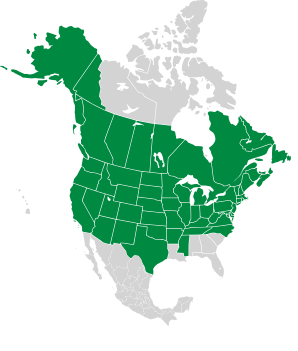
Canada goldenrods are natives of North America. For a comparison chart of some of the varieties of goldenrods, see Solidago.
Plants: 2–6′ (60–182 cm) high. The main stem is smooth near the base, with rows of soft small hairs nearer the top.
Leaves: Lance-shaped (”lanceolate”), sharply serrated, gray-green, mostly hairless above, hairy below. They are up to 6 ⨉ 1″ (15 ⨉ 2.5 cm) at the base, and progressively smaller up the stem.
Flowers: Several yellow flowerheads, each up to 3–5″ (7.6–12 cm) in length, branch sideways from the main stem, and have flowers on one side only. Individual flowers are less than ⅛″ (3.2 mm) around, usually having 8-14 ray florets and 3-6 disc florets. Flowers bloom July to September.
Fruits: Flowers become small spherical arrangements of seeds on “parachutes,” called cypselae, like dandilions gone to seed. The cypselae are ~1/32″ (1–1.5 mm) in diameter.
Habitats: Openings in prairies, forests, thickets, and savannas, wet or dry.
The insect who looks like an escapee from the Emerald City in Photo 2 is a cuckoo wasp. Cuckoo wasps are frequently mistaken for sweat bees (also called halictid bees), as both are colorful and about the same size. Here is an excellent comparison.
Edibility: Not edible.
Online References:
References:
Spellenberg, Richard, National Audubon Society Field Guide to Wildflowers, Western Region, Alfred A. Knopf, 2001, p. 321, 397

1 · 9/28/2013 · Wild Gardens of Acadia, Acadia National Park, Bar Harbor, Maine · ≈ 4½ × 7″ (12 × 18 cm) 

2 · The visitor is a cuckoo wasp (from the Chrysididae family) · 8/17/2013 · Hopkinton State Park, Hopkinton, Massachusetts · ≈ 1¼ × ⅞″ (3.5 × 2.5 cm) 

3 · 9/28/2013 · Wild Gardens of Acadia, Acadia National Park, Bar Harbor, Maine · ≈ 4½ × 7″ (11 × 16 cm) 

4 · 9/16/2016 · Sieur de Monts Botanical Gardens, Acadia National Park, Bar Harbor, Maine 

5 · The beetles are shining flower beetles (perhaps Phalacrus or Olibrus). · 7/25/2025 · River Point Conservation Area, Falmouth, Maine · ≈ 5 × 3″ (12 × 8.5 cm) 

6 · 8/17/2013 · Hopkinton State Park, Hopkinton, Massachusetts · ≈ 9 × 6″ (23 × 16 cm) 

7 · 9/20/2009 · Wild Gardens of Acadia, Acadia National Park, Bar Harbor, Maine · ≈ 14 × 9″ (35 × 23 cm) 

8 · The panicles are characteristically lopsided. · 8/17/2013 · Hopkinton State Park, Hopkinton, Massachusetts · ≈ 7 × 6″ (18 × 14 cm) 

9 · 8/4/2006 · Sterling Falls Gorge, Stowe, Vermont 
| Kingdom | Plantae | Plants, but not fungi, lichens, or algae (from Stearn's Botanical Latin) |
| Subkingdom | Tracheobionta | Vascular plants—plants with a “circulatory system” for delivering water and nutrients |
| Division | Magnoliophyta | Flowering plants, also known as angiosperms |
| Class | Magnoliopsida | Dicotyledons—plants with two initial seed leaves |
| Subclass | Asteridae | A large class that encompasses asters |
| Order | Asterales | Flowering plants with a central disk flower and surrounding petals, like daisies |
| Family | Asteraceae | The aster family, which also includes daisies and sunflowers; from the Greek ἀστήρ, “star,” for the star-shaped flowers |
| Genus | Solidago | From Latin solido, “to make whole or heal,” because it was believed these species had healing properties |
| Species | canadensis | “Of or from Canada” |
Solidago canadensis description by Thomas H. Kent, not updated.

© FloraFinder.org. All rights reserved.