Solidago speciosa Nutt.
Showy goldenrod
Showy goldenrods are natives of North America. For a comparison chart of some of the varieties of goldenrods, see Solidago.
Plants: 2–6′ (60–182 cm) high, usually a single, unbranched stem that is usually reddish, sometimes green.
Leaves: 6 ⨉ 1½″ (15 ⨉ 3.8 cm), long and narrow (”lanceolate”) or somewhat wider at the center (“narrowly ovate”). Upper leaves are much smaller. Leaf edges are usually smooth and leaves are hairless.
Flowers: Flowerheads are erect and upright, conical in shape, up to 1′ (30 cm) at the top of the stem, with tight clusters of tiny yellow flowers. Each composite flower is about ¼″ (6.3 mm) across, and has 3-7 ray florets and 6-16 disc florets. Flowers appear from August to October.
Fruits: Flowers become small spherical arrangements of seeds on “parachutes,” called cypselae, like dandilions gone to seed. The cypselae are 1/16–⅛″ (1.6–5.5 mm) in diameter.
Habitats: Openings in prairies, forests, thickets, and savannas, slightly wet or dry.
Edibility: Not edible.
Online References:
References:
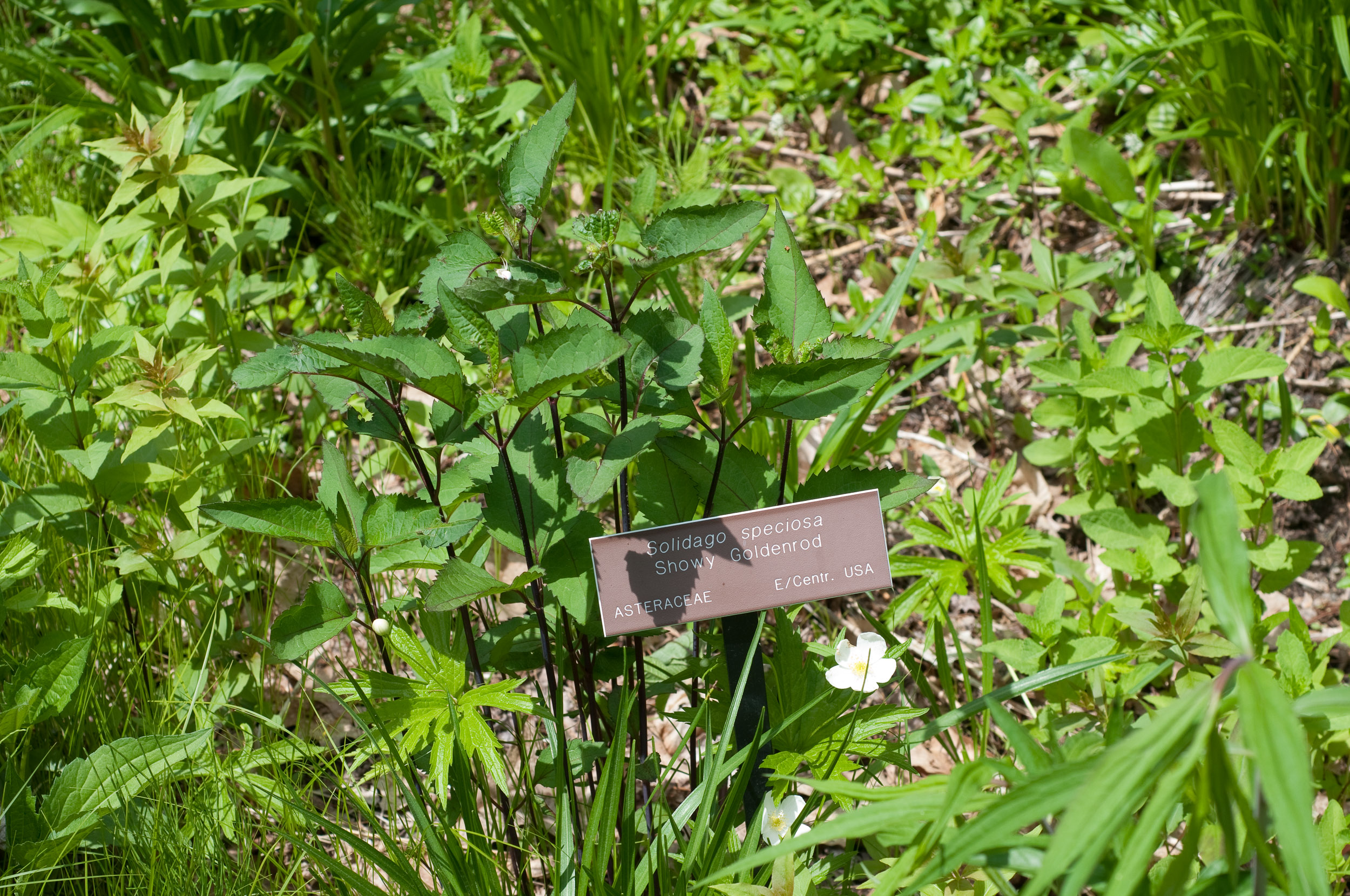
5/22/2010 · Garden in the Woods, Framingham, Massachusetts 
| Kingdom | Plantae | Plants, but not fungi, lichens, or algae (from Stearn's Botanical Latin) |
| Subkingdom | Tracheobionta | Vascular plants—plants with a “circulatory system” for delivering water and nutrients |
| Division | Magnoliophyta | Flowering plants, also known as angiosperms |
| Class | Magnoliopsida | Dicotyledons—plants with two initial seed leaves |
| Subclass | Asteridae | A large class that encompasses asters |
| Order | Asterales | Flowering plants with a central disk flower and surrounding petals, like daisies |
| Family | Asteraceae | The aster family, which also includes daisies and sunflowers; from the Greek ἀστήρ, “star,” for the star-shaped flowers |
| Genus | Solidago | From Latin solido, “to make whole or heal,” because it was believed these species had healing properties |
| Species | speciosa | "Showy, splendid" (from Stearn's Botanical Latin) |
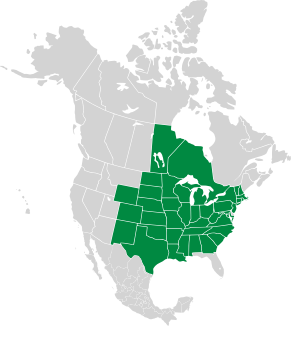
Solidago speciosa description by Thomas H. Kent, not updated.

© FloraFinder.org. All rights reserved.